
Kyle Patel’s workstation shows multiple software products, including AI assistants, at work during an average business day.
Private charter can be a counterintuitive business. Though the end product carries a very high price, each flight is usually provided by a complex network of small businesses, each delivering a bespoke and expensive-to-produce service—and all under constant pressure to deliver outstanding quality while keeping costs below the prices charged by their many competitors.
So it was entirely understandable when a spate of companies launched in the 2010s, promising to bring new technology to bear on the sector. App-based charter brokerages offered the prospect of quick and streamlined quoting, easy aircraft comparisons and instant digital transmission of booking data to every party in the process. Their advent appeared to threaten traditional incumbents, with their cabinets of paper records and Rolodexes of handwritten client phone numbers.

Reality has only partially lived up to the initial hype. Today’s charter industry has certainly been changed by digital technologies. But many of the fundamentals of the traditional broker-operator business models remain in place.
“A majority of brokerages who have an app have created that predominantly as a front end, and it’s a client interaction method,” says Glenn Hogben, CEO of the UK-based Air Charter Association. “Generally speaking, [apps] are a sort of shop window, and there is a team of brokers behind them in the office. The app may give an indication price, then the brokers go and identify the best suitable aircraft and get the real price.”
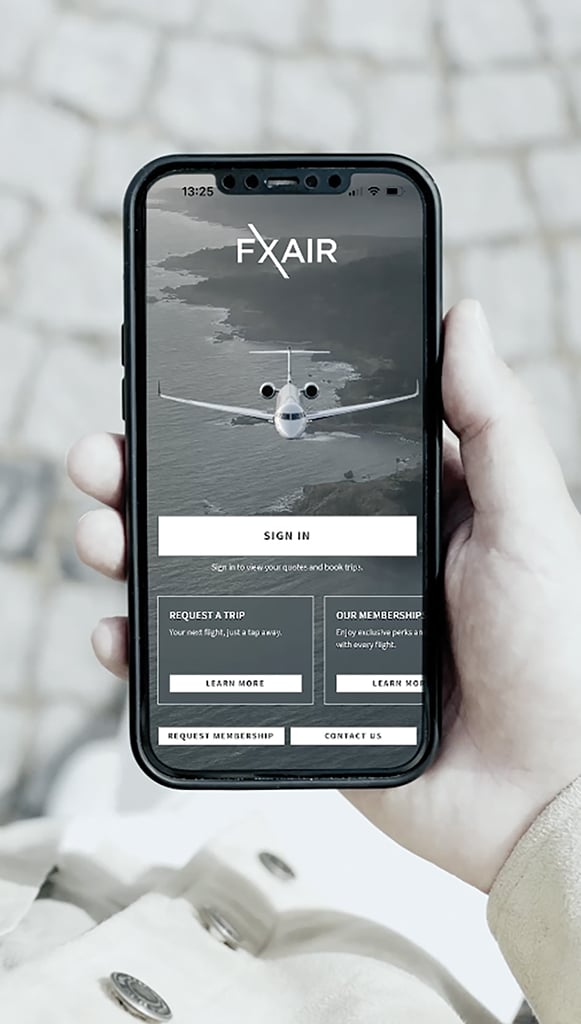
This broad overview is backed up by individual companies. One of the earliest app-based brokerages, PrivateFly, helped modernize the front-end experience for customers, although specialist brokers provided the back end of the operation. PrivateFly was acquired by Directional Aviation in 2018, and its operations are now part of the Flexjet brand, FXAIR.
FXAIR views its app as another medium for customers to connect with staff—alongside phone calls, text messages, emails and the website. President Gregg Slow highlights the brand’s “relationship-based approach” to clients, complemented by digital tools but with no likelihood of staff members ever being replaced by them.
“We continue to develop and adopt new technologies to allow clients to interact with us in their preferred manner,” he said in a statement to BCA. “At the same time, we have been equally deliberate about preserving something that is becoming increasingly rare in the on-demand charter industry, which is human connection. Many providers are moving toward fully digital transactional models, but we are seeing the opposite desire from our clients, who are increasingly looking for a bespoke, luxury experience. They value knowing that there are trusted experts in our . . . team on the other end who understand their preferences, anticipate their needs and take ownership of every detail. For us, it is not a case of an either/or approach.”
Keeping Up APP-EARANCES
If an app is ultimately just another medium of interaction between brokers and customers, the savings one can bring will be limited. At the same time, app design, development and maintenance are expensive. The question for brokerages is whether the increased business an app may help bring in will more than cover the substantial investment required to create and operate it. Hogben suggests this may be why only “a relatively small percentage” of major brokerages have adopted an app-based model.
“It costs quite a lot of money,” he says. “What value is it adding back? At the end of the day, someone has to pay for that, so all that means is that the prices of flights are going to go up. A lot of brokers have said, ‘We know our customers, we know how to acquire new customers—why would we add another fixed cost to our bottom line that we’ve then got to recover?’
“Does it add enough value?” he asks. “‘I don’t know’ is the answer. Some companies have made it their thing, and that makes perfect sense, and it seems to be very successful. But wide adoption seems to be relatively low at the moment.”
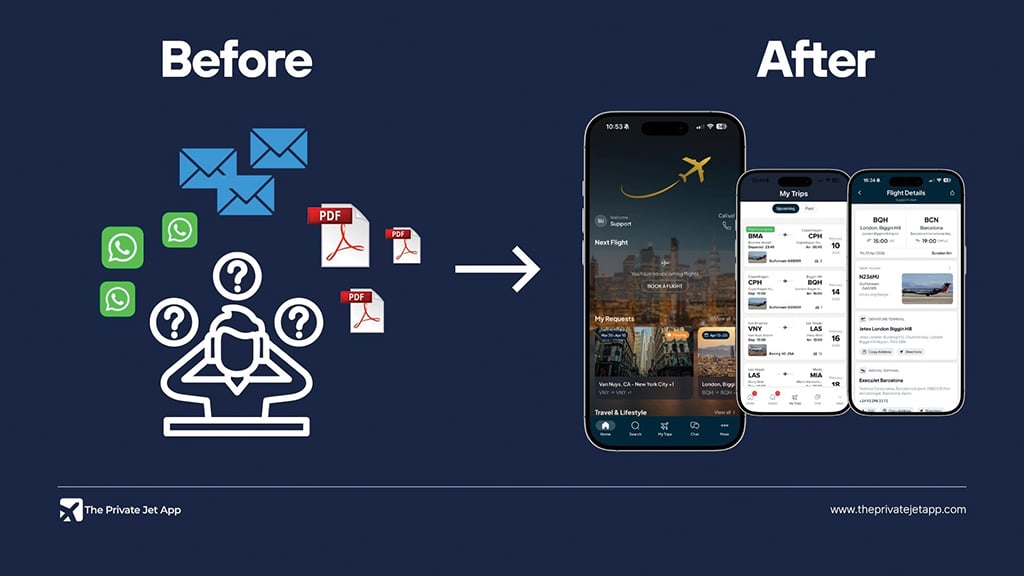
Brokerages looking to add an app-shaped “shop window” have options beyond building their own specialist app development teams. The Private Jet App has developed a nonbusiness-specific platform that offers the functionality many brokerages will need from a customer-focused system. The Stockholm-headquartered company supplies the app under license with an interface redesigned to fit an individual company’s branding and specific requirements. Co-founder and former tennis professional Simon Freund, 29, argues its business model offers customers—including corporate flight departments and charter brokers—the advantages of having their own bespoke app without the high costs.
“Our business model is a subscription model,” Freund says. “The long-term goal is to help support [customer organizations]. We’re looking hard at ways that we can help. With payment solutions through the app, maybe how we can help with [ground] transportation so it can be booked through the app, or catering—different ways where our customer base can make more money and deliver a better service, and then see what is reasonable for us to take a little cut for.”
The baseline app interfaces with the main software and data systems brokers and operators will use—Avinode, Myairops, Schedaero and Leon, with which the initial iteration of The Private Jet App was built in partnership—and the focus is on communication and interaction with the person paying for the flight. But its potential uses go beyond simply updating the passenger about the status of their charter, Freund explains.
“On the corporate flight department side, we have a Fortune 50 company that utilizes our platform, and they use it to communicate with all the execs and board of directors that utilize their corporate fleet,” he says. “All the flight details would come from Myairops that they have currently. But then they utilize our platform to resolve a lot of the admin tasks—the logistics around the flight itself,” including how each exec is getting to the airport and hotels. That centralized logistics piece “is what we’ve seen has really become the core value of our platform. The communication just becomes a lot more centralized for both their operational side of it but also for the customer and client side of it.”
Virtual Assistance
Another company set up by a digital native is Bitlux, founded by 34-year-old Kyle Patel. His vision for the digital-based broker involves using new technology wherever possible to streamline all interactions—both with charter buyers and between his brokerage and all the companies involved in producing the flights. Like Hogben, Slow and Freund, Patel is adamant that digital tools cannot replace experienced and skilled human beings. Still, he has found more areas where technology can help ease the burdens on staff, freeing up more of their time for the parts of the job that need to be done by a human being.
“We will always be a company that picks up the phone—that’s what we’re here for,” he says. “If I couldn’t see or interact with people, I’d be extremely disappointed—but I would love to minimize that to where the seeing and interacting with people is the most valuable of interactions that we can have. Which is meeting them at the airport, talking about what it is that they actually need. That way, [we have] a thorough understanding of exactly what they need, and then we leave all the heavy lifting nonsense and things that just get frustrating up to something that can do it on its own, and way faster and way more accurately than we can.”
To this end, Patel has deployed a large language model (LLM) internally to help run the company’s operations. Bitlux Intelligent Assistant (BIA) has become a valued member of the team. “You wouldn’t know it’s not a person by the way I talk about this thing,” Patel says. Examples of how BIA have been helping Bitlux’s human staff are intriguing.
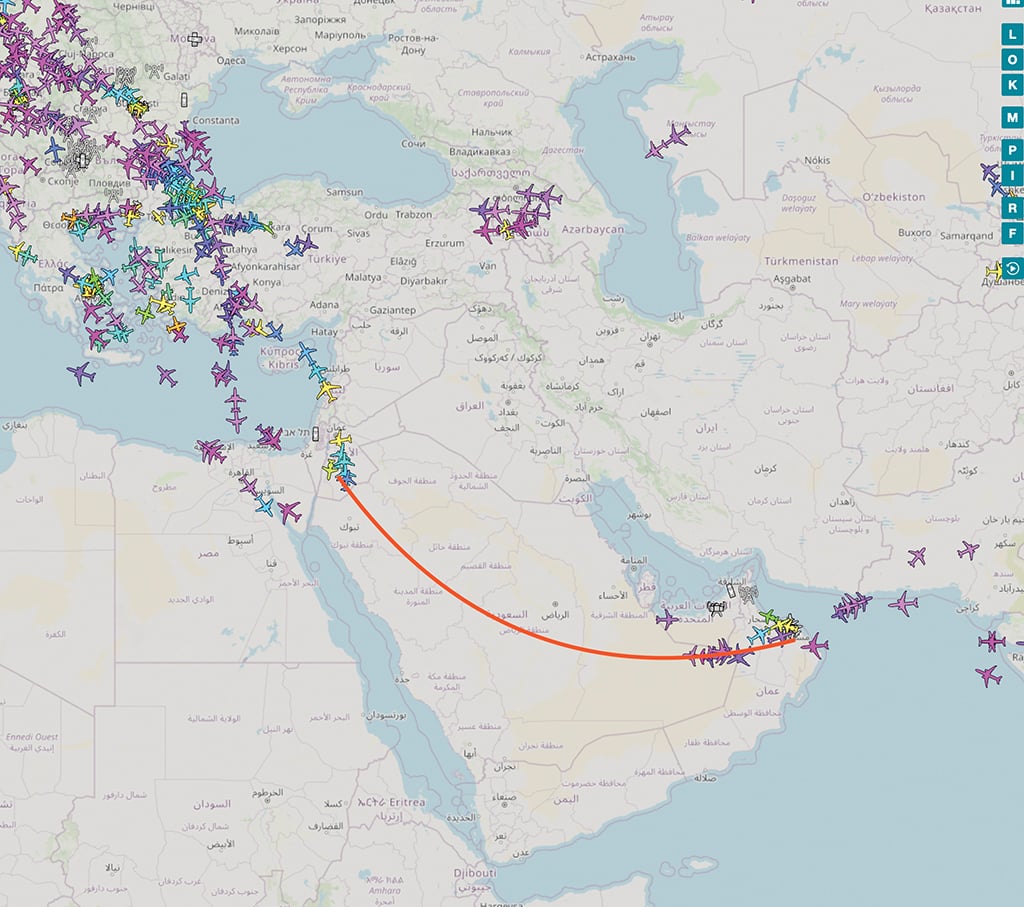
“When the cartels were acting up in Mexico [in February-March], one of the things I tasked it to do was to constantly get news updates,” Patel says, “Find whatever videos on [social media network] X you can, digest whatever you can, and let us know what’s going on. That was kind of a dry run, and then when the Iran [war] happened, which was the next week, we deployed BIA, and within 25 min. she had herself set up an entire command center, which she designed, and popped up dashboards on one of the screens, and was like, ‘OK, here’s the situation.’ It was pretty crazy.”
Patel says some elements of what BIA did during the early days of the Iran war were not optimal. The system was 20 min. late in recognizing that Fujairah International was the first airport in the United Arab Emirates to reopen because it had not allowed for the possibility that information given earlier by a reliable source might have changed. Noticing these problems and tweaking the system so it learns what to do in a similar situation in the future will help—in the same way a member of staff will improve once exposed to new experiences. Patel suggests this is only going to be possible in a business such as his, which retains “every single record from every single thing that we have ever done of all time.” The more relevant and properly contextualized the data BIA has to work with, the better its performance will get.

On the other hand, BIA excelled during the early stages of the Iran war at collating contact information for the dozens of entities Bitlux needed to liaise with—regional border authorities, airports, fixed-base operators, aircraft operators, customers and others—and keeping the company’s staff constantly updated on both booked flights and the constantly changing geopolitical situation. Patel describes the system’s role as follows:
“I said, ‘OK, here’s our vendors list that we already have preapproved. If they’re not on a preapproved list, I need you to fast-track some of these. I need their [aircraft operating certificates], I need their insurance, I need you to be able to reach out and establish contact by email, and I need you to vet them, make sure there’s no accident records. And I need you to also make sure we have a clear channel of communication so that if there’s an issue, we can get that done.’ And within 2 hr., she had a list of 40-something people. Three had already replied. We had their operating certificates; we had their aircraft and their locations.

“Being able to see BIA go through this whole process of identification based on region, the telephone numbers associated with them, any of the files and documents that we had uploaded or that she had found on her own—it was just pretty nuts to see that whole thing happen,” he says. “If we didn’t have her, who would have done that job? Because it still has to be done. And that’s our operations department. And instead, our operations department was able to focus on the people.”
As impressive as this all is, there will be limits to how far such technologies can be integrated into a safety-critical industry. Just as with relationships between humans, trust takes time to build. And in aviation, when the consequences of misplacing that trust could be catastrophic, use of LLMs will have to be restricted to non-safety-critical areas. But Patel says that in the right businesses and given the right kind of training, these tools can provide a significant contribution to information-gathering tasks and help businesses make sense of fast-moving and complex situations more rapidly.

Related Content