This article is published in Business Aviation & AAM Report part of Aviation Week Intelligence Network (AWIN), and is complimentary through Sep 21, 2027. For information on becoming an AWIN Member to access more content like this, click here.
Electrical Infrastructure Could Become eVTOL Bottleneck, Schneider Electric Says
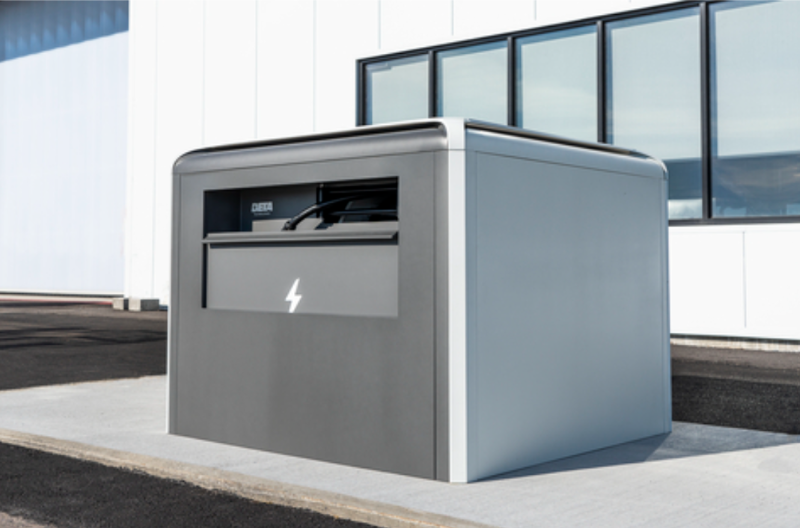
Beta Technologies has designed its electric aircraft chargers to be aircraft-agnostic.
The electrical infrastructure needed to support high-frequency electric vertical-takeoff-and-landing (eVTOL) aircraft operations could require years of advance planning, potentially making power availability a bottleneck as operators seek to scale commercial services.
A commercial vertiport supporting multiple aircraft could eventually require 5-10 megawatts of power, with individual fast chargers rated at roughly 500 kW to 1 megawatt, according to Jérôme Tourdiat, senior vice president of One Solutions Operations Europe and Governance at Schneider Electric.
“If you are operating a vertiport and an eVTOL, you want them to fly—you don’t want them to stay on the ground to get charged,” Tourdiat told Aviation Week. He estimates operators will seek charging times of roughly 15-30 min., beyond which aircraft utilization and return on investment could suffer.
Securing that much electrical capacity may prove challenging, particularly for vertiports located in dense urban areas where local grids are already constrained. Tourdiat said new grid connections can require at least one to two years in some markets and as long as four years or more in others.
Electrical equipment itself could also become a pacing item. Large transformers currently carry lead times of roughly 18-24 months, Tourdiat said.
Schneider Electric is working with airports and some vertiport developers in the U.S. and Middle East on infrastructure planning, although Tourdiat declined to identify the advanced air mobility customers. The company already supplies energy-management and microgrid technology to conventional airports, including a 12-megawatt microgrid at New Terminal One at New York John F. Kennedy International Airport. Schneider Electric says that system can maintain terminal operations during grid outages.
Tourdiat said battery energy storage and microgrids could help vertiports manage the sharp demand peaks created when several aircraft charge simultaneously. Rather than sizing a grid connection to accommodate the maximum possible charging load, operators could store electricity during periods of lower demand and draw on those batteries during charging peaks.
He also argued that charging infrastructure should be as aircraft-agnostic as possible, warning that competing proprietary standards could undermine already challenging infrastructure economics.
“The less agnostic you are, the more costly it will be,” Tourdiat said. “I think the industry will have difficulties to survive or to really scale-up in case everybody wants to stick to their own technology.”

Related Content