This article is published in The Weekly of Business Aviation part of Aviation Week Intelligence Network (AWIN), and is complimentary through Nov 10, 2025. For information on becoming an AWIN Member to access more content like this, click here.
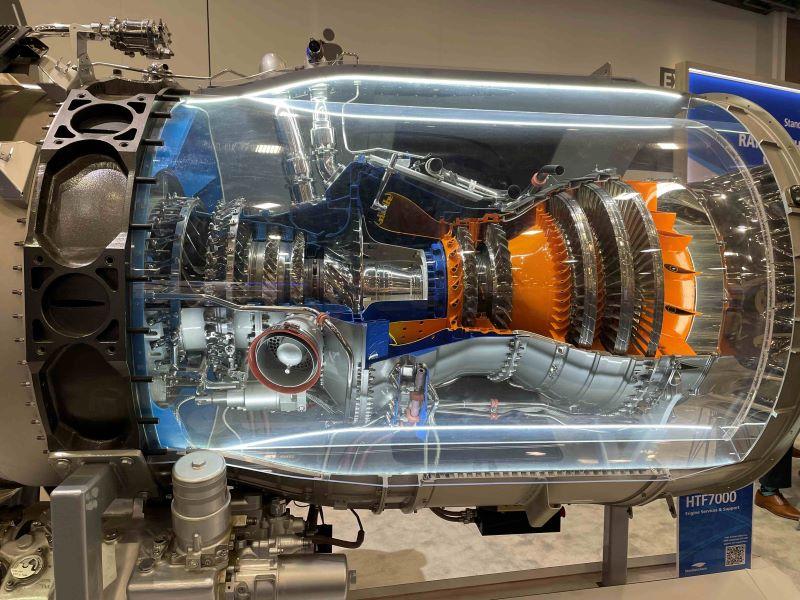
LAS VEGAS—Bolstered by a late 2024 agreement with Bombardier to provide an advanced version of its HTF7000 engine family for the Canadian manufacturer’s long-anticipated Challenger replacement, Honeywell is planning a set of block upgrades for its best-selling super-midsize (SMS) business jet engine series.
Although details of the upgrades and the new variant for Bombardier remain scarce, Honeywell says the progressive input of new technology is key to maintaining the company’s tight grip on the popular SMS sector.
Since entering service on the Challenger 300 in 2004 as the newly designated HTF7000, the engine has gone on to power the Challenger 350/3500, the Cessna Longitude, Gulfstream G280 and the Embraer Praetor 500 and Praetor 600. On Sept 30, the HTF7250G version was also announced as the powerplant for the newly unveiled Gulfstream G300—a successor to the G280 targeted at certification in early 2027.
To plot its block upgrade path, Honeywell continues to focus on engine efficiency improvements and testing with sustainable aviation fuels (SAF) through its own internal R&D work, as well as through the U.S. FAA’s long-running Continuous Lower Energy, Emissions and Noise (Cleen) program.
“All of this technology fits with our future road maps and so it is something that we can put into block point upgrades for the existing engine, and it also helps us for any future engines,” says John Head, vice president and general manager, Engines, Honeywell Aerospace Technologies.
“The work that we’ve done with the FAA has been very beneficial as we look to make the engine and our technology lighter, cleaner and more fuel efficient,” says Head. Under the current third phase of Cleen he adds Honeywell has “developed a novel, advanced combustor system which is demonstrating significant reductions in NOx and non-volatile particulate matter (nvPM) emissions.”
The engine maker has also successfully demonstrated an advanced high pressure (HP) turbine ceramic shroud as well as overall noise reductions developed through several technologies proved during earlier Cleen phases.
“That continues, and it will mostly conclude next year, but we’ve got fan module rig tests underway. We have low emissions combustor flight tests and endurance testing that’s happening this year,” says Head, who adds some of this work will involve the company’s Boeing 757 flying testbed.
“We’ll also do the core engine test for the advanced HP compressor and HP turbine technology. So, there a number of items still in front of us, but the work is progressing very well,” says Head. A Cleen III technology engine demonstrator which encapsulates the bulk of the advances at a full-up engine level is planned to be run in the third quarter of 2026, while a low-pressure turbine rig test will be the final test in the program, wrapping up with a run scheduled for the last quarter of 2026.
The work is expected to help lay foundations for a next-generation SMS engine for entry into service in the 2030s which will be around 3 EPNdB quieter and more than 8% more fuel efficient than current engines in the HTF7000 class. Emissions are similarly targeted to be cut dramatically—in this case, to levels with around a 70% margin to CAEP/8 standards for NOx, as well as a 70% reduction in nvPM.
How much of the technology will feature in the new engine for Bombardier remains to be disclosed. “Nothing has been announced at this time. We continue to work very closely with Bombardier and obviously, we have been an engine and system provider to them for a long time. I think there’s good things to come there,” says Head.
With around 3,500 engines in service, the HTF7000 fleet continues to grow steadily toward the 4,500 mark over the next decade as predicted in 2024 by Dave Marinick, Honeywell president of Engines and Power Systems. With a target of close to 8,000 engines over the total life of the program, Honeywell delivered 360 units last year and expects to produce more than 400 in 2025. “We are seeing double digit growth, and that will continue from 2025 to 2026,” says Head.