This article is published in Business Aviation & AAM Report part of Aviation Week Intelligence Network (AWIN), and is complimentary through Sep 03, 2026. For information on becoming an AWIN Member to access more content like this, click here.
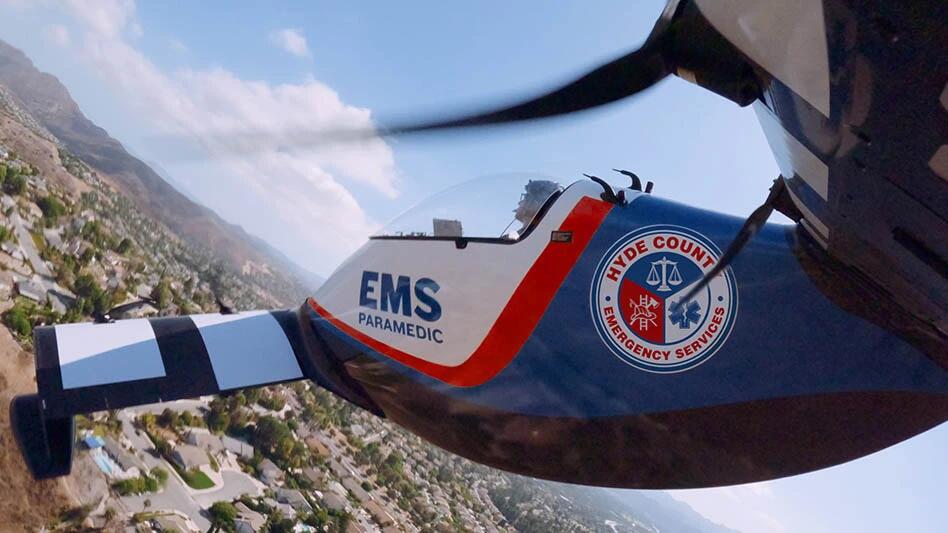
Paramedics have performed the first live 911 emergency response missions using an eVTOL aircraft, flying Pivotal’s single-seat BlackFly directly to patients to provide advanced medical care.
The two missions were carried out by Hyde County EMS in rural eastern North Carolina as part of a pilot program with Pivotal and EMS training organization Code Blue Resources. Two patients were reached by flight-trained paramedic Quinn Reece, including one who received advanced life support roughly 15-min. before a ground ambulance arrived. On that call, Reece administered intravenous medication and cardiac monitoring while the ambulance was still en route, according to Hyde County EMS Chief Brooke Cox.
Hyde County covers nearly 1,500 mi.² of land and water. Its EMS system serves a mainland and an island across an area containing rivers, marshland and communications gaps, complicating emergency response efforts. Cox also said that medical helicopters can be difficult for the county to access and are oftentimes unavailable, illustrating the need for new mobility solutions for EMS missions.
The pilot program saw Pivotal train four paramedics through its standard flight course. Reece then accumulated more than 300 flights to build familiarity with local terrain and possible landing sites. A typical recreational Pivotal customer, by contrast, completes about 12 to 15 flights during training, CEO Ken Karklin said.
“Being an expert in your local terrain, being where the landing areas associated with different neighborhoods are second nature, and you can navigate quickly without looking down on a map, that takes practice,” Karklin said. “By that point in time, one of our pilots had accumulated over 300 flights and is probably the second most proficient light eVTOL pilot we have.”
That local knowledge proved important during one response when the dispatch coordinates pointed to the wrong location. Reece recognized the terrain, found a suitable landing area and directed the ambulance to the correct scene.
“Because of her doing all those test flights and just seeing the geography and getting comfortable with it to where it was second nature, she was actually able to land and direct the ambulance and also to tell communications that it was not, in fact, where they had originally dispatched us,” Cox said. “That even shaved off more time for the ambulance.”
Pivotal maintained a 10-min. battery reserve during the trial, effectively limiting outbound flights to about 10-min. That restriction, combined with other operational criteria, led the team to pass on numerous potential 911 responses before completing the two live patient missions.
Karklin said the learnings from the pilot program and live responses will feed into future software upgrades that could automatically plot routes and identify alternate landing sites, among other improvements. Pivotal also expects to expand the concept into other North Carolina counties with higher call volumes and more challenging terrain.
The company plans to begin early operational flights in the Pacific Northwest in September and October through the Pennsylvania Transportation Department multistate eVTOL Integration Pilot Program initiative. Karklin said Pivotal could join at least one additional eIPP team in the coming months.
“We want to devote as much bandwidth as we can to the activities that we think are going to have the best payoff in terms of enabling EMS response,” Karklin said. “A lot of that’s going to be the kind of partnership-type pilot projects like the one we just completed with Hyde County.”
Karklin said that Pivotal still expects initial customer deliveries of its new-generation Helix aircraft before the end of the year.