This article is published in Business Aviation & AAM Report part of Aviation Week Intelligence Network (AWIN), and is complimentary through Nov 07, 2026. For information on becoming an AWIN Member to access more content like this, click here.
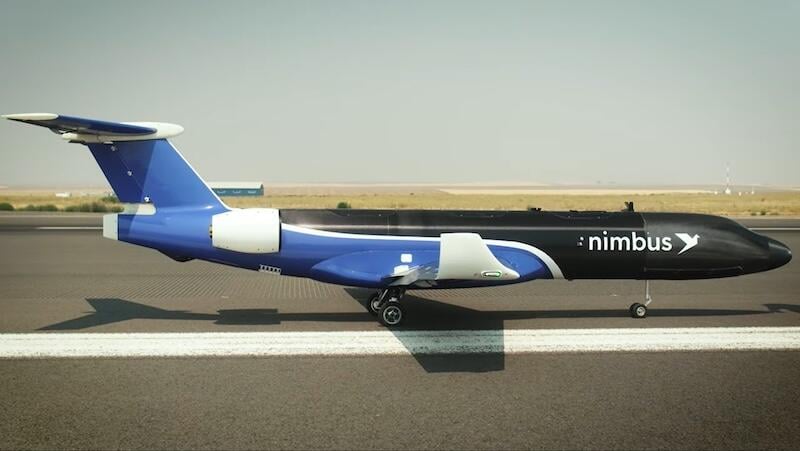
Nimbus NX1.
Nimbus Aerospace has completed flight tests of a large-scale model of its planned N1000 hybrid-electric business aircraft as the company works on sizing the propulsion system for the production aircraft.
A small Seattle-based startup founded in 2023, Nimbus is targeting the light business jet market, using hybrid-electric propulsion to provide jet performance with 40% lower fuel consumption.
The ¼-scale remotely piloted model, designated the NX1, was flight tested at Pendleton Uncrewed Aircraft Systems (UAS) Range in Oregon. Weighing 200 lb., with a 15-ft. wingspan, the model was powered by a pair of small jet engines.
Nimbus started out planning to develop an all-electric business jet with distributed propulsion, and in November 2024 flew a 1/10th-scale model with six electric ducted fans mounted above the wing. “We did a lot of tests on that aircraft and found out it was not a good solution, so we took those learnings and built [the NX1],” says co-founder and CEO Adrian Groos.
The wing-integrated propulsors were replaced with a pair of tail-mounted ducted fans. “We did build both configurations — both the distributed propulsion system and the tail-mounted engines,” says Akim Niyonzima, co-founder and chief technology officer, but Nimbus decided distributed electric propulsion would not be practical.
“By putting that many engines on top of the wing, you’re adding all that weight,” he says. “Plus, the fact you’re trying to make it fully electric means your weight is going to be the same from takeoff. All that weight is going put a lot of strain on your landing gear.”
Nimbus also learned that designing a wing to accommodate the wiring harnesses for an array of electric engines resulted in a complicated design. “We managed to do it. It was great to see that thing take off and land in one piece,” says Niyonzima. “But then we decided this might not be commercially viable, especially when you scale it up.”
At the same time, Nimbus built a second 1/10th-scale model. “That only had the two rear-mounted engines, and was just much simpler,” says Groos, adding this aircraft flew for three times longer than the distributed-propulsion model, with good battery reserves.
Having decided on a design with a hybrid-electric powertrain and rear-mounted propulsors, Nimbus built the larger NX1. “We realized the other configuration was better, so we scaled it up, optimized it to define more of our engineering, manufacturing and supply chain processes, and that’s what we built at quarter scale,” says Niyonzima.
First flown in June, the NX1 represents the outer mold line of the planned N1000, a six-to-eight-passenger business aircraft designed to fly 2,000 mi. at 400 kt and 41,000 ft. “We’re aiming for jet-like performance with available technology while improving efficiency and reducing fuel consumption,” Groos says.
Larger than most subscale models built by startups and well above the FAA’s 55-lb. limit on drones, the NX1 provided Nimbus with an opportunity to validate its design, optimization and manufacturing processes.
Because of the model’s size, Niyonzima says the startup had to take the NX1 through an approval process to obtain a certificate of airworthiness from the operator of the Pendleton UAS Range, an FAA-designated test site. “With all those processes it was a learning curve, and seeing that come to fruition, as we closed the flight test campaign, was exactly what we need for the full-scale aircraft — define the design goals, optimize the airframe for the specific mission, and then build, manufacture and test,” he says.
Nimbus is now defining the propulsion system for the N1000. “We’re still exploring the best path to take,” he says. “But we 100% know it’s going to be hybrid, so we’re trying to size it. How much battery can we put on? How efficient is that going to be?”
The startup is also working with jet brokers that are helping it define the aircraft’s cabin. “People are going to buy for the mission but then, secondarily, they’re going to buy for the cabin,” says Groos.
Nimbus is not disclosing a timescale for development of the N1000 but hopes to have a closed design within two years. The startup plans to certify the aircraft under FAA Part 23 regulations, Niyonzima says, having managed to reduce weight by moving to hybrid-electric from all-electric propulsion.

Related Content