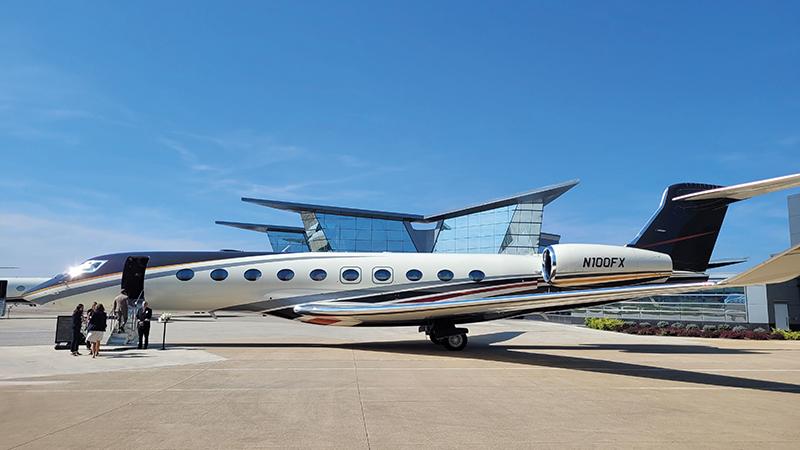
Ten years ago, Flexjet did not operate large-cabin aircraft. Now, it is adding Gulfstream G700s to expand long-haul options.
For more than a month, Flexjet was gradually removing the covering from a long-haul business jet on its website, and then on Sept. 16, the fractional operator revealed it has added three $96 million Gulfstream G700 large-cabin aircraft. By the end of 2026, Flexjet expects to have taken delivery of 12 G700s in order to reach “critical mass,” Kenn Ricci, Flexjet chairman, told Aviation Week following the rollout at its headquarters here.
By the end of next year, “we’ll have them all bought—whether they will all be in service because it takes six to nine months to outfit them,” Ricci noted.
The G700 is a good fit because Flexjet’s customer base is skewing younger and flying farther, Ricci said. Flexjet averages 41 flights a week across the Atlantic.
In just the past nine months, Flexjet announced an $800 million private equity investment from luxury brand LVMH and partners in July, a $7 billion order for Embraer aircraft in February and a public bond offering in December that Flexjet CEO Michael Silvestro said is “trading at a 6% premium to their issue price.”
These moves were not made because Flexjet wants to become the largest private aviation fractional jet company, but instead to extend the luxury experience it provides.
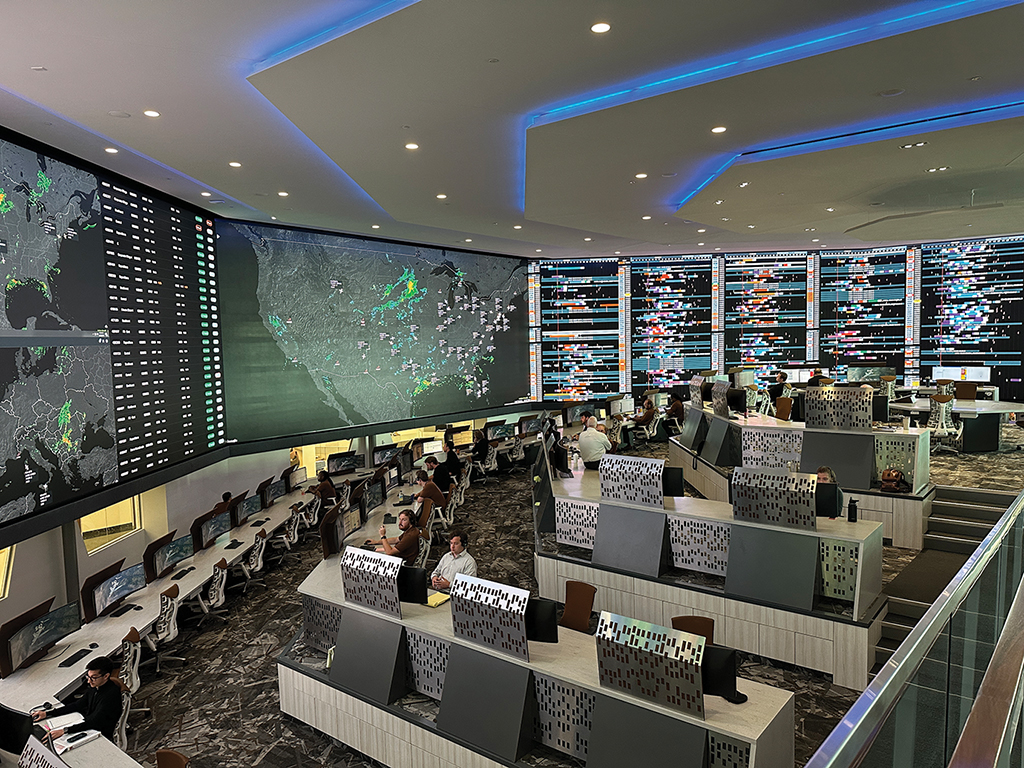
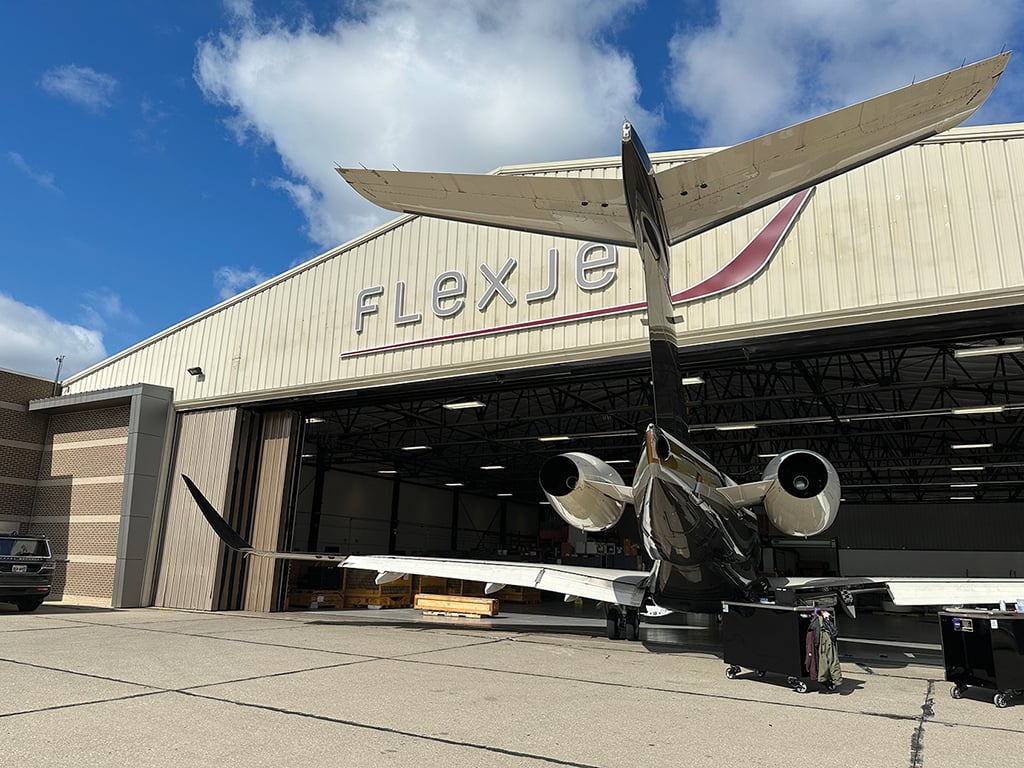
Flexjet moved into a “luxury, experiential kind of journey” about five years ago as a way to differentiate its aircraft subscription business and control more of the flying experience, Silvestro said. That includes things such as launching the Red Label Academy, buying Constant Aviation and Flying Colours in 2023 to bring maintenance in-house, expanding its boutique-style LXi Cabin Collection of interiors, enlarging private terminals and launching a world-class global command center.
“For the preeminent luxury company in the world to have evaluated and then invested in Flexjet, I think speaks volumes to what they saw in us,” Silvestro said, adding that it validates Flexjet’s move into that luxury, experiential journey. “I think our customers can kind of see an increased pace to what we’ve done in the past.”
Silvestro said that because of the investment and the potential partnership of the LVMH group’s brands, including Louis Vuitton, Christian Dior, Tiffany, Dom Perignon and Bulgari, Flexjet’s moves will “be more and faster,” from aircraft acquisitions to Chairman’s Club events to its FX Lux travel group.
Flexjet received a cold call from LVMH in February and discussed what it saw as the future of luxury, which includes time, health and wellness. The “time” part is enhanced by private travel. “We backed into the $800 million [by] thinking about what we would do with the money,” Ricci said. That includes investing in more infrastructure and rapid growth in international programs.
Flexjet operates 40-50 flights across the Atlantic per week from the U.S. “But all those planes end up on the other side, so we need customers on the other side to come back,” Ricci said. Therefore, some of Flexjet’s investment in international infrastructure will be spent on sales and marketing to generate a bigger following outside the U.S.
The fractional operator is focusing on its customers’ fixed-based operator (FBO) and terminal experience. “We’re seeing a lot of difficulty now on the FBO side,” Ricci said. If customers “get bad catering and bad line service” at FBOs, that “reflects poorly on what we’re trying to do to deliver high-end service,” he said, noting that “solving the FBO experience is part of infrastructure.”
Flexjet operates 11 private terminals, which allows it to control all of the customer touchpoints there. But, rather than building more private terminals, Flexjet is considering placing its own teams at FBOs to take care of owners and customers.
Fleet
Flexjet’s fleet includes 325 aircraft, which are sold on five-year contracts. When the contract ends, owners can opt to invest more capital in a new aircraft or keep the same aircraft. If they choose the latter, the aircraft comes off warranty and the operating costs increase, Ricci explained. At the end of 10 years, the aircraft “move into core fleet, or they move into leasing or jet cards,” he said. “So those planes back up our fleet between years 10 and 15, and then we sell them at 15.” When Flexjet aircraft reach that age, they usually have 10,000-12,000 hr. on them, “so it’s time for them to leave,” he added.
Flexjet is gradually phasing out its Bombardier Challenger 300s. The Embraer Praetor 600, which is part of that $7 billion February order, will replace the company’s super-midsize business jets.
Despite such replacements, Flexjet’s fleet “growth has been pretty steady, at about 10% to 12% per year of new add-ons, which I think is digestible,” Ricci said. “The fleet will grow by 15-20 or 30 aircraft per year, but we buy 40-50 to end up with the 30 because of the replacement cycle.”
Outlook
The Flexjet executives view the future of private travel positively in the short and long term. “I think short term is driven a lot by the [aircraft] bonus depreciation” in the Trump administration’s One Big Beautiful Bill Act, Silvestro said. He is even more positive about the long-term outlook. “I think private aviation has become the ultimate luxury because it’s the only thing that [customers] can do to get more time in a 24-hr. day,” he said.
As with other private aviation companies, Flexjet has benefited from a younger clientele since the COVID-19 pandemic. “You have a whole tranche of 40-somethings that a generation ago waited another 10-15 years because of the sensibilities that generation had in terms of spending money,” Silvestro said. “The 40-year-olds are all in, so we see a drastically younger flyer than we ever had before.”
This is part of why Flexjet is migrating its fleet from smaller jets to bigger ones. “We’ll have almost 70 by next year. While our light jets are still important, they’re the smallest part of our business,” he added.
When asked whether Flexjet will add the Gulfstream G800 to its fleet, Silvestro said “it would be the natural evolution for the 650, so we have it on our radar screen,” as well as the G500, which could replace Flexjet’s G450 fleet at some point. In addition, younger customers seldom start in light jets and work their way up. “They are going right into mid-, super-mid and heavies,” Silvestro said.
In the next five years, the Middle East could be a natural progression for expansion, he said, because “there’s lots of travel between London and the Middle East.”

Related Content