This article is published in Business Aviation & AAM Report part of Aviation Week Intelligence Network (AWIN), and is complimentary through Aug 14, 2026. For information on becoming an AWIN Member to access more content like this, click here.

Beta CEO: Autonomous Military eVTOL Launch A 'Smart Tactical Move'

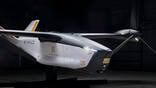
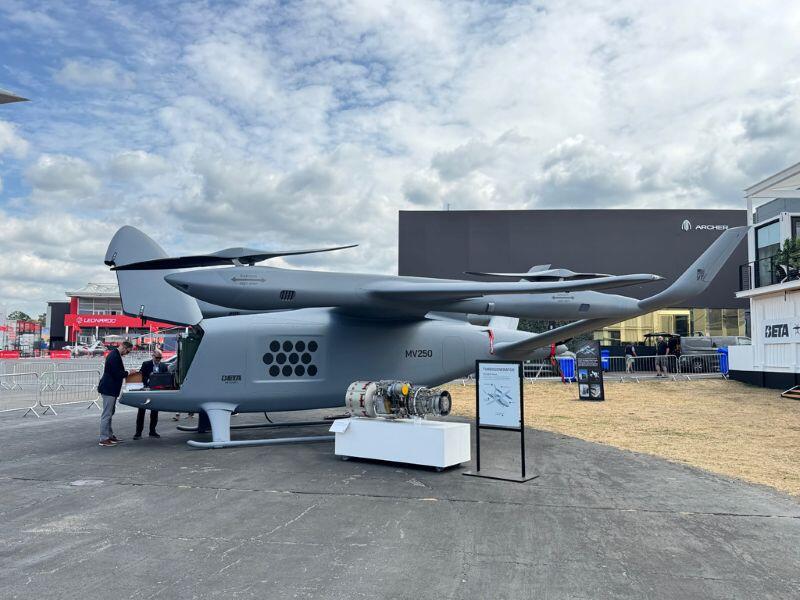
Beta MV250

The MV250 outside Beta's chalet at Farnborough was not a mock-up. Kyle Clark says it is made of "all flyable components," but that specific aircraft has not flown.

Credit: Mark Wagner

FARNBOROUGH—The launch of the MV250—an autonomous hybrid electric vertical take-off and landing (eVTOL) aircraft derived from the in-development commercial Alia A250, and intended for military use—is helping, not hindering, Beta’s civilian certification programs, founder and CEO, Kyle Clark, tells Aviation Week.

Rather than diverting effort away from work to certify the VTOL A250 or its conventional take-off and landing (CTOL) CX300 variant, Clark says work on the military product is helping increase the pace at which those programs are proceeding.

“It’s always been in the plan,” Clark says of the announcement of the military aircraft. “I would say it was not strictly inevitable [that Beta would develop such an aircraft]—however, it is the right choice. Not only do I believe that we should supply our soldiers with the best product; but the time on wing, time on rotor is directly, positively affecting our FAA certification efforts. It’s a smart tactical move.”

Besides enabling the developer to start seeing income sooner than will likely be the case for a passenger-carrying civil aircraft, demonstrations with the military end user are feeding directly into the civil programs, Clark argues.

“We have over 80,000 hours of running with the motor,” he says, referring to the H500 which powers the pusher propeller on all three Beta aircraft, and which the company will supply to other eVTOL developers, including Embraer subsidiary Eve. “A lot of it is done under military flight release and PAOs [the FAA’s Public Aircraft Operations conditions]. We’ve flown right down the [National] Mall in Washington, D.C. under a PAO. No other company has done that. But more importantly, we developed the confidence and the surety to do it, and we’ve gotten paid by the military to do it. So, it’s the right strategic move for us to walk into this.”

Beta will give detail on certification of the H500 in its next earnings call, Clark says, for now only offering that work to resolve issues related to continued rotation that had been delaying certification “is going exceptionally well.” But he stresses that this has not held up any other part of the program.

“Ultimately, in order to certify the aircraft, the engine has to be certified—but we are way ahead of the aircraft with the engine,” Clark says. “It was designed that way, because we saw it has a high-risk element.” The continued rotation issues “have no bearing on getting into TIA [the FAA’s type inspection authority],” he says, while confirming that the A250 continues to track around one year behind the CX300 on their respective certification journeys. The next earnings call will update on those timescales, and on a timetable for TIA for-credit testing of the CX300, which has not yet begun.

The company believes reliability and economics make as compelling a case for the MV250 to its potential military customers as performance and payload capacity. Beta flew its Alia CX300 CTOL as part of NATO’s Exercise Aurora 26 in Sweden, at the invitation of the U.S. Army. At the end of the exercise the company was presented with a bill for fuel which came to $330, or approximately $11 per flight. After a program of around 270 flights for the U.S. Air Force at Eglin AFB, Florida, Clark says the first question the Secretary of the Air Force had for him was: “I want to know how an experimental airplane hit 100% dispatch reliability.”

“Speed, range and payload are very important to the military,” he says. But “cost, dispatch reliability [are] non-obvious front-runners. I think that was my biggest learning.”

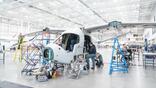
Beta is also confident of being able to deliver large numbers of aircraft in a tight timescale once an order is secured. The fuselage is bonded and does not use fasteners, which “allows us to make this in a panini press, basically,” Clark says. An aircraft which, in earlier iterations, was made of 580 parts with 14,000 fasteners has become one with “under 300 parts and zero fasteners, [which] went from six weeks to build to a number of hours to build.”

Beta has opted to use Sikorsky’s Matrix autonomy technology on the MV250, though all the company’s aircraft are “autonomy agnostic” and the contract previously announced with Near Earth to supply the autonomy stack on the Alia remains in place.

“The telegraph we’ve gotten from the Army is, ‘We like Matrix,’ so here we go with Matrix,” Clark says. “Part of my objective is to ensure that we give our customers the option of the right platform for the application. Sikorsky is focused on off-airport, austere locations, lost-link and GPS-denied environments. Those are the key features that we see matching this application. When UPS wants to fly autonomously for cargo delivery, they need ATC [air traffic control] integration, they need detect-and-avoid, and they need co-operative and non-co-operative civil targets. Those have a different flavor than a military application.”

Angus Batey

Angus Batey has been contributing to various titles within the Aviation Week Network since 2009, reporting on topics ranging from defense and space to business aviation, advanced air mobility and cybersecurity.