This article is published in Aviation Week & Space Technology and is free to read until Apr 09, 2026. If you want to read more articles from this publication, please click the link to subscribe.
An Appreciation: Russ Meyer, Business Aviation Legend
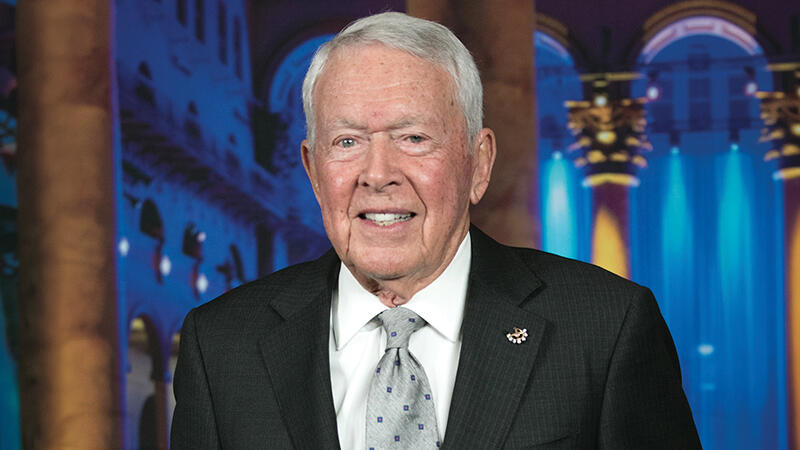
Meyer accepted Aviation Week’s Grand Laureate for Business Aviation in March 2025.
The general aviation industry as we know it today would not exist without Russ Meyer. While he was not a company founder, Meyer became one of the sector’s most respected and consequential leaders—“legendary” is often applied to him—and is largely credited with saving business aviation from possible ruin and then helping propel its sustained recovery.
Meyer did that while gaining the trust and support of employees and industry colleagues, creating career opportunities for future generations and, notably, conceiving the all-volunteer Citation Special Olympics Airlift for competing athletes.
Meyer, the longtime CEO, chair and chairman emeritus of Cessna Aircraft, died March 4 in Wichita after a brief illness. He was 93.
Ron Draper, Textron Aviation president and CEO, lauded Meyer “not only for his extraordinary business acumen, but for the integrity, humility and genuine care he showed for people at every stage of his life.”
Meyer’s rise to prominence resulted from study and determination, not privilege. His father worked construction and drove a beer truck around Davenport, Iowa, the family’s hometown. Fortunately, Russ’ key asset was a strong intellect, which he employed academically to great effect, prompting Yale University to grant a scholarship.
After graduating in 1954, Meyer went to fulfill his ambition by joining the U.S. Air Force and earning his pilot wings. Once his tour ended, he entered Harvard Law School and exchanged those silver wings for gold as an aviator in the U.S. Marine Corps Reserves. He would eventually log 19,000 hr. of military and civilian flying.
Upon receiving his Juris Doctor degree in 1961, Meyer joined a Cleveland law firm and was asked to represent a client in the purchase of a new Learjet. The client, golfing great Arnold Palmer, would become a lifelong friend.
Meyer was also assigned to a local company then struggling to develop a small kitplane. As that effort stalled, investors asked Meyer to take charge, which he did, but with misgivings about leading a business. He need not have worried.
The company, American Aviation, abandoned kits and manufactured type-certified models that were well received. They were received so well, in fact, that Grumman acquired the operation and put Meyer in charge of a new entity that included its Gulfstream models.
Meyer’s elevation, combined with his involvement with the then-new General Aviation Manufacturers Association, drew industry attention that ultimately led to an offer to join Cessna’s management and, when appropriate, succeed Dwayne Wallace, the company’s longtime CEO. Meyer became executive vice president in June 1974 and a year later was elected chairman and CEO, posts he retained until he retired in 2003.
When he joined Cessna, it was by far the leader in light aircraft production and had recently introduced a light business jet, initially called the Fanjet 500, the first in a long line of Citations that would expand and flourish under Meyer.
Initially, business was good—Cessna turned out almost 10,000 aircraft annually early in the 1970s. But as would become glaringly apparent by the mid-1980s, each unit delivered posed a serious threat. Whenever one came to grief, its manufacturer was sued, regardless of cause or aircraft age. Product liability costs were devastating light aircraft manufacturers.
As a result, Cessna, along with most manufacturers, halted production of single-engine piston aircraft. Meyer described it as “the toughest decision I had ever made,” one that eventually resulted in Cessna’s employee count dropping to fewer than 3,000 in 1986 from 13,000 in 1981.
Meyer then helped lead a lobbying campaign for federal legislation that would limit liability to 18 years. He succeeded, and then-President Bill Clinton signed the General Aviation Revitalization Act in 1994. Meyer considered that one of his greatest achievements. Meanwhile, the law lived up to its name as he restarted production of Cessna’s suspended models.
“There is simply no one who has had a more positive and profound impact on general and business aviation,” said Ed Bolen, head of the National Business Aviation Association, recalling that legislative achievement as well as Meyer’s continuing impact on the segment he served so long.
The 67,000 aircraft, including 5,000 Citations, that Cessna produced with Meyer at the helm, the laws and regulations he helped shape and the culture he nurtured stand collectively as a “tribute to his leadership, determination, grace, integrity and compassion,” Bolen noted. “We will miss him.”