This article is published in Aviation Week & Space Technology and is free to read until May 08, 2026. If you want to read more articles from this publication, please click the link to subscribe.

20/Twenty: Embraer Lineage 1000, A Brazilian Rare Bird
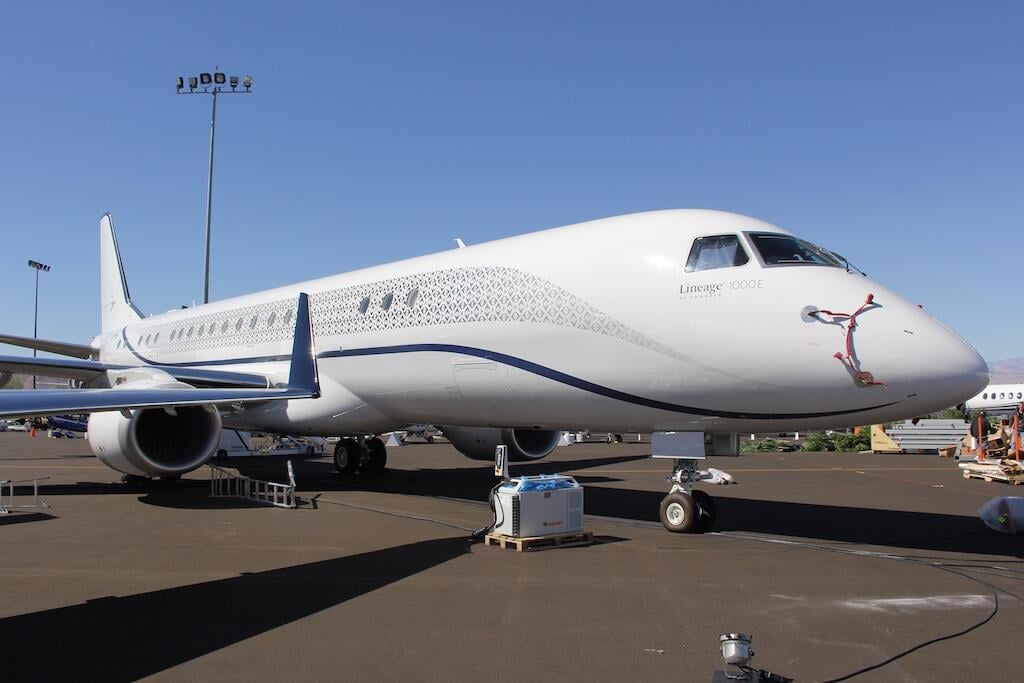
Lineage 1000E

The Lineage 1000E reduces empty weight by 500 lb. and delivers slightly better range and runway performance than the 1000.

Credit: Nigel Prevett/Aviation Week

Embraer entered the executive jet market in 2000 with the Legacy 600 series (600 and 650), a conversion of its popular 37-seat ERJ135 regional jet. The Legacy series sold reasonably well, fielding 289 copies between 2002-2020, providing the foundation for the company to deliver a full line of private jets that came to market in the decade between 2005 and 2015, an unmatched industry achievement.  

Across all corporate jet models last year Embraer delivered 155 executive jets worth $2.5 billion, according to the General Aviation Manufacturers Association.

In 2006, the manufacturer tried to catch lightening in bottle twice, introducing the Lineage 1000, an executive version of its E190 100-to-114 seat regional airliner. As a regional airliner, Embraer’s E-series (the E170, 190, and 195) have been popular, with more than 2,400 jets sold.

The Lineage offered a capacious 4,000 ft.3 of interior space in a cabin that measures 84 ft., 3 in. long by 8 ft., 10 in. wide by 6 ft., 7 in. tall. Up to 19 passengers can enjoy this spacious comfort. Thanks to auxiliary fuel tanks in the baggage hold, the Lineage can offer a range of up to 4,600 nm (at Mach 0.78 long range cruising speed, eight passengers, and NBAA IFR reserves). The baggage hold can accommodate 443 ft.3 of luggage, three-quarters of it accessible in flight through the aft lav.

The Lineage did not come close to matching the Legacy 600 series’ level of sales success. Only 28 were produced from 2009-2019 and the program was officially discontinued in 2020. Production is divided into equal shares of 14 of the Lineage 1000 made from 2009-2013 and the updated 1000E produced from 2014-2017.

The 1000E features a variety of refinements that reduces empty weight by 500 lb. and delivers slightly better range (4,600 nm versus 4,200 nm) and runway performance; however, with a max takeoff weight (MTOW) of slightly over 120,000 lb. the aircraft still requires more than 6,000 ft. for takeoff.

And then you need to find a place to park. The Lineage has a wingspan that measures 94 ft., 3 in. It is 118 ft., 11 in. long and 34 ft., 8 in. tall.

Time On Market

The Lineage 1000 cabin accommodates a five-zone layout. Credit: Comlux

Completed price out-the-door began at $50 million to $55 million depending on options. Given the limited production, time on market is long—up to 12 months—and prices for used aircraft are soft. According to the Aircraft Bluebook, retail used prices range from $10 million for a 2009 Lineage 1000 to $31.5 million for a 2019 Lineage 1000E.

Like most airliner-to-executive jet conversions, the Lineage is a product of compromise—flying lower (ceiling 41,000 ft.) and slower (fast cruise Mach 0.82) and needing more runway and ramp support than the typical ultra-long range business jet. This is the price for all of that cabin space, where you can install a five-zone layout including a master suite with stand-up shower, two more lavs, and a full galley equipped with multiple convection/microwave ovens, a real refrigerator, coffee maker, wine and food chillers, and more than enough storage for long flights.

It also inspired aircraft interior designers to alight on truly remarkable flights of fancy—most of them never realized. Perhaps the most outrageous of these was an unbuilt concept called the “Kyoto Airship,” that featured floor-to-ceiling cabin windows, arced skylights, and a shower big enough for two.

In reality, the Lineage is rooted in practicality, given its regional jet roots. Power comes from a pair of General Electric CF34-10E7-B turbofans (each rated at 18,500 lb. of thrust), a proven design that dates back to the 1960s with more than 200 million flight hours and 7,500 units produced. Engines installed on business jets—including the Lineage 1000—are frequently backed by GE’s OnPoint hourly service program.

Both the Lineage 1000 and 1000E utilize the Honeywell Primus Epic avionics system, although the updated system on the 1000E offers a variety of new options, enhancements, and improvements including enhanced vision, head-up display, Autoland, certification for steep approaches (including London City Airport), and faster Pentium M processors.

While maintenance on engines and externals can be accomplished at virtually any service center authorized to work on the E190, cabin refurbishments are typically a more specialized matter. For Lineage 1000 and 1000E aircraft in the U.S., West Star Aviation is the lone independent full-service center. A complete interior rerag, new cabin management system, and new paint can run up to $3.5 million.

While the Lineage was not a commercial success for Embraer, it does offer a unique opportunity for the right buyer. It’s a rare bird at an attractive price.

BCA welcomes comment and insight from aircraft dealers and brokers for its monthly 20/Twenty pre-owned aircraft market feature. The feature aircraft for May is the Bombardier Challenger 350 and for June the Dassault Falcon 2000EX. To participate, contact [email protected].