
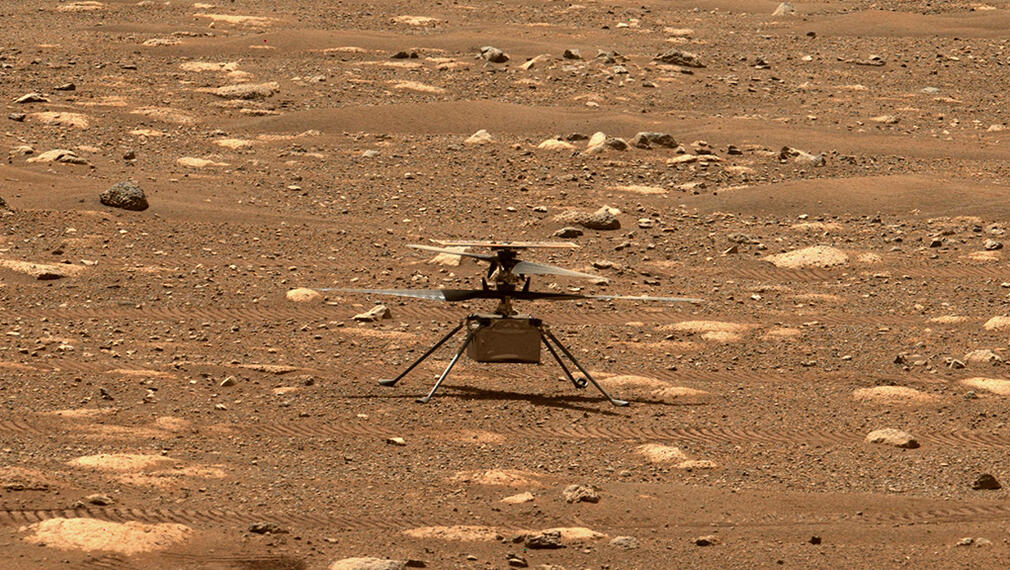




“How do we use aerial mobility in the future on Mars, to help not just robotic exploration, but to help human exploration?”
Ellen Stofan
Smithsonian


More Space Content From Aviation Week & Space Technology





Apr 23, 2012
The space industry usually takes a crawl, walk, run approach when pursuing new challenges. But flush with cash and hungry to propel itself to the forefront of the global aerospace market, the United Arab Emirates (UAE) has no time for baby steps. The UAE is one of a number of Middle Eastern countries that is gradually building a portfolio of space initiatives in response to growing instability in the region, a perceived threat from Iran and a desire to spur local industry.

Apr 23, 2012
New French space strategy urges the EU to play a stronger role.
Apr 23, 2012
An article in the April 16 issue (p. 44) incorrectly stated NASA's plans for launching cargo to the International Space Station. The agency plans to use commercial rockets for the missions.
Apr 18, 2012
Honeywell and Inmarsat have signed an exclusive agreement to provide global in-flight connectivity services to business, commercial and government aviation customers around the world.
Apr 17, 2012
Yahsat 1B, the second of Abu Dhabi-based Yahsat's high-capacity satellites, is now set to launch on April 24.
Apr 17, 2012
Virgin Galactic is to set up Spaceport Abu Dhabi in the UAE and has appointed a chief adviser to oversee the project.
Apr 16, 2012
Scientists preparing to use International Space Station facilities for research will have better online access to their experiments after U.S. astronauts finish revamping communications links. The work, intended to support a substantial increase in simultaneous science research, includes a doubling of the downlink data rate, solid-state recording and additional voice loops.
Apr 16, 2012
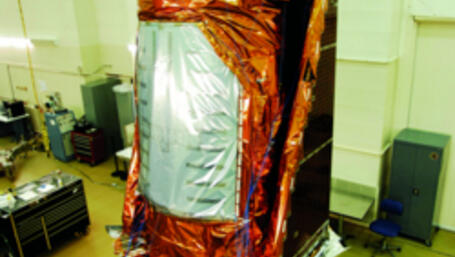
Scientists using NASA's Kepler spacecraft (see photo) to look for planets around other stars have been “surprised by the universe,” and the value of those surprises has earned the mission a four-year funding extension. Kepler was one of nine astrophysics programs granted peer-reviewed extensions on the recommendation of a NASA Senior Review Committee (SRC). Most of them—including the Hubble Space Telescope and Chandra X-ray Observatory—also will continue operating through 2016.