





“How do we use aerial mobility in the future on Mars, to help not just robotic exploration, but to help human exploration?”
Ellen Stofan
Smithsonian



More Space Content From Aviation Week & Space Technology




May 07, 2012
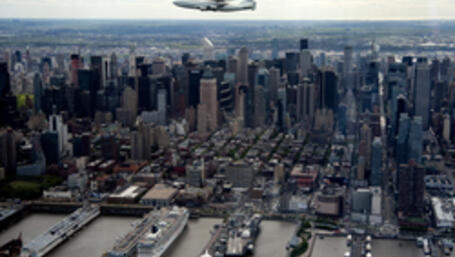
Space Shuttle Enterprise flies past the Manhattan skyline while making its final voyage April 27, from Washington to New York, where it will be placed on permanent exhibit July 19 as one of the Intrepid Sea, Air and Space Museum's major attractions. En route to John F. Kennedy International Airport, tens of thousands of spectators on the New York and New Jersey sides of the Hudson River were treated to dramatic views of the prototype test vehicle and the NASA Boeing 747 that transported the orbiter.
May 07, 2012
Blue Origin is one commercial crew option, but can NASA afford any?
May 07, 2012
Across composite and metallic aircraft structures, technology is being developed and deployed to minimize component lead times, reduce manufacturing costs and increase production rates. Automated processes that can take component geometry data directly from three-dimensional design databases are high on the most-desired list for aerospace manufacturers.
May 07, 2012
Cutting and drilling of cured composite components during manufacture or repair are a growing challenge as structures become bigger, more complex and costly.
May 07, 2012
Overseas space companies are seeking U.S. partnersOverseas space companies are seeking U.S. partners
May 07, 2012
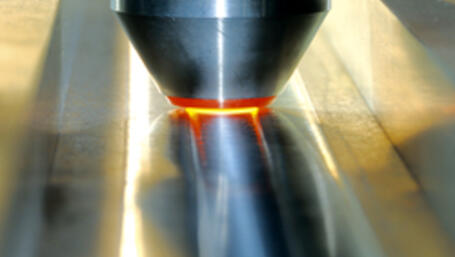
Friction welding fuses metals without melting them and is used in aerospace to join engine disks (rotational welding) or fabricate aircraft and spacecraft structures (friction-stir welding). Now hybrid components produced by linear friction welding of dissimilar metals promise to overcome a key disadvantage of composites: carbon fiber cannot be attached directly to aluminum because of galvanic corrosion, forcing use of higher-cost titanium. But friction welding can allow titanium to be incorporated into the join between aluminum and composite structures.
May 07, 2012
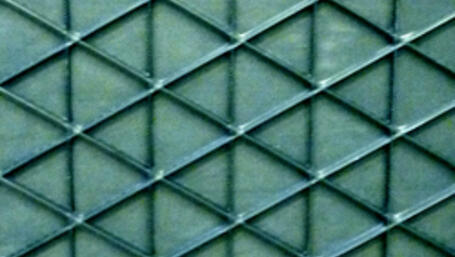
Isogrids are among the lightest and strongest of structures, the lattice pattern of integral stiffening ribs providing extremely high strength-to-weight ratios. Lightweight isogrid panels machined from aluminum plate to produce thin-walled, self-stiffened and damage-tolerant structures are used in launch vehicles and aircraft doors. Advanced grid structures made from composites have been used for components such as payload shrouds, but require time-consuming and costly manual layup. Isogrid Composites Canada Inc.
May 07, 2012
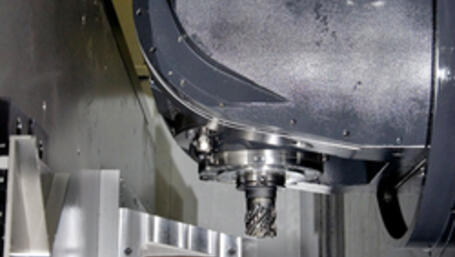
Composites may be replacing metals in aircraft structures, but the use of titanium is increasing both to reduce weight and because of the incompatibility of aluminum and carbon fiber. Boeing's 787 is 50% composite by structural weight, whereas its earlier 777 is only 12%, but a 787 contains almost 90 tons of titanium compared with 55 tons in a larger 777. And titanium can be around 10 times as expensive as aluminum, so pressure is on to reduce costs.