This article is published in Aviation Daily part of Aviation Week Intelligence Network (AWIN), and is complimentary through May 13, 2026. For information on becoming an AWIN Member to access more content like this, click here.

U.S., Mexico Cite Progress In Resolving Air Services Dispute

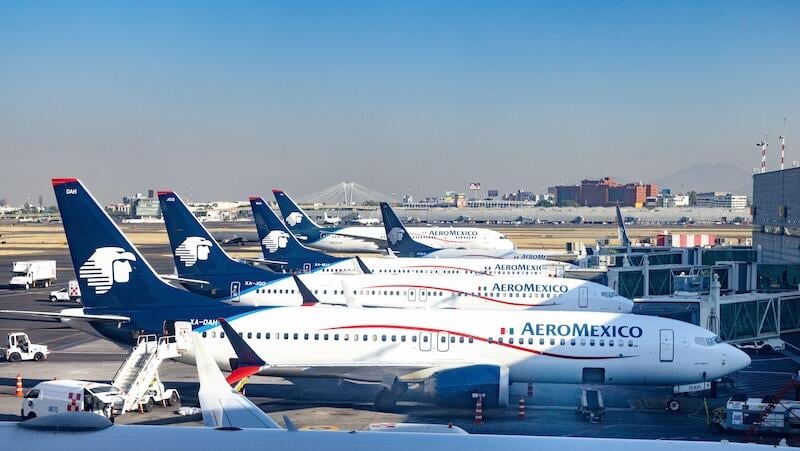
aeromexico jets at MEX

Aeromexico jets at Mexico City Benito Juárez International Airport.

Credit: Kumar Sriskandan/Alamy Stock Photo
The U.S. and Mexico governments said they have agreed on steps toward resolving their longstanding dispute over Mexico’s alleged violations of the countries’ 2015 open skies air services agreement, including the U.S. potentially lifting restrictions imposed last year on Mexican airlines’ transborder routes.
 
U.S. Transportation Secretary Sean Duffy said in a May 5 statement that the countries have reached an “understanding [that] follows multiple rounds of bilateral consultations between the two nations.” According to Duffy, a “memorandum of consultations represents a first step.”
 
He added Mexico’s Secretariat of Infrastructure, Communications and Transportation (SICT) “has committed to, among other things, conduct [an airport] capacity declaration process following international best practice [and] guarantee that U.S. carriers will have fair and transparent access to request and operate slots at” Mexico City Benito Juárez International Airport (MEX). Duffy said Mexico will “amend its slot policies to align them with international best practice.”
 
SICT said in a May 5 statement that Mexico has “reaffirmed its commitment to a competitive bilateral air market in which operating conditions promote the free flow of people and goods, within a clear, consistent regulatory framework based on international best practices.”
 
The U.S. Transportation Department (DOT) in October 2025 issued an order that disallowed 13 transborder routes operated or planned by Mexican carriers and advanced a ban on Mexican airlines carrying belly cargo between MEX and the U.S.
 
Duffy said: “[The] critical part of the process remains ahead—specifically, Mexico’s implementation of the commitments and reforms established through our consultation process to address DOT’s ongoing concerns … Mexico must work to operationalize the reforms before DOT would be in a position to reconsider the restrictions it imposed on Mexican carriers.”
 
The dispute extends back to the previous presidential administrations of Joe Biden in the U.S. and Andrés Manuel López Obrador in Mexico. López Obrador, citing severe congestion at MEX, in 2023 ordered freighter operators, including U.S. carriers FedEx and United Parcel Service, to move Mexico City operations from MEX to Felipe Ángeles International Airport (NLU), which opened in March 2022. NLU, a former military base converted for commercial operations, is located about 30 mi. from MEX and is viewed by U.S. carriers as much less desirable for efficiently moving cargo through and around Mexico City.
 
That came a year after American Airlines, Delta Air Lines and United Airlines—along with Mexican carriers Aeromexico, Viva Aerobus and Volaris—were forced by the Mexican government to reduce passenger slots at MEX.
 
“The agreement [with the U.S.] affirms [NLU] as an integral part of Mexico City's airport network,” SICT said. “Both parties will engage in ongoing dialogue to track progress on the future of air transportation between Mexico and the U.S.”
 
SICT said it has agreed with DOT on “conditions … established to ensure equitable and transparent access to the airport infrastructure at [MEX and NLU], expanding operational options and strengthening cargo links between the two countries, to the benefit of both airports.”
 
SICT and DOT officials “will establish a bilateral working group to oversee implementation of these commitments and, in due course, review current U.S. regulatory measures. The group may also draw on industry input, including from Mexican and U.S. airlines interested in continuing to consolidate their cargo operations at [NLU],” according to the SICT statement.
 
Receiving a commitment regarding NLU being viewed as a legitimate part of Mexico City’s airport system, particularly regarding cargo, appears to be a key to SICT agreeing to the process ahead. “SICT has made progress in facilitating the expansion of operations at [NLU],” the agency said.
 
However, DOT made no mention of NLU in its statement and reiterated that Mexico “forced U.S. all-cargo carriers to relocate operations” in 2023 after it “abruptly rescinded U.S. passenger carriers’ slots” in 2022. 
 
“By restricting slots and mandating that all-cargo operations move out of MEX, Mexico broke its promise, disrupted the market and left American businesses holding the bag for millions in increased costs,” Duffy said.
 
Regarding Mexico’s commitments under the “memorandum of consultations,” Duffy said the U.S. needs “to see these promises turn into action. Until then, our restriction on Mexican carriers will remain in place.” He said Mexico has “finally agreed to come into compliance and stop their anti-competitive behavior.”
Aaron Karp

Aaron Karp is a Senior Editor at Air Transport World.