The U.S. Transportation Security Administration (TSA) is exploring whether new screening technologies can allow for reduced requirements for passengers at airport checkpoints, including rules requiring removing items from carry-on luggage.
On July 8, TSA ended the requirement that passengers remove shoes at checkpoints, which the agency believes will increase screening efficiency and lower stress for travelers. “The next ones that we'll be evaluating is what it requires [to change rules] for the liquids, for removing electronics,” U.S. Homeland Security Secretary Kristi Noem said at a July 17 press conference at Nashville International Airport (BNA). “My goal would be that someday someone could walk into an airport, walk through a scanner and go right to their airplane. That's the goal, and that's the challenge I put in front of TSA and these [airport security technology] companies.”
Noem said advanced technology is the key to less invasive screening at checkpoints.
“We’re looking at some of the policies we have today,” she said. “How can we add technology to streamline some of the processes and maybe remove some of the requirements that we do have today ... Every single thing that happens at a checkpoint today is being evaluated.”
TSA requires liquids, aerosols, gels, creams and pastes be placed in a quart-sized bag in carry-on luggage. The liquids and gels must be in travel-sized containers 3.4 ounces or less per item. “Placing these items in the small bag and separating from your carry-on baggage facilitates the screening process,” TSA states on its website.
The UK is in the process of slowly lifting similar liquids rules at its airports. The UK Department For Transport has said airports with appropriate computed tomography scanners—similar to those used in medical imaging—will be able to lift the liquids rule.
So far, two UK airports—Birmingham, England, and Edinburgh, Scotland—have been cleared by the government to allow liquids in containers up to two liters to be left in passengers’ carry-on bags and taken through security checkpoints. There is no limit on the number of two-liter containers per passenger.
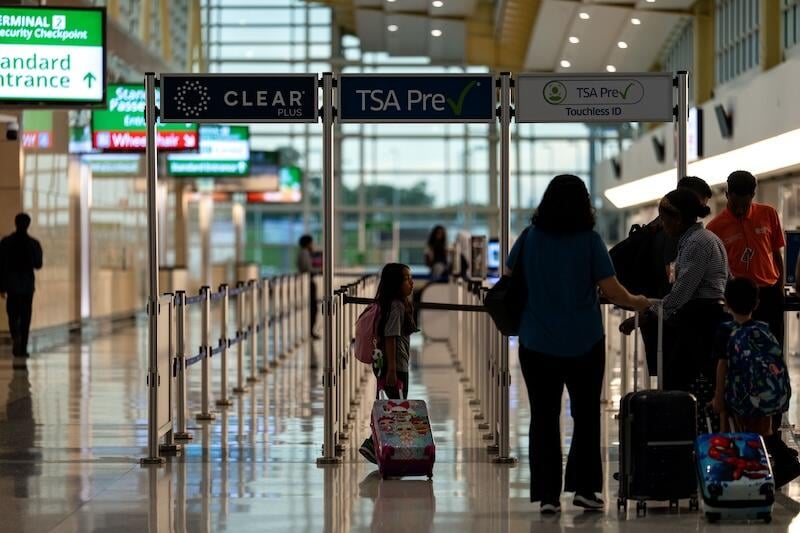
Noem held the press conference at BNA to announce that TSA is in the process of rolling out dedicated security lanes for families traveling with children. A pilot program was tested at Orlando International Airport, which processes large numbers of families because the Florida city is home to Disney World.
Noem said screening families with children in standard security lanes is “cumbersome and time-consuming” both for families and TSA.
She said families with children will be screened via an “expedited process.” Noem said implementing the new lanes will include “reducing some of the invasive pat-downs that individuals have seen with children. And so, we'll be focusing on making sure that activity is as limited as it possibly can be, recognizing that when people are traveling with their children many times that has been invasive in their privacy.”
Family-dedicated TSA lanes have also been rolled out at Charlotte Douglas International Airport. The next airports where such lanes will be deployed are John Wayne Orange County Airport in California and Daniel K. Inouye International Airport in Honolulu, according to TSA. With nationwide implementation planned, family lanes are targeted to be rolled out in the near future at Charleston International Airport in South Carolina; Jacksonville International and Tampa International airports in Florida; Rhode Island T. F. Green International Airport; and Luis Muñoz Marín International Airport in San Juan, Puerto Rico.
“Additional airports” will see the lanes “in the coming months,” TSA said.