This article is published in Aviation Week & Space Technology and is free to read until Nov 04, 2026. If you want to read more articles from this publication, please click the link to subscribe.
Opinion: Proposed FAA Rule For Overland Supersonic Flights Misses Mark
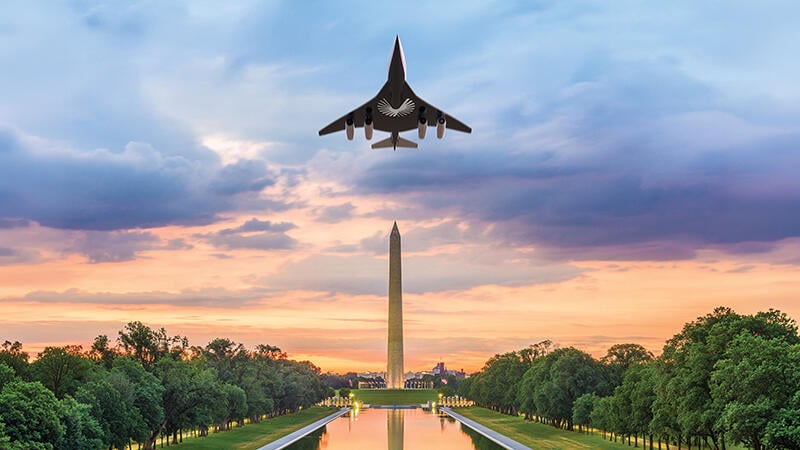
Boom Supersonic has welcomed moves in Washington to lift the restrictions on overland supersonic flight.
The FAA released a proposal in July to replace the five-decade-old U.S. ban on overland supersonic flight with a performance-based noise standard, following President Donald Trump’s 2025 executive order.
The overall concept has merit: Sonic boom, not speed, is the negative externality to worry about. Sonic boom occurs whenever conventional aircraft operate faster than the speed of sound. Because the aircraft moves faster than the surrounding air can respond, it generates a powerful shock wave that reaches the ground, startling and annoying people, disrupting sleep and rattling homes. The resulting “boom carpet” is roughly 50 mi. wide for the duration of supersonic cruise at 50,000 ft., making sonic booms far more disruptive than conventional airport noise.
Performance-based standards work when they set enforceable targets, giving companies the flexibility to pursue technological innovation while letting markets, not regulators, choose winning approaches. They fail when targets cannot be effectively enforced, which leads manufacturers to focus innovation on how to circumvent the regulation rather than meet its intent. For example, the “technology-neutral” emissions standards for passenger vehicles triggered the “Dieselgate” scandal rather than accelerating the shift to electric cars.
As currently designed, the FAA’s proposed rule seems more likely to promote regulatory arbitrage than technological innovation. Industry’s reaction to the proposal shows why. Major OEMs such as Lockheed Martin, Gulfstream and Rolls-Royce question the feasibility of the agency’s performance-based standard, arguing against its choice of maximum overpressure as the performance metric, since overpressure does not measure loudness, vibration or human annoyance. Representatives of airlines, airports and regulators—Airlines for America (A4A), Airports Council International - North America (ACI-NA) and the European Union Aviation Safety Agency (EASA)—have similarly noted the lack of supporting data for the FAA’s proposed overpressure limit of 0.11 lb./ft.2
The choice of maximum overpressure notably would not reflect the performance of low-boom aircraft designs, such as NASA’s Lockheed Martin X-59 QueSST demonstrator. The X-59 relies on boom shaping, which elongates an aircraft’s fuselage to produce a sonic “thump” with a lower perceived (PLdB) level in decibels at the ground for a given amount of overpressure.
Instead, the FAA’s rule favors a different technology to manage sonic boom: Mach cutoff operation (MCO). Under MCO, an aircraft operated at a precise combination of speed, aerodynamics, aircraft mass and atmospheric conditions can, in theory, exploit differences in the speed of sound across atmospheric layers to create a “caustic” that refracts the shockwave away from the ground.
MCO has clear limitations. Unlike boom shaping, it can only be used in a narrow speed range, typically 110-130% of the speed of sound. MCO has not yet been demonstrated on commercial flights, and research by NASA and the International Civil Aviation Organization concludes that achieving and maintaining MCO would be challenging under real-world conditions. Of special concern is the potential for concentrated “super booms” if an aircraft slips outside the narrow flight conditions that MCO requires.
Gulfstream, Lockheed Martin, A4A, ACI-NA and EASA have all described MCO as an unproven technology that would be difficult to enforce. And A4A questioned the wisdom of shifting compliance responsibility for a sonic boom standard from a handful of aircraft manufacturers (an easily enforceable type-certification approach) to a large number of airlines on a per-flight basis.
The strongest proponent of the FAA’s proposed rule is Boom Supersonic founder and CEO Blake Scholl, who has different views on sonic boom than most of his industry counterparts. Scholl, who has previously framed his company’s mission around “sustainable supersonics,” has more recently called on Trump to “Make America Boom Again.” He has also described NASA’s work on low-boom aircraft as “a boondoggle” and questioned the value of the agency’s collecting further data on human response to sonic boom.
Taken together, the rule’s reliance on an unproven and inconsistent technology, its shift of compliance responsibility from manufacturers to airlines and Boom Supersonic’s dismissive stance on the risks of sonic boom raise concerns about its overall approach. The FAA’s proposed rule seems more likely to create a boom market for regulatory gaming than to drive real technological progress.
Dan Rutherford is a senior director of research at the International Council on Clean Transportation, a nonprofit organization whose research helped uncover widespread cheating on diesel emission standards in 2015.
Related Content