This article is published in Aviation Week & Space Technology and is free to read until Jun 12, 2026. If you want to read more articles from this publication, please click the link to subscribe.

Opinion: A Pilot Envisions The End Of His Kind
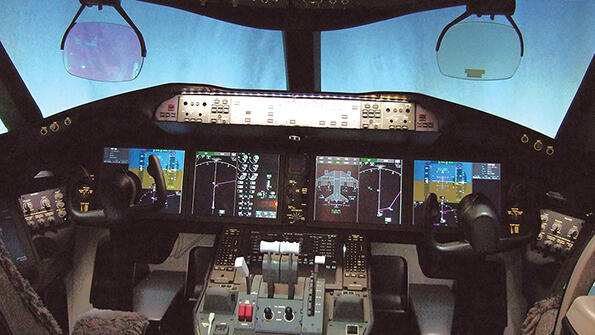
Credit: Brandrodungswanderfeldhackbau/Wikipedia

Most of us assume that we will have driverless cars before we fly on a pilotless plane, but thanks in large part to a more favorable operating environment, pre-existing automation and the nonlinear adaption of new technology, pilots will likely go before drivers do.

Let’s start with the operating environment. The tech and auto industries are attempting to overcome the inherent mismatch between computing’s natural ability to recall and crunch static data and the dynamic environment where humans simply get in their cars and drive, responding to variables in real time. Conversely, the well-planned, low-variable flight environment—with standardized arrivals, departures and en route clearances—plays well to a computer’s strengths.

Existing aircraft automation already meets the three primary capabilities required of a pilot: the physical capacity to fly; extensive knowledge of aircraft systems, procedures and aviation rules; and sound judgment. When it comes to flying, no human can replicate the precision and accuracy of the autopilot. And unlike a computer’s capacity for data storage, pilots commit to memory only the routine information they encounter every day and the rarely encountered emergencies practiced in simulators and evaluated on check-rides. By contrast, as long as the data and programming are available, a computer is equally competent in the most routine and rare situations, requiring no training or currency for either.    

Brandrodungswanderfeldhackbau/Wikipedia

Even without advanced artificial intelligence (AI), computers are already competing with humans on judgment. Around 80% of aviation accidents and close calls are a result of pilot error, according to the FAA. Human factors such as fatigue, crew dynamics, decision-making, physiological problems (e.g., vertigo and visual illusions) and disregard for regulations are common causal factors in aircraft accidents. Judgment errors are compounded by the limited number of human sensors—eyes, ears, inner ears and hands being the primary yet fallible ones—and the time the brain takes to assemble into usable information data presented through flight instruments and warning displays. Computers, on the other hand, follow checklists, apply uniform and immediate judgment based on a multitude of independent and redundant flight and system sensors and immediately share experiences and lessons system-wide. 

Although far more people have died due to pilot error than heroics, events like the “Miracle on the Hudson” show that rare occasions will require some level of adaptability in an autonomous aircraft. However, the level of AI required to fly will be far less than that required to drive, and the airlines and manufactures have terabytes of data based on millions of flight hours from which to teach the algorithms. 

Predicting exactly when airplanes will fly without a pilot on board is difficult since people do not adopt technology linearly. Adoption follows a geometric path with a few early adopters followed by a steep upward curve. People used to think that traveling faster than a horse would kill a human. However, railcars quickly dispelled that myth, and people took to the technology overnight. So where are we on the autonomy curve? It is unlikely that flight engineers or navigators saw their demise coming more than 10 years before computers took their place, and pilots have probably already entered that window.

Yes, psychology and security are two conspicuous hurdles to passengers boarding autonomous aircraft, but concern will lessen as familiarity grows. Riding in driverless cars will knock down psychological barriers to flying without a pilot and vice versa. Cybersecurity remains a concern, too, but a pilot’s ability to defend against a hack is easily defeated. For a pilot to successfully override a hacker’s attempt at controlling the aircraft, he or she must both recognize the hack and, lacking a mechanical override, be able to electronically disconnect computer control.

In the end, safety and economics will force the change. Although flight in autonomous aircraft will be safer than in manned aircraft, the first move will likely come from the military and cargo companies that do not have to worry about the psychology of paying passengers. Economics will also motivate cargo companies that can reduce the need for system redundancies and the heavy and expensive life-support equipment that keeps pilots alive. Passenger airlines will still require redundant systems and life-support equipment, but autonomous flight will eliminate the need to pay pilot salaries, benefits, training costs and travel expenses.

Flight attendants’ roles in emergency situations should make them feel secure that it will be much longer before robots are moving down the aisles. But with an empty flight deck, they will be burdened with the duties of making destination weather announcements and appreciating you for choosing their airline.

Hansberger currently serves as the 89th Air Wing Chief of Safety and flies the C-32. The views expressed in this article are his own and do not represent official policy or position of the U.S. Air Force or those of Aviation Week.