This article is published in Aviation Daily part of Aviation Week Intelligence Network (AWIN), and is complimentary through Jun 13, 2026. For information on becoming an AWIN Member to access more content like this, click here.
MIAMI—United Airlines is betting that the future of inflight entertainment (IFE) is not about entertainment.
United Airlines director inflight entertainment Dominic Green described the carrier’s rapidly expanding onboard technology ecosystem as a fully connected digital platform designed to deepen customer loyalty, drive revenue and extend United’s app experience directly into the cabin. “We’re kind of pivoting to this broader onboard digital platform,” Green said, adding that connectivity plays a central role across nearly every aspect of the onboard experience.
For United, inflight connectivity touches nearly every part of the passenger journey. The obvious layer is passenger internet access, where Starlink has dramatically expanded what customers can do onboard. But the airline also views connectivity as infrastructure powering personalization, operational messaging, ecommerce and real time engagement directly through seatback screens and personal devices.
The scale of the rollout has been aggressive. United launched its first Starlink-equipped regional aircraft customer flight in May 2025 and now has nearly 400 aircraft equipped, including the entire two-class regional fleet completed in under a year. “We’re doing roughly one a day,” Green said, with United expecting roughly 900 aircraft to be equipped with Starlink by early 2027.
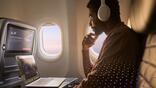
United decided several years ago to place seatback entertainment systems across its entire mainline fleet, seeing them as critical engagement channels rather than just movie players. “That’s critical so we have that one-to-one engagement with every single customer,” Green said in a presentation at the Aviation Festival Americas conference in Miami last week.
United delivers real-time flight information, gate changes, baggage claim details, upgrade offers and irregular operations notifications directly to passengers through seatback screens tied to the airline’s broader app ecosystem. In many ways, Green said, United has placed a version of its app directly into the seatback screen. “We actually deployed a version of our app into the seatback last year,” he said.
The airline uses those systems to personalize the onboard experience based on customer profiles, MileagePlus loyalty program status and travel behavior. Passengers can be welcomed onboard by name, receive targeted upgrade offers or promotions and access customized travel information relevant to their specific itineraries. “We know a lot about every customer,” Green said, noting the airline was just beginning to explore the possibilities around personalization.
United is integrating partners such as rideshare company Lyft and grocery delivery service Instacart into the experience, while also exploring more connected content ecosystems. United recently rolled out a fully integrated Spotify app directly into the seatback system, allowing passengers to access their personal libraries as they would at home. “What this does for us is it sets a template,” Green said.
Live and near real time content are also becoming important. United recently began formally rolling out enhanced live sports and highlights programming timed around major sporting events, while cloud based moving maps now synchronize across both seatback screens and personal devices.
Operationally, connectivity is becoming just as important behind the scenes. Flight attendants can receive real-time customer information, while maintenance issues can be transmitted immediately to ground teams before aircraft arrive at the gate. Green said that capability allows airport teams to begin preparing repairs proactively rather than waiting until the aircraft arrives.
United’s Starlink take-up rates have nearly doubled compared with previous connectivity systems, while customer satisfaction scores for connectivity have also doubled, according to the airline. Overall customer satisfaction tied to the onboard digital experience has risen approximately 20%.