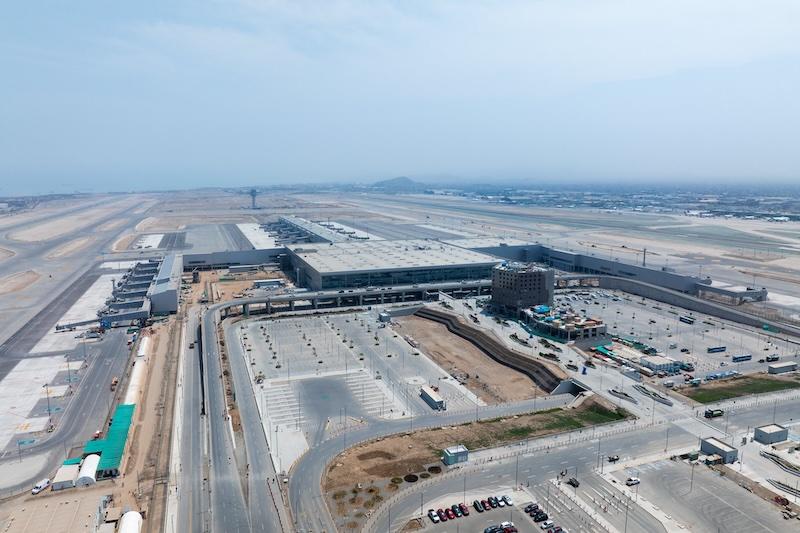
Lima's Jorge Chavéz International Airport.
Peru has signed new air transport memoranda of understanding with Chile and Panama, aiming to expand international connectivity beyond Lima and support the growth of regional air services as the country positions itself as an emerging hub in Latin America.
The agreements were signed by Peru’s Transport and Communications Ministry (MTC) with the civil aviation authorities of both countries. The pacts focus on liberalizing capacity, expanding route options and improving access to international markets from cities outside the capital.
“These agreements respond to a vision of air integration that seeks to bring people closer together, boost tourism and generate new opportunities for regional economies,” Peru’s Transport Minister Aldo Prieto says.
Under the memorandum with Chile, the two countries agreed to double third- and fourth-freedom frequencies on the key Lima-Santiago route from 84 to 168 flights per week. In addition, all frequency limits on services between Chile and Peru’s regional cities will be removed, allowing airlines to operate without restrictions to destinations outside Lima.
The MTC said the Chile agreement represents a “significant step forward” in the progressive liberalization of air transport and provides “stability and predictability” for existing operations, while encouraging new direct routes to Peru’s interior regions.
According to OAG Schedules Analyser data, the Peru-Chile market is currently served by LATAM Airlines Group, Jetsmart and Sky Airline, with about 48,000 two-way weekly seats. LATAM holds a 62.1% capacity share, followed by Jetsmart at 19.5% and Sky at 18.4%.
Most capacity is concentrated on Lima-Santiago, although LATAM also serves Cusco-Santiago daily and Lima-Antofagasta 3X-weekly, while Jetsmart serves Trujillo-Santiago 5X-weekly.
Sabre Market Intelligence data shows demand between the two countries is growing. O&D traffic between Peru and Chile totaled about 1.25 million two-way passengers in the 12 months to June 2025, up 36% year on year, with about 75% of traffic flowing between Lima and Santiago.
The memorandum with Panama focuses on preserving and expanding connectivity with Panama City’s Tocumen International Airport. “[It] will allow us to expand the range of flights between both countries and consolidate Peru’s connectivity with one of the main air connection hubs in the region,” Prieto says.
The agreement also opens the door to evaluating additional regional routes, designed to promote competition and provide passengers with more options.
Copa Airlines is currently the sole nonstop operator between Peru and Panama, offering up to seven daily flights between Lima and Panama City, as well as a 2X-weekly service from Chiclayo. OAG data shows the carrier provides about 16,400 two-way weekly seats, up from roughly 14,150 a year ago.
Sabre data highlights the hub role Panama plays for Peru. In the 12 months to June 2025, about 65% of travelers flying from Peru to Panama traveled onward to destinations beyond Panama City. The top beyond markets included Washington, San Jose, Guatemala and Orlando.
The timing of the agreements coincides with major capacity expansion at Lima’s Jorge Chávez International Airport (LIM), where a new terminal opened in mid-2025 and is designed to handle up to 40 million passengers annually by the end of the decade.
Peru has also recently signed an open skies agreement with Australia, further signaling its intent to liberalize air services and attract new long-haul routes. Other new routes include Level’s plans to launch a 3X-weekly Barcelona-Lima service in June, alongside resumptions by Delta Air Lines from Salt Lake City and Air Canada from Toronto and Montreal.
The Level route will be the only direct link between Barcelona and Lima and targets Spain, Peru’s leading European source market for tourism, which accounted for nearly 145,000 visitors in 2025, according to Promperu data.

Related Content