Air Greenland has reported a deeper first-half loss as the relocation of its international hub from Kangerlussuaq to Nuuk disrupted feeder traffic and exposed the carrier to significant operational challenges.
The flag carrier posted a pre-tax loss of DKK87.4 million ($12.7 million) for the six months to June 30, compared with a DKK21.1 million loss in the same period last year amid weather-related disruptions and issues associated with the shift to the new Nuuk International Airport (GOH) in late 2024.
Although traffic on international routes rose, overall profitability was hit by reduced domestic connectivity. Feeder traffic fell by 53% as passengers no longer needed to connect via Kangerlussuaq, while remaining domestic travelers flew on average 54% longer distances, especially from northern Greenland, with only “minor fare adjustments.”
“The change of hub from Kangerlussuaq to Nuuk has caused several changes in the domestic traffic with connection to international flights with material financial impact,” the company says in its interim report.
Operational reliability deteriorated with adverse weather impacts, teething problems at GOH and long lead times for spare parts leading to 59 jet cancellations in the first half, compared with just three a year earlier. Fixed-wing fleet regularity fell to 72% from 83.9%, and on-time performance reduced to 46.6% from 71.1%. Total costs rose 10.3% to DKK 958.4 million, while revenue increased 3.2% to DKK 885.3 million.
However, CEO Jacob Nitter Sørensen says the airline is adapting to its new operating environment. “We are undergoing a major transition after many years of operating under the same traffic pattern and must now adapt to a new reality,” he explains. “While many of the challenges are beyond our control, we are part of the equation and take responsibility by implementing measures to stabilize operations where possible.”
Nuuk has faced adverse weather, icy runways, security delays, baggage bottlenecks and fueling constraints, all of which disrupted operations. The situation worsened in late August when Danish authorities suspended international screening over staffing issues, forcing Air Greenland to temporarily shift its Copenhagen flights back to Kangerlussuaq.
The airline says it now expects to post a full-year pre-tax loss of DKK30 million, provided that external factors do not further affect the result. It also plans to adjust schedules to optimize capacity and better manage disruption.
Board Chair Malik Hegelund Olsen says that the carrier must also look beyond current difficulties, pointing to new airports in the pipeline at Qaqortoq and Ilulissat. “It is crucial that we maintain our long-term ambitions, even under pressure from short-term challenges. The upcoming airports must be ready for stable operations so we can realize our long-term strategy,” he adds.
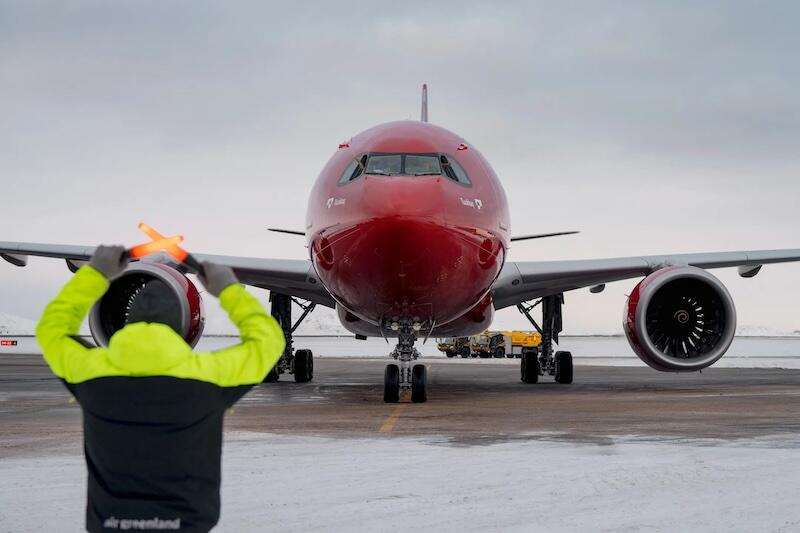
Air Greenland operates a fleet of eight De Havilland Canada Dash 8-200s and one Airbus A330-800 aircraft. Earlier this year, the carrier signed an agreement to lease an A320neo from Carlyle, due for delivery in December 2026.