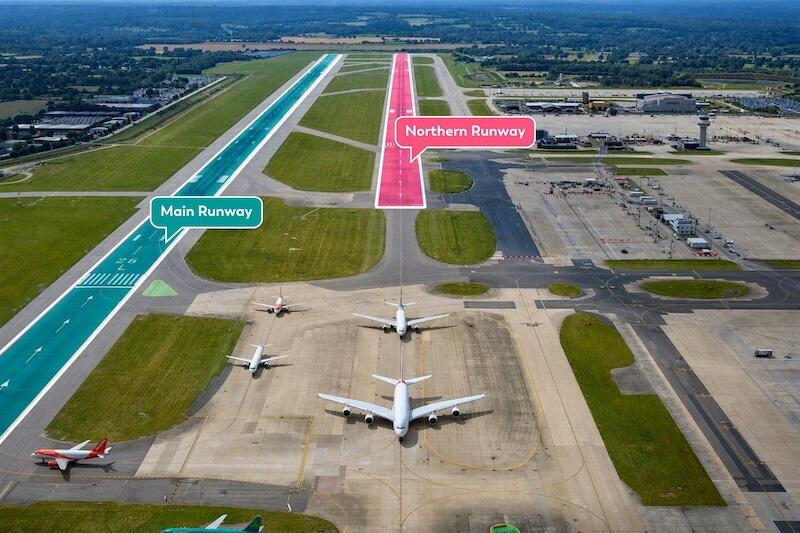
London Gatwick Airport’s £2.2 billion ($3 billion) plan to bring its northern runway into routine use is set to proceed after the Court of Appeal refused campaigners permission to appeal an earlier ruling upholding the expansion.
The second runway would allow Gatwick, which handled 42.8 million passengers in 2025, to raise its capacity to as many as 80 million passengers per year. First flights under routine dual-runway operations could begin in 2030, according to the UK government, which is backing the project.
Judges on Aug. 4 rejected applications from campaigner Peter Barclay and Communities Against Gatwick Noise Emissions (CAGNE), which wanted to appeal the High Court’s dismissal in June of their challenges to the project. In their judgment, the judges concluded that none of the proposed appeal grounds had a realistic chance of succeeding.
“We conclude that each of the grounds of appeal raised by each appellant is unarguable,” the judges said. “Neither appeal has a real prospect of success. We also consider that there are no other compelling reasons for either appeal to be heard.”
The ruling follows a two-day hearing on July 27-28 and removes a significant source of uncertainty surrounding the Northern Runway Project. The UK government granted development consent in September 2025, authorizing Gatwick to reposition its standby runway about 12 m (40 ft.) north and operate it routinely alongside the airport’s main runway.
The northern runway can currently only be used when the main runway is unavailable because they are too close to operate simultaneously. The development consent order also covers airfield and terminal works, new hotels and offices, additional parking and improvements to surface access infrastructure.
“This is a major milestone for Gatwick for local communities, with expansion unlocking investment and creating thousands of new jobs,” UK Transport Secretary Heidi Alexander said. “Around 13 million more passengers and 100,000 more flights will give holidaymakers greater choice and strengthen global links to help make the UK one of the most attractive places in the world to invest.”
Gatwick Airport CEO Pierre-Hugues Schmit welcomed the ruling, saying it confirmed that the government’s decision last September “was taken properly and lawfully.”
“We are also very pleased that this ruling, from senior Court of Appeal judges, brings to an end an eight-year planning and legal process which has carefully tested and scrutinized every aspect of our expansion plans on multiple occasions,” he added. “This final ruling means that we can now press on with the important job of bringing this exciting project to life and move forward into the design and delivery phase.”
The Court of Appeal considered six grounds across the two applications. Barclay argued that the government had misinterpreted national airport policy and had failed to address alleged flaws in Gatwick’s assessment of the project’s economic benefits, particularly its forecasts for business passenger growth.
Holgate and Dove rejected the argument that government policy supporting a third runway at London Heathrow Airport precluded significant expansion at Gatwick. They found that national policy expressly allowed airports to make better use of existing runways, provided that the need served was additional to or different from the demand expected to be met by Heathrow’s proposed northwest runway.
The judges highlighted differences between the two airports’ markets. Gatwick is dominated by low-cost and leisure traffic and is expected to remain primarily a point-to-point airport. Forecasts cited in the ruling indicated that transfer passengers would remain below 5% of Gatwick’s total, compared with an estimated 23% at Heathrow.
CAGNE’s proposed appeal focused on greenhouse gas emissions, the assessment of non-CO2 aviation effects, risks surrounding delivery of the government’s Jet Zero Strategy and provisions for wastewater treatment.
The campaign group argued that the government had reached contradictory conclusions by finding that the project would have a moderate significant adverse climate effect while also deciding it would not materially affect the government’s ability to meet its carbon-reduction targets.
The Court of Appeal found no inherent contradiction, saying a project could fall short of fully contributing to the UK’s net-zero trajectory without materially preventing the government from meeting national carbon budgets.
Gatwick handled 42.8 million passengers in 2025, down 1.1% from the previous year, although long-haul traffic increased by 3.3%. The airport served 227 destinations with 57 airlines during the year and generated revenue of £1.13 billion and a profit of £334.7 million.
Alongside the northern runway development, Gatwick has outlined a separate £1.9 billion capital investment program covering terminal expansions, new taxiways, additional aircraft stands and projects to reduce emissions from airport operations.

Related Content