South Korea and China have agreed to their first expansion of bilateral air traffic rights since 2019, paving the way for additional passenger and cargo services as travel demand between the countries surpasses pre-pandemic levels.
According to South Korea’s Ministry of Land, Infrastructure and Transport (MOLIT), the countries agreed to increase available frequencies from 662 to 732 per week. The expansion includes 56 additional passenger frequencies, raising the total from 608 to 664 weekly services, and 14 additional cargo frequencies, increasing the total from 54 to 68 per week.
The agreement marks the first increase in traffic rights for seven years and comes as demand in the market continues to recover strongly. Passenger traffic between the countries reached 4.4 million travelers during the first quarter of 2026, according to MOLIT, exceeding the 4.1 million passengers recorded during the same period of 2019.
Weekly frequency limits on Seoul Incheon-Beijing will rise from 45 to 52, while Seoul Incheon-Shanghai will increase from 56 to 63. Additional capacity will also be made available on routes linking Seoul Incheon with Guangzhou, Dalian, Chengdu and Harbin.
Regional airports are also set to benefit. Frequencies linking South Korean regional cities with destinations across China, excluding Beijing and Shanghai, will increase from 87 to 101 per week. The move is intended to support international connectivity beyond Seoul while encouraging inbound tourism to regional destinations.
The capacity increase comes as the South Korea-China market is already experiencing robust growth. According to OAG Schedules Analyser data, two-way seat capacity between South Korea and mainland China will reach approximately 2 million seats in June 2026, up from 1.8 million a year earlier. Overall summer 2026 capacity is projected to total 14.3 million two-way seats, a year-on-year increase of 14.2%.
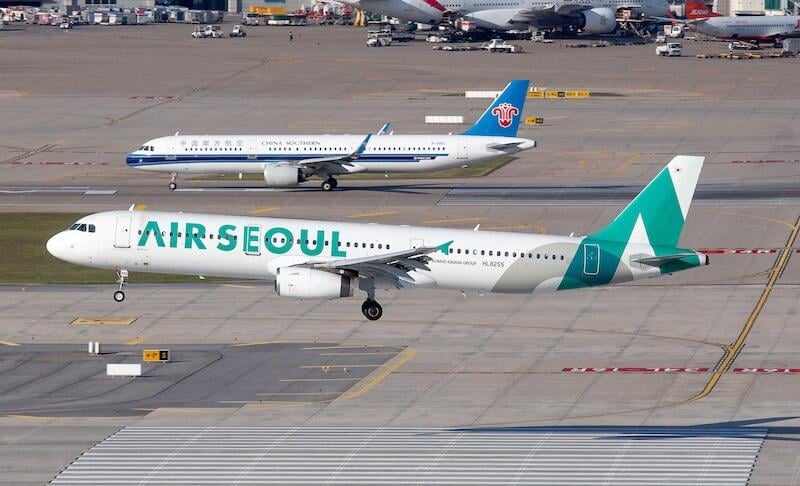
Overall, 27 airlines are operating services between the countries. Korean Air is currently the largest carrier with an 18.5% capacity share, followed by Asiana Airlines at 15%, China Eastern Airlines at 14.4%, China Southern Airlines at 11.6% and Air China at 7.2%.
Combined, these carriers serve 74 airport pairs. The largest route by capacity is Seoul Incheon-Shanghai Pudong, followed by Seoul Incheon-Qingdao and Jeju-Shanghai Pudong.
The expansion comes as Chinese airlines increasingly redeploy capacity toward markets such as South Korea and Russia while scaling back operations to Japan amid geopolitical tensions and weaker demand. OAG data shows Chinese carriers have increased capacity to South Korea by 17.4% in summer 2026 compared with a year earlier, while capacity to Russia has risen by 26.2%.
By contrast, mainland China-Japan capacity has fallen sharply to 7.6 million seats this summer from 15.4 million in summer 2025. Chinese airlines account for most of that decline, cutting their Japan capacity by 59% year-on-year.

Related Content