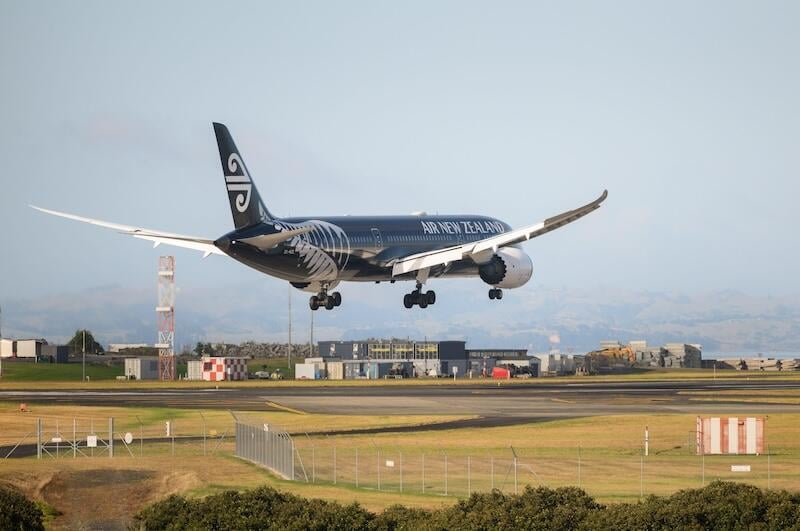
An Air New Zealand jet landing at Auckland Airport.
Auckland Airport (AKL) says it will open a revamped check-in hall by 2030 with a heavy emphasis on self-service technology intended to create a fast-track process for passengers arriving at the airport.
The project, on which construction will begin next year, is part of NZ$5.7 billion ($3.4 billion) in infrastructure investment planned by AKL over the next seven years. This includes construction of a new domestic passenger terminal, which is already underway.
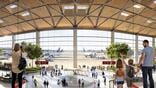
AKL says the new check-in facility will feature “a seamless, digital-driven experience for travelers that’s powered by self-service technology.” The 13,000 m² (140,000 ft.²) hall will enable biometric processing, including use of facial recognition technology. The airport added the hall “will remove traditional queuing.”
AKL CEO Carrie Hurihanganui says the new facility will “completely reimagine the check-in experience,” describing it as “a digital overhaul.”
The airport is served by 28 airlines connecting Auckland to 42 international points and 23 domestic destinations. AKL handled 18.7 million passengers during its fiscal year ended June 30, up 1.1% year-over-year. Domestic passengers for the 12 months decreased 0.5% year-over-year to 8.4 million, while international passengers grew 2.5% to 10.3 million.
The new check-in hall will be “a big change,” Hurihanganui said. “As we prepare for the future, we’re modernizing right to the core of our systems ... Internationally, we are seeing work toward digital passports and digital travel credentials, integrating biometric data and cryptographic algorithms to ensure information is kept private and secure.”
The new check-in facility will feature common-use self-service kiosks—in place of individual airline kiosks—and automated bag drops. This will provide airlines with flexibility, AKL said. “The new kiosks and bag drops can be used by different airlines throughout the day, improving efficiency and reducing infrastructure duplication.”
AKL plans to remove 60 traditional check-in desks.
“This is the direction airports globally are heading with Changi Airport, Dubai and Heathrow all showing how terminal upgrades drive the shift to self-service,” Hurihanganui said.
Construction of the new check-in hall will be done in stages. “To maintain capacity during the phased construction, a temporary check-in pavilion will be built,” AKL said. “Work on the pavilion begins later this year, with main construction on the terminal check-in areas starting early 2026.”
The airport recently completed the first phase of a remodeling of its customs facility. “The upgrade includes an enhanced ‘nothing to declare’ express lane supported by detector dog screening,” AKL said.
The airport said in coming weeks it will open a 250,000 m² expansion of AKL’s airfield that “will create the essential airfield headroom needed to allow for the construction of the domestic jet terminal pier and apron.”
While a good deal of expansion is underway at AKL, the airport earlier this year pushed back building a second runway by a decade, saying operational changes have mitigated the capacity constraints previously expected. AKL had planned to have a second runway operational by 2028 but now says a second runway will not be operational until 2038 and perhaps later.
AKL’s revenue was up 12% year-over-year to NZ$1 billion for the fiscal year ended June 30, while net income for the 12 months also increased 12% to NZ$310.4 million.