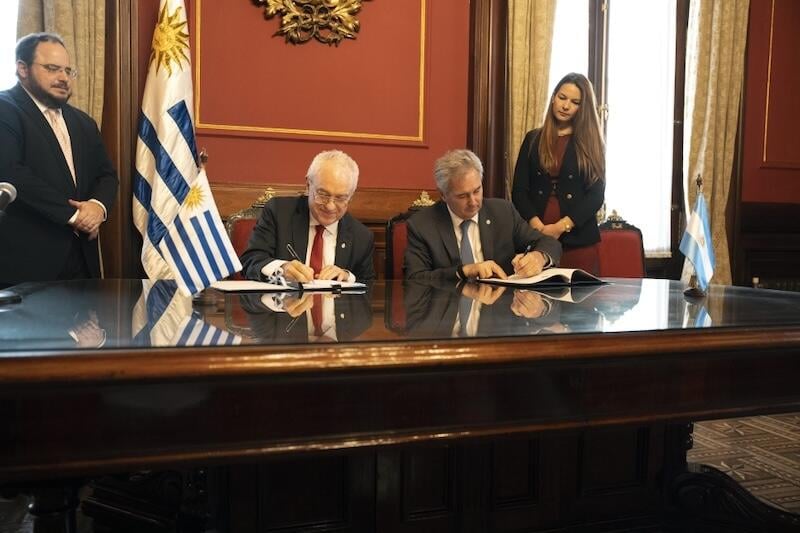
Argentina and Uruguay have signed a new air services agreement designed to liberalize passenger and cargo operations.
The pact, signed by Argentine Foreign Minister Pablo Quirno and his Uruguayan counterpart Mario Lubetkin, aims to modernize the bilateral framework governing flights between the neighboring countries and forms part of their open skies policy.
The agreement introduces broader traffic rights and a flexible route framework while facilitating airline cooperation, including codeshares. According to a joint statement, it “allows airlines to freely determine the frequency and capacity of their services on the basis of commercial considerations.”
The governments said the changes are intended to encourage additional services and destinations, strengthen competition and support tourism and trade.
OAG Schedules Analyser data shows approximately 160,700 two-way seats between Argentina and Uruguay during the northern summer 2026 scheduling season, covering late March to late October. That represents a 2.5% increase from about 156,900 seats a year earlier.
Aerolineas Argentinas operates all capacity during the season, with nearly 98% concentrated on two routes from Buenos Aires’ Jorge Newbery Airport (AEP) to Montevideo’s Carrasco International Airport (MVD) and Uruguayan resort city Punta del Este (PDP).
AEP-MVD accounts for approximately 122,700 seats, down 2.6% year over year, while AEP-PDP provides about 34,500 seats, up 21.6%. The remaining capacity comprises limited Bariloche-Montevideo flights and a handful of departures on other airport pairs.
Overall passenger numbers between the countries totaled about 272,000 in 2025, according to Sabre Market Intelligence data, down 21.7% from 347,300 in 2024. Traffic between Argentina and Montevideo fell 33.6% to about 178,900 passengers, while Buenos Aires-Montevideo contracted 36.2% to approximately 119,200 passengers.
However, the Argentina-Punta del Este market expanded 19.6% to about 93,000 passengers, including approximately 79,700 between Buenos Aires and the coastal destination, up 16.8%.
Beyond Buenos Aires, underlying markets remain thin. Sabre estimates approximately 15,800 passengers traveled between Bariloche and Montevideo in 2025, while Cordoba-Montevideo generated about 7,500 and Mendoza-Montevideo approximately 7,100.
The bilateral agreement comes amid a wider push toward regional liberalization. Argentina, Brazil, Chile and Paraguay signed a memorandum of understanding in Asuncion, Paraguay, in July, establishing a framework for the South American Air Liberalization Agreement (ALAS), with Uruguay expected to join after completing domestic administrative procedures.
Although the agreement does not immediately alter market access, it provides a road map for progressively expanding airline operating rights, reducing regulatory barriers and harmonizing technical standards across the participating countries.

Related Content