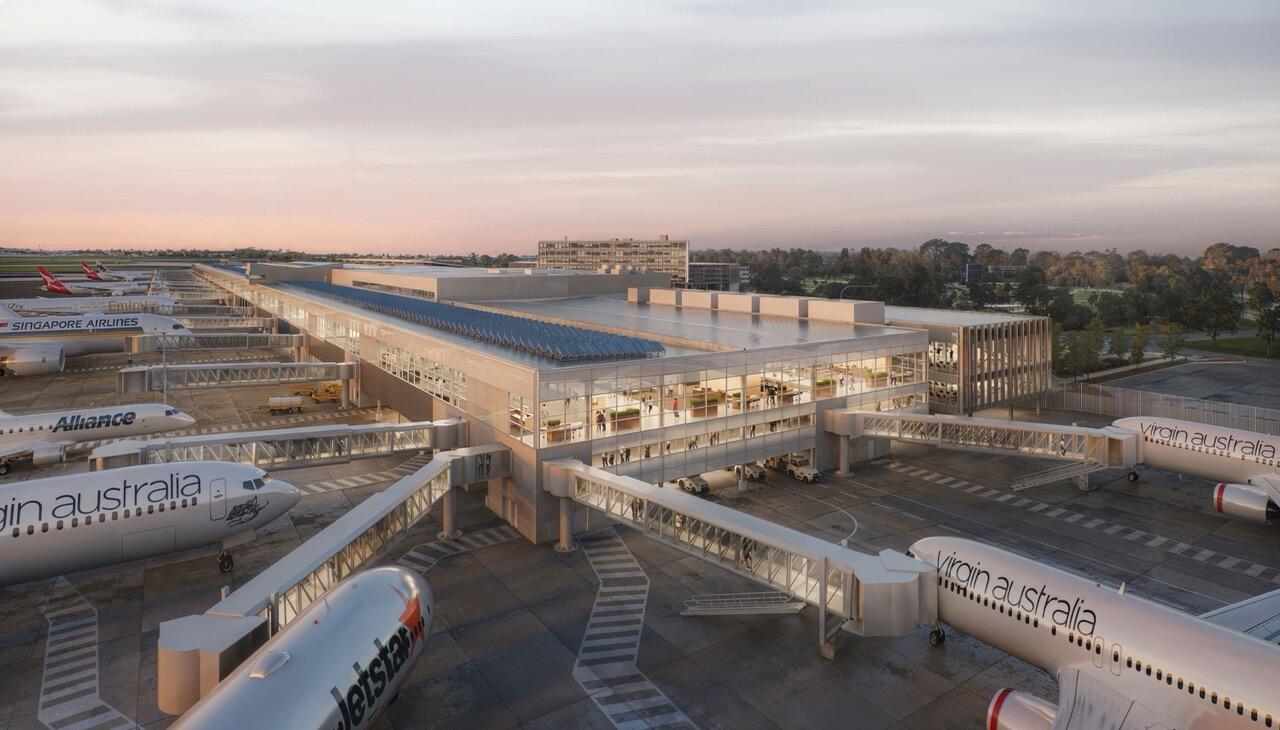
A rendering of Adelaide Airport’s northern terminal expansion.
The latest news on airports globally, with updates on financing, infrastructure expansion and sustainability initiatives.
Adelaide Airport, Australia, has launched the next phase of its A$600 million ($391 million) Project Flight, aimed at upgrading infrastructure to meet the airport's 2050 aviation network vision. The project will include expanded check-in hall, new gates, and aerobridges at both ends of the terminal. Key upgrades include the expansion of the southern check-in hall by 1,500 m2 (16,000 ft.2) increasing capacity by 25%. The northern terminal will expand by 10,000 m2 by 2026, adding new domestic gate lounges and aerobridges. The southern terminal will expand by 5,500 m2 by 2027, introducing new domestic and regional gates. Security screening improvements will also be completed by the end of the year, with new body scanners and 3D X-ray bag scanners. The project also features enhanced family facilities and upgraded seating throughout the terminal.
Ethiopia has appointed the African Development Bank as the mandated lead arranger to mobilize up to $8 billion in financing for Bishoftu International Airport. The $10 billion project will serve as Ethiopian Airlines’ global hub and is key to the airline’s Vision 2040 growth strategy. The new airport, located 40 km south of Addis Ababa, will have an initial capacity of 60 million passengers, expanding to 110 million. The project aligns with the African Union’s Agenda 2063 and the African Single Air Transport Market. It is hoped that construction of the first phase will begin in late 2025.
Chisinau International Airport, Moldova, plans to expand its passenger terminal as part of a €35.5 million investment. The project, which aims to enhance the airport’s capacity and passenger experience, is expected to be completed by the end of 2026. The expansion includes improvements to check-in and baggage areas, the construction of new departure zones, and the integration of automated passport control and self-service baggage systems. Additionally, the waiting areas and business lounge will be expanded, and new amenities such as a covered terrace and shower cabins for passengers will be introduced.
Gold Coast Airport, Australia, has received federal government approval for its 2024 master plan, outlining a 20-year vision to develop a sustainable, innovative, and accessible airport precinct. The plan incorporates community consultation, including input from cultural stakeholders, and emphasizes environmental and sustainability commitments. It aims to drive both economic and social growth, particularly in the lead-up to and legacy of the 2032 Olympic and Paralympic Games in Brisbane. Amelia Evans, CEO of Queensland Airports Limited, highlighted the plan’s focus on seamless connectivity for the Gold Coast and northern New South Wales. By 2044, GCA forecasts 13 million passengers annually, more than double current figures. Planned developments include a public plaza, additional hotel accommodations, commercial office space, and a conference hub. The master plan is expected to nearly double the airport’s economic contribution to the region, reaching A$990 million annually and supporting 6,000 jobs.
Miami Regional Airport, Oklahoma, has opened a new terminal following a $3.3 million upgrade. The project, aimed at enhancing passenger experience and regional connectivity, was funded through a mix of local, state, and federal support. The new terminal, part of the Oklahoma Department of Aerospace and Aeronautics’ Airport Construction Plan, includes $1 million from ODAA, over $1 million from the FAA and $1.2 million from the City of Miami and the Miami Special Utility Authority.
Hobart Airport, Tasmania, has completed a A$130 million upgrade. The project included major improvements to the runway, taxiways, and supporting infrastructure, allowing the airport to accommodate larger aircraft such as the Boeing 787 and Airbus A350, and facilitate direct access to Asia. The upgrade was funded with A$60 million from the Australian Government and $70 million from Hobart Airport. “This investment has secured Hobart's status as Australia's Antarctic gateway and will help grow economic activity from the Antarctic and Southern Ocean sectors,” Australia’s minister for infrastructure, transport, regional development and local government Catherine King says.

Related Content