This article is published in Aviation Daily part of Aviation Week Intelligence Network (AWIN), and is complimentary through May 13, 2026. For information on becoming an AWIN Member to access more content like this, click here.

Frontier Expects Spirit Exit Boost, Is Self-Help Focused Amid Fuel Spike
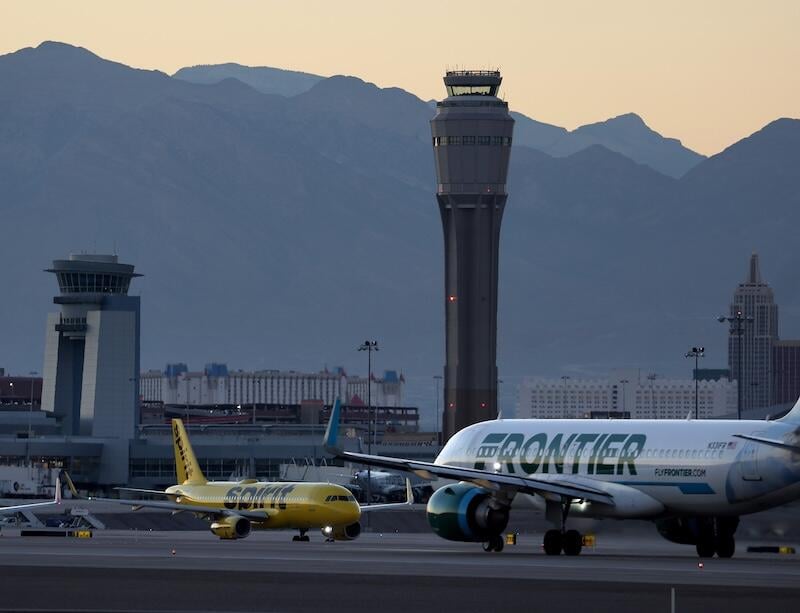
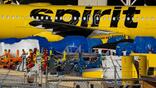
spirit frontier airlines jets at harry reid
Credit: Justin Sullivan/Getty

Frontier Airlines expects a revenue uplift from Spirit Airlines’ departure, planning to act on capacity opportunities and evaluate assets coming out of the budget rival’s winddown.

“Drawing on the benefits realized from prior Spirit capacity adjustments, we believe their exit supports a RASM uplift of 3-5% going forward,” Chief Commercial Officer Robert Schroeter said on a May 5 earnings call. CEO James Dempsey told investors and analysts, “We actually think it could be higher than that, going forward.”

Spirit ceased operations in the early morning hours of May 2. Over the last six to nine months Frontier has moved into markets where the restructuring ULCC pulled back and in the second quarter will have more route overlap with former Spirit markets than any other U.S. carrier. The airline intends to be “very disciplined” in deploying incremental capacity from here. Disciplined growth is a key focus of a strategic plan it announced earlier this year, in pursuit of sustained profitability. Executives are encouraged by early results of that plan.

“Prior to the fuel price spike, we were actually going to get very close to break even in [the first quarter],” Dempsey said. “We were certainly on a trajectory to make money in [the second quarter] ... we were ahead of our plan.”

Frontier, a member of the Association of Value Airlines (AVA), recently joined other budget carriers in relaying to U.S. transportation officials how fuel prices are impacting their segment of the industry. Since March, the carrier has participated in five broad industry fare increases and isn’t ruling out the potential for more. AVA has sought $2.5 billion in government assistance to help its members offset incremental fuel costs and keep airfares low.

Following Spirit’s exit, Transportation Secretary Sean Duffy said he didn’t think the financial support was necessary, at this point. “They do have access to cash,” Duffy told reporters on May 2. “If they want to come to the U.S. government, we would be a lender of last resort.” Speaking in the hours after the Spirit shutdown he added, “I think after today, we are going to see a stronger, competitive market in our airline industry.”

Frontier’s CEO told analysts and investors the carrier is “very focused on self-help” in the high-fuel environment and pleased with its current liquidity position. In addition to raising fares and fees, the brand has adjusted capacity to contend with the industry-wide headwind and expects to recapture approximately 35-45% of added fuel costs in the second quarter. It anticipates continued improvement in fuel recovery as the year progresses, enhanced by adjustments it sees in overlap markets where its competitive capacity is down 4% in the June quarter.

For the first quarter, Frontier reported total operating revenues of $992 million, up 9% year-over-year, on a 33% uptick in operating expenses inclusive of a $139 million charge related to early lease terminations, and a $30 million increase in fuel expense. A net loss of $272 million compares to its year-ago net loss of $43 million, and by March 31 Frontier’s total liquidity stood at $974 million, $100 million higher than year-end 2025. Loyalty revenue grew 30% during the period, following investments in its co-brand credit card and membership programs.

Frontier ended the first quarter with a fleet of 183 aircraft, after taking delivery of five A320neos and two A321neos. The airline plans to take five A321neos and two A320neos in the second quarter and return 24 leased A320neos by early June, under a previously announced early termination agreement with AerCap. Working to keep the fleet count roughly flat through 2027, Frontier has an agreement in principle to sell five newly delivered aircraft this year and six the next, with no corresponding leaseback agreement.

“We’ll effectively have the same fleet for those two years,” Dempsey said. “Where we’re getting the upside on that is actually removing A320neos ... and replacing them, as we progress through this year, largely with A321neos, which is really an efficiency drive.”

Still to come are completed installations of its new first-class product, a process that will run through the second half of 2026. The carrier is also nearing the selection of a vendor for new onboard Wi-Fi with installations slated to begin in 2027, as part of an ongoing push to rollout new premium products and services.

Looking ahead, Frontier expects second quarter adjusted diluted loss per share to range between $0.45-$0.60, on year-over-year capacity growth of 6-8%. The airline projects RASM will increase by over 20% in the second quarter versus the year-ago period. Executives noted that about two points of improvement built into the quarterly guide are linked to Spirit shutting down.

“As we think about the foundation of our performance expectations, the recent conclusion of Spirit’s operations represents an incremental opportunity for Frontier,” Schroeder said. “We have seen significant revenue intake since the weekend, a trend we expect to continue throughout this coming week as customers who are most acutely impacted seek alternatives. Demand for the Frontier product is strong.”

Christine Boynton

Christine Boynton is a Senior Editor covering air transport in the Americas for Aviation Week Network.