This article is published in Aviation Daily part of Aviation Week Intelligence Network (AWIN), and is complimentary through Nov 10, 2026. For information on becoming an AWIN Member to access more content like this, click here.
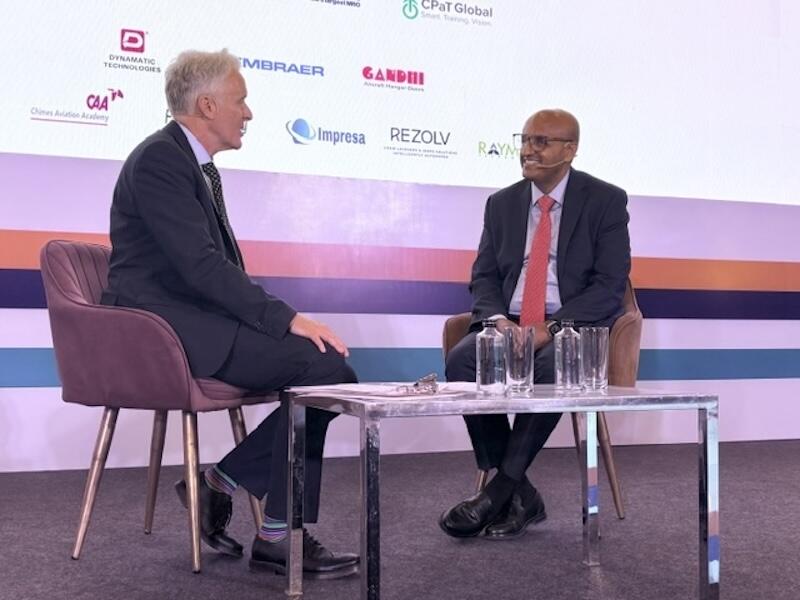
Air India CEO Tewolde Gebremariam (right) pictured at the Aviation India 2026 summit.
NEW DELHI—Air India intends to increase its widebody orderbook to tap into long-haul growth, CEO Tewolde Gebremariam said Nov. 3, while acknowledging that profitability remains a key concern for the Tata Group-owned carrier.
Speaking at the Aviation India 2026 summit in Delhi, in his first major public appearance since taking charge of the flag carrier, Gebremariam described a long-term transformation that could take “15 to 20 years.”
“We want to increase our widebody aircraft order,” Gebremariam said, pointing to the large growth opportunities ahead. He said the airline has the right foundation to pursue them, even as it contends with high fuel costs, the closure of Pakistani airspace, which is disrupting operations, and continuing losses.
Air India and Air India Express together posted a net loss of more than 220 billion Indian rupees ($2.3 billion) in the fiscal year that ended March 31, according to Tata Group’s annual report. The airline has been investing heavily in its fleet and expanding since Tata Group took it over from the government in 2021. Singapore Airlines holds a minority stake.
Gebremariam said his immediate priorities are restoring profitability, rebalancing the network amid the airspace disruption and strengthening connectivity. Beyond the larger aircraft order, he said Air India is looking at more investment in infrastructure, training and maintenance, and at building India into a global aviation hub with Bengaluru, Delhi, Hyderabad and Mumbai as international gateways.
“India can be a global hub if we do the right thing at the right time,” he said.
Gebremariam, who led Ethiopian Airlines for 11 years before stepping down in 2022, took over at Air India at the end of August 2026, succeeding Campbell Wilson. Asked about ownership, he noted that Air India is privately owned while Ethiopian is state-owned, and he said government ownership is “neither inherently good nor bad.”
According to CAPA – Centre for Aviation, Air India—excluding subsidiary Air India Express—has 166 aircraft in service. The fleet includes Airbus A319, A320 and A321 family jets, A350-900s, and Boeing 777-300s and 787s.
In closing his remarks, Gebremariam said, “Together, we will make Air India great again.”

Related Content