This article is published in Aviation Daily part of Aviation Week Intelligence Network (AWIN), and is complimentary through Mar 09, 2026. For information on becoming an AWIN Member to access more content like this, click here.
Air Canada continues to expand its sixth freedom network, which is driving some of the carrier’s recent growth into South America.
As geopolitical factors caused a decline in demand from Canada to the U.S. last year, Air Canada’s performance in its sixth freedom markets continued to improve. “With improved schedule quality, we increased sixth freedom revenues by 10% [in 2025] from 2024, reaching record levels,” Air Canada Chief Commercial Officer and President Cargo Mark Galardo said during a Feb. 13 earnings discussion.
Canada’s largest airline has made a push into Latin America during the last year to counteract falling transborder demand. In July 2025, Air Canada stated its seat capacity from Canada to Latin America and the Caribbean would grow 16% year-over-year for the winter period. More recently, the airline outlined plans to resume service from Toronto to Quito, Ecuador, in December 2026 after suspending the route in March 2020. Additionally, the carrier plans to resume flights to Lima, Peru, and Rio de Janeiro up to six weeks earlier than in winter 2025-26.
Unpacking Air Canada’s strategy in Latin America and the Caribbean, Galardo said, “it’s a very broad geography.”
“On the South American piece, this is not necessarily a diversion of capacity away from the U.S.,” he said. It is rather to take advantage of Canada’s geography and opportunities to bolster sixth freedom traffic flows from Europe to Latin America, he explained.
Noting Air Canada’s movement of some transborder capacity into the Caribbean, Galardo said, “We’ve seen positive load factor and positive yield nearly in every destination that we fly there. So, the capacity has been very well absorbed.”
Air Canada’s U.S. transborder revenue fell 10.4% year-over-year in 2025 on a 9.6% decline in capacity. Traffic dropped 12% but yields notched up 1.9%. Offering insight into current trends, Galardo said Air Canada expects the status quo to continue in market conditions on transborder routes.
Domestically, Air Canada is seeing roughly 5% capacity growth in the spring and summer. “But if you were to segment that down to our three hubs of Montreal, Toronto and Vancouver ... I think you’d find that the demand-capacity balance is pretty much in our favor,” Galardo said. “There’s a bit of pressure in other cities in Canada, but we have less exposure to those particular cities.”
In longer-haul markets, Air Canada is seeing considerable corporate demand growth on the North Atlantic. “We’ve seen almost a 30% increase in the amount of corporate traffic going to Europe and Pacific, and we attribute part of that to the fact that Canada is looking to diversify trade corridors,” Galardo said.
Air Canada expects to take delivery of 35 aircraft in 2026. However, CFO John Di Bert warned capacity growth will be modestly constrained due to deliveries being loaded in the back half of the year, some available seat mile attrition due to the transfer of Boeing 737 MAX jets to Rouge, and planned aircraft retirements.
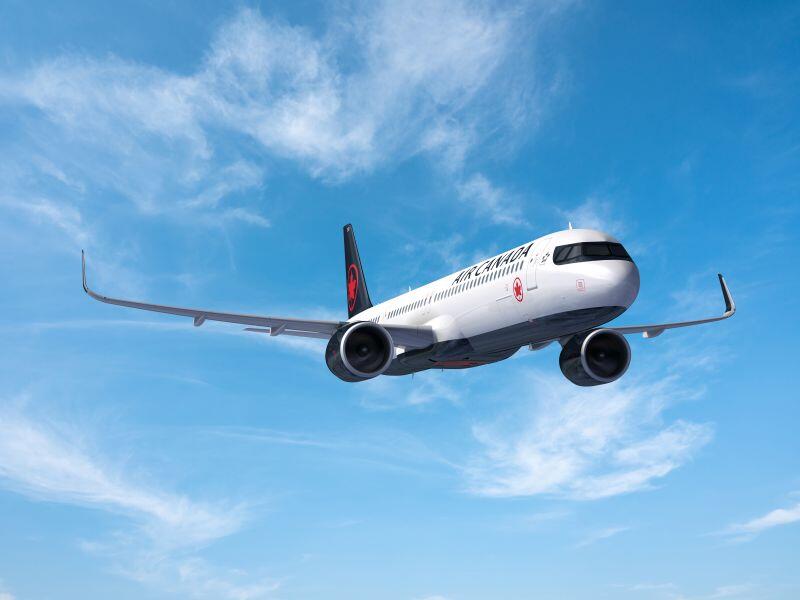
The first Airbus A321XLR is scheduled to arrive at Air Canada early this year, and the airline plans to debut the aircraft on seasonal service from Montreal to Palma de Mallorca. The aircraft will also be used on existing routes, including year-round Montreal–Toulouse and seasonal Montreal–Edinburgh sectors.
Additionally, the aircraft “also has a role to play within North America,” Galardo said. “Within the year, we will unveil plans to offer a consistent year-round A321XLR product on a set of routes to bolster our premium offering in North America.”
The airline also has placed an order for eight A350-1000s and purchase rights for eight additional aircraft. Di Bert said the firm aircraft are set to replace Air Canada’s oldest A330-300s. The Aviation Week Fleet Discovery database shows Air Canada has 18 A330-300s in operation and two aircraft inactive.
For 2025, Air Canada recorded a net income of C$644 million ($474 million) compared with C$1.7 billion the year prior. Operating revenues increased from C$22.2 billion to C$22.3 billion as expenses grew from C$21 billion to C$21.4 billion. In the fourth quarter, Air Canada’s net income was C$296 million, a reversal of a C$644 million loss in 2024. Revenues during the last three months of 2025 increased from C$5.4 billion to C$5.8 billion, and expenses fell from C$5.6 billion to C$5.4 billion.