Air Astana Sees Strong Network Growth Despite Airspace Disruptions

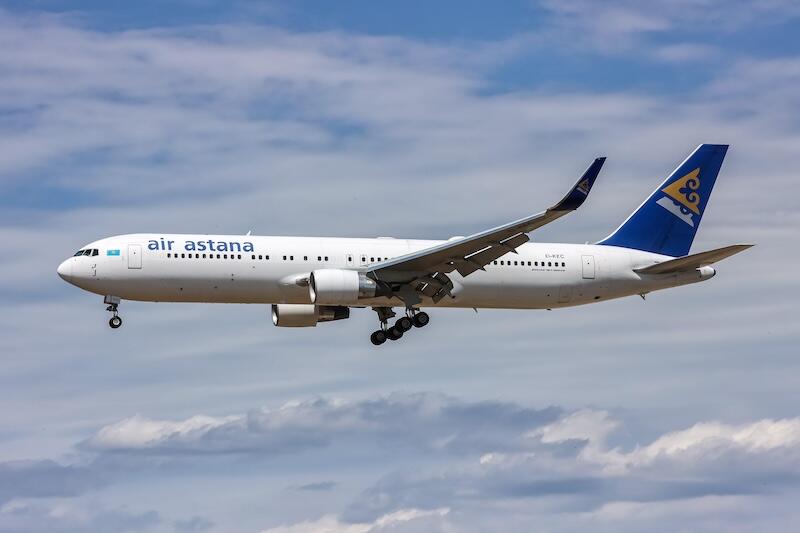
air astana 767
Credit: Zoonar GmbH/Alamy Stock Photo

Air Astana has reported strong network and capacity growth for the first half of 2025, overcoming operational headwinds caused by Middle East and India airspace closures and continuing its expansion into key Asian and Gulf markets.

The Kazakhstan-based group, which includes full-service Air Astana and LCC FlyArystan, added 20 new routes during the six months to June 30 and grew capacity by 17.8% year on year. CEO Peter Foster said that the primary growth markets included China, the Caucasus region, India and Saudi Arabia.

“Our sixth-freedom business—connecting traffic from Central Asia and the Caucasus onto the long-haul network and vice versa—has grown by 30% in the first half of 2025,” Foster added during an investor call on Aug. 6. He said that more flights and denser connectivity would drive further growth in this segment.

Air Astana currently operates 129 routes, including 91 international services. Foster said that the Chinese market has fully recovered from the pandemic and new routes such as Almaty-Guangzhou have been launched. In July, the carrier also upgraded its relationship with China Southern Airlines to a codeshare agreement across routes to Beijing, Urumqi and Guangzhou.

In India, the airline had temporarily suspended flights during May due to airspace closures amid India-Pakistan tensions, but has since resumed operations. “We were affected by those conflicts in May ... but that situation is now stable,” Foster said.

He added that while Indian carriers remain barred from using Pakistani airspace, Air Astana can continue to operate normally. “That’s perfectly good for us in the short term, but it's an unstable situation,” he said.

However, Foster confirmed that Indian demand is becoming increasingly significant: “Now well over 60% of passengers traveling on the routes to and from India are Indian nationals coming here as tourists and as businessmen. That is a trend we wish to accelerate.”

The group now operates a simplified fleet of 61 aircraft—34 with Air Astana and 27 with FlyArystan—comprising only Airbus A320-family aircraft and Boeing 767s. The retirement of its final Embraer E2 in May marked the completion of its fleet simplification strategy, resulting in the group’s most streamlined fleet since 2003.

The airline also concluded its A321LR modification program in June, equipping six aircraft with auxiliary fuel tanks to support longer-haul routes such as Almaty–London, Almaty–Frankfurt, Astana–Phuket and Astana–Nha Trang, with Almaty–Tokyo to follow from March 2026.

“Combined with our investment in our in-house MRO and ground service capabilities, we have increased our resilience, improved our passenger experience and enhanced the group’s efficiency,” Foster said. “These new capabilities and additional capacity have enabled us to demonstrate our resilience in the management of the ongoing industry-wide Pratt & Whitney GTF engine challenges.”

On the financial side, Air Astana Group reported total revenue and other income of $658.2 million for the 2025 first half, a 12.1% increase compared to the same period last year. Profit after tax rose to $10.7 million, up from $4.6 million, while earnings before interest, tax, depreciation, amortization and rent climbed to $157 million, with the margin improving to 23.9%.

David Casey

David Casey is Editor in Chief of Routes, the global route development community's trusted source for news and information.