Africa's Air Travel Is Surging, But Airlines Are Still Losing Money
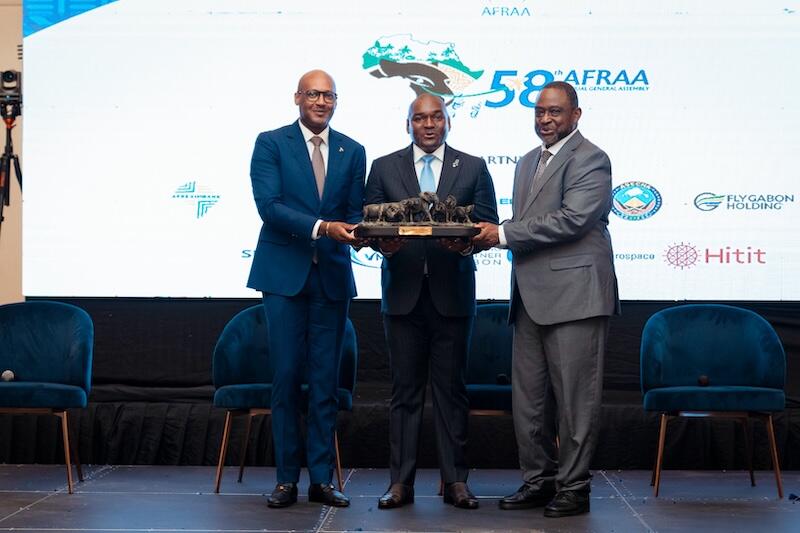
From left: FlyGabon CEO Nyl Moret Mba, Ulrich Manfoumbi Manfoumbi, Gabon’s transport minister, and AFRAA’s Abdérahmane Berthé at the 58th AFRAA AGM.
Credit: AFRAA
LIBREVILLE, Gabon—African aviation is growing faster than any other region in the world, but that growth is not yet turning into profit, industry and government leaders told the African Airlines Association (AFRAA) annual general assembly on Nov. 23.
Opening the event, held under the theme “African Aviation 2030: The Industry We Must Build,” Gabonese Transport Minister Ulrich Manfoumbi Manfoumbi said now is a pivotal moment for the sector and a milestone for African integration.
“Air transport is more than just a simple means of moving goods and people; it is a driver of economic growth, a factor in competitiveness, a catalyst for cultural exchange among our peoples, and an element of sovereignty,” he told delegates in Libreville.
According to AFRAA, African airlines carried 113 million passengers in 2025, up 15.3% and the strongest growth of any region. Abdérahmane Berthé, AFRAA’s secretary general, said the association expects more than 137 million passengers in 2026. Air transport supports 8.1 million jobs across the continent and contributes $75 billion to its GDP, he said.
Berthé stressed, however, that the potential remains largely untapped. Africa is home to nearly 19% of the world's population but accounts for only 2.6% of global air traffic and 2.1% of global cargo. Fewer than one African in 10 flies, and African airlines carry just 41% of passengers traveling on their own continent.
Profitability is the sharper concern. Citing the International Air Transport Association (IATA), Berthé said African airlines are expected to earn a net profit of barely $100 million in 2026, a margin of 0.2%. That works out to about 40 cents per passenger, compared with $2.10 in 2025.
He blamed a combination of factors, led by fuel—with jet fuel expected to average $152 a barrel in 2026, about 69% more than in 2025. Taxes and charges, blocked funds and a still-fragmented market also weigh on airline accounts.
Berthé said airlines need more from governments. Africa's fleet, now 755 aircraft, is expected to double by 2045, and three decisions rest with governments if that growth is to benefit Africans: cutting taxes and charges that make flying more expensive; repatriating blocked funds without delay; and fully implementing the Single African Air Transport Market (SAATM). “However, safety also remains our top priority,” he added.
Manfoumbi Manfoumbi said the disparities highlight both the sector's potential and “the distance we have yet to travel to transform our integration ambitions into concrete reality.” He said Gabon, at the heart of the continent, is “particularly sensitive” to the issue, describing connectivity as “not a luxury” but “an essential requirement,” especially as the country diversifies its economy.
He said it is at times easier for an African to travel to a city outside the continent than between two African capitals, with entrepreneurs traveling from Dakar to Nairobi and students moving between African cities facing complex itineraries. “Four in five potential routes remain unexploited,” he said.
The minister added that air transport liberalization must be tied to the African Continental Free Trade Area (AfCFTA), a pillar of the African Union's Agenda 2063. “If the AfCFTA acts as the engine of intra-African trade, then the liberalization of air transport serves as its circulatory system,” he said.
He urged AFRAA to oversee effective implementation of the Yamoussoukro Decision and to act as guarantor of the African Union's commitments. Institutions, he said, will be judged “not by the number of events organized or the number of declarations adopted, but rather by results that are visible to all.”
Manfoumbi Manfoumbi also praised Asecna, the air navigation agency, as a concrete example of African integration. After more than 30 years of effort, from the Yamoussoukro Decision to SAATM, the vision, institutions and legal frameworks are in place, he said. The question is the speed of progress.
“It is time to act,” he said, “concretely, collectively and courageously.”

Related Content