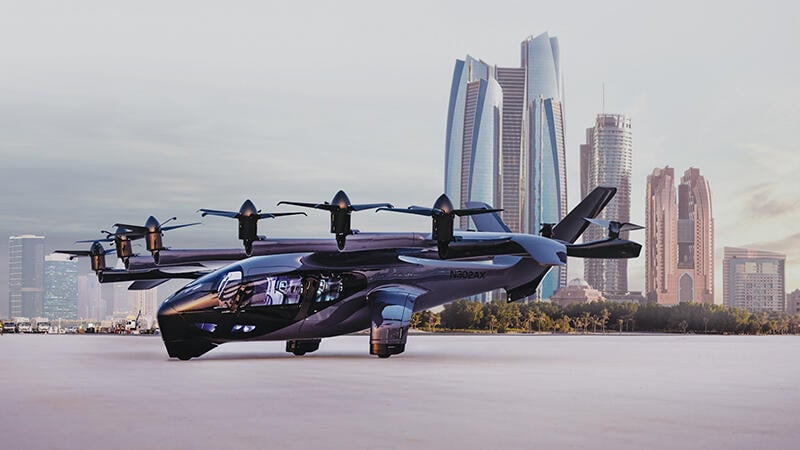
Archer is test-flying with its uncrewed Midnight prototype.
U.S. air taxi startups Archer and Joby Aviation are no longer providing firm guidance on when they plan their commercial launches in the U.S., reflecting uncertainty about the timeline to type certification with the FAA.
But both companies remain firm that they will carry paying passengers in the United Arab Emirates (UAE) by 2026—or possibly even earlier—part of the country’s top-down push to re-invent itself as a leader in technology, advanced mobility and smart cities.
The two companies have similar strategies. Joby, in partnership with the Dubai Road and Transit Authority and Skyports Infrastructure, is building out a launch network of several nodes connecting the Dubai International Airport with Dubai Down, Dubai Marina and Palm Jumeirah. The first vertiport—at Dubai International—is on track for completion in early 2026.
Archer, on the other hand, is targeting Abu Dhabi in partnership with the Abu Dhabi Investment Office, Abu Dhabi Aviation, Etihad Aviation Training, Falcon Aviation, JetEx and Air Chateau. The company has begun working to convert the first node in its planned network, the Abu Dhabi Cruise Terminal, into the first “hybrid vertiport” that can accommodate both traditional rotorcraft and eVTOLs.
Both Archer and Joby plan to sell their aircraft to local operating partners in their respective emirates, as opposed to the U.S., where they plan to operate their own Part 135 airlines.
Flight Testing
Archer and Joby have both achieved major milestones this summer by launching in-country flight testing with their eVTOL air taxis.
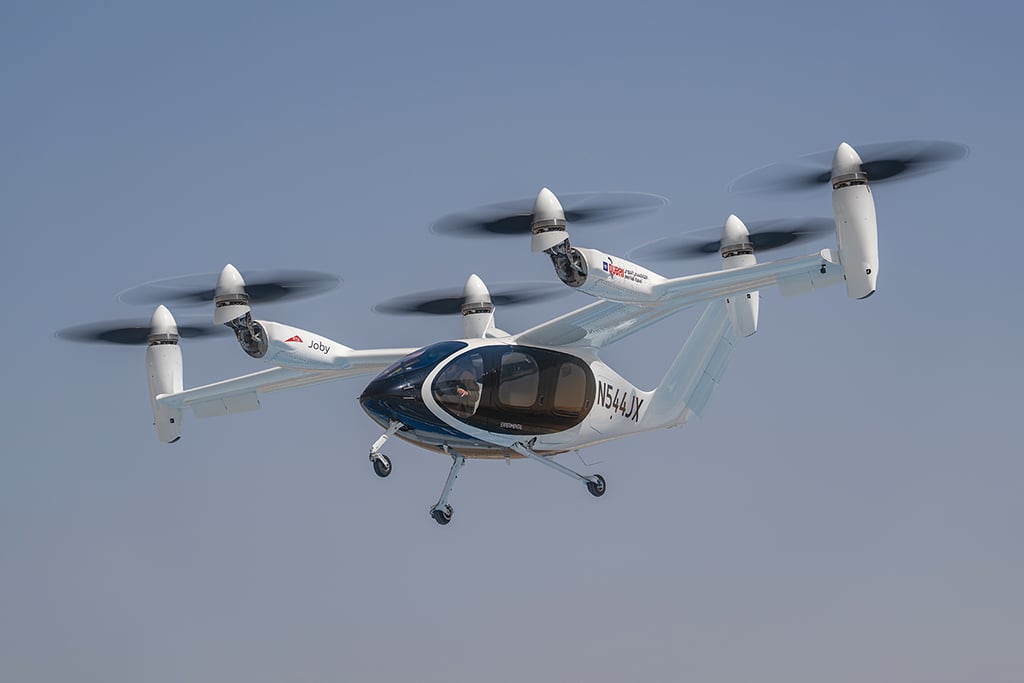
Joby beat Archer to the punch in June, when the company announced that one of its pre-production aircraft, registered tail number N544JX, had completed a first piloted flight in the country. In August, the startup announced the conclusion of the first phase of its flight test campaign there, which consisted of 21 flights, mostly away from people and busy areas, and covering complete piloted transitions between thrustborne hover and wingborne cruise.
Temperatures reached as high as 110F, and the aircraft performed well considering the heat and humidity, says Didier Papadopoulos, Joby’s head of aircraft OEM.
Papadopoulos says that Joby had multiple goals heading into the first stage of testing. Those included evaluating the aircraft's performance in the desert environment, setting up a product support organization, assessing its flight operations and deepening collaboration with the Gulf Civil Aviation Authority (GCAA) and other regulatory bodies.
“The focus for us was to set up a takeoff and landing spot that’s representative of what we might see in real operations; set up a maintenance and repair center somewhere that’s representative of what we might see; and then start exercising these missions,” Papadopoulos says. “We did about 21 missions of various profiles there during stage 1, and later stages will eventually progress into moving into the cities, progressively carrying passengers and then moving into the commercialization phase.”
With the start of local flight testing, Joby Chairman Paul Sciarra says that he believes Joby is on track to launch into some type of commercial service in Dubai as soon as later this year or early next, adding that Gulf regulators may be able to “streamline” or “fast-track” certification relative to the FAA.
“We’re going to move to commercial service,” Sciarra says. “We’ve guided for the end of this year, early next year, and we feel really good about that timeline.”
Archer
Archer began its flight-test campaign in Abu Dhabi in early July. But in contrast to Joby, the startup is flying with its uncrewed “Midzero” prototype.
An Archer spokesman said in an emailed statement that the flights are intended to gather data on how the aircraft performs in desert environments, while also beginning to stand up its Launch Edition initiative, in which it partners with local operators in international markets like the UAE, Ethiopia and Indonesia.
Unlike Joby, Archer is selling aircraft to those partners and expects to receive “low tens of millions” in revenues over the next 18-24 months, CTO Tom Muniz said on an August conference call, adding that the startup plans to build up a “small fleet” of test aircraft in the UAE going forward.
In terms of infrastructure, Archer does not plan to build new vertiports in the near term, but prefers to lean on its partners to electrify their existing helipads and FBO terminals—for example, JetEx at Al Bateen Executive Airport or Falcon Aviation at the Abu Dhabi Cruise Terminal at Zayed Port.
Archer has already delivered its first flight simulator to Etihad Aviation Training to begin instructing the first batch of pilots in Abu Dhabi. Toward that aim, the GCAA has released new regulations for hybrid vertiports that accommodate both helicopters and eVTOLs.
The test flights now underway will culminate in market survey flights, in which Archer plans to operate non-revenue trials of the types of routes and missions it will perform in commercial service. The company has previously said that service could potentially be launched as soon as late 2025 or early 2026.
An Archer spokesperson said in an emailed statement that the flights are intended to gather data on how the aircraft performs in desert environments.
“This is particularly important in the UAE, where high temperatures are a common occurrence,” the spokesperson said. “It was also an opportunity to stand alongside our partners to mark the beginning of our Launch Edition program in the region. There are a lot of milestones ahead on the road to commercialization that we will work toward with our partners.”
But some observers reacted with puzzlement about the decision to send an uncrewed demonstrator to the UAE.
“It is not clear to me what the benefit is of sending a demonstrator that does not represent the production aircraft to fly in the UAE,” Sergio Cecutta from SMG Consulting says. “I think this is another confirmation of the difference in progress between Archer and Joby: one is flying an unpiloted prototype, the other is flying a piloted preproduction aircraft.”
Commercialization
While Archer and Joby are remaining quiet on the precise timing of their U.S. launches, both are confident they can launch sooner in the UAE.
“The GCAA is 100% aligned with the FAA approach—we might just get to execute faster with the GCAA, depending on the support and emphasis we get there,” Papadopoulos says. “But ultimately, they are both the same, and one could be first versus the other. They’re not necessarily coupled from a [type certification] standpoint.”
“My whole theory is we have to monetize these businesses at some point,” Archer’s founder and CEO Adam Goldstein says. “I’ve always said we’re trying to find the most efficient path to commercialization, and that’s what this is all about.”