This article is published in Aviation Daily part of Aviation Week Intelligence Network (AWIN), and is complimentary through Dec 16, 2025. For information on becoming an AWIN Member to access more content like this, click here.
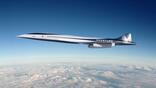
Boom Supersonic is developing an industrial gas turbine version of its Symphony turbofan to power AI data centers, providing a technical and financial boost toward its goal of building the Mach 1.7 Overture airliner later this decade.
Dubbed Superpower, the natural gas-fueled Symphony derivative has been launched by Crusoe, an energy company building the first Stargate AI data center in Abilene, Texas. Crusoe has ordered an initial batch of 29 Superpower units, each of which will have a full-rated output of 42-megawatts at ambient temperatures of more than 110C.
In parallel with the Superpower order, Boom has also closed a $300 million funding round which the company says, together with the AI gas turbine deal, will be sufficient to complete development of the Symphony and initial Overture aircraft. At the same time, Boom says work on the Superpower gas turbine will augment the development of Symphony by adding thousands more test hours of the common core.
The $300 million funding round was led by Darsana Capital Partners, with participation from Altimeter Capital, ARK Invest, Bessemer Venture Partners, Robinhood Ventures and Y Combinator. “The logic of it is this [round] funds the engine program through to shipping the Superpower turbine which then, in turn, funds the Overture airliner. So, this is the last round of capital we ever need to raise,” says Blake Scholl, Boom founder and CEO.
“One of the biggest challenges with this is how you fund it. But we have now raised the last money we need to ship the turbine, and then we use the turbine revenue to fund the airplane,” Scholl tells Aviation Week.
Planning for the Superpower derivative began in March following a call to Scholl from Sam Altman, CEO of OpenAI, which is a collaborator with Crusoe on Stargate and an earlier Boom investor, and Cully Cavness, co-founder of Crusoe AI.
“They said to me the limiting reagent for artificial intelligence is electricity. We can't get enough. The grid is way backed up, so we must make our own. We've bought all the turbines we can get, and we have racks of GPUs and nothing to plug them into. Can you make us a turbine and how quickly can you do it?” Scholl recalls.
The large high-pressure core configuration of the Symphony, which is designed to operate at high temperatures and high thrust for the bulk of the Overture’s mission, makes it highly suitable for use as an industrial gas turbine, says Abhir Adhate, Boom's lead on engine performance and the cold section.
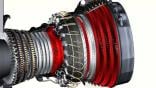
Based on the same six-stage high-pressure (HP) compressor and single-stage HP turbine as Symphony, the Superpower core “will have a custom low [pressure] spool around it to pressurize even further,” Adhate says. “But since we don't have to go Mach 1.7 our temperatures are lower, so we have a lot more headroom. We will also have a free power turbine on the back that takes all the exhaust gas and generates electricity,” he adds.
Other changes to the Symphony configuration for the Superpower will include a dual fuel combustor capable of burning either liquid natural gas or diesel fuel. Boom adds that building on the Crusoe order, which represents a $1.25 billon launch backlog, it aims to ramp up Superpower production to over 4 gigawatts annually by 2030.
Boom’s relatively large core and low-bypass-ratio Symphony supersonic engine design makes it unusual compared to today’s commercial subsonic engines, Adhate says. “The general trend has been especially for subsonic engines to go to smaller cores. We have a big core because the aircraft wants a turbojet, but we have a turbofan to try to balance noise and performance. So, we have a big core for even the 3:1 bypass ratio that we're going for. The result is it makes a pretty good heart for an industrial gas turbine.”
Supporting Symphony
The Superpower development program is “directly on the path for Symphony,” Scholl says. “We'll have the first fully integrated 42-megawatt unit on a test stand at the end of next year,” he adds. The initial Symphony core, now being assembled by Florida Turbine Technologies (FTT), is now due to begin tests at Boom’s site in Watkins, Colorado, before mid-2026. “In parallel, we are building the first twin spool, or really three-spool, if you want to include the free power turbine,” Scholl says.
Although the gas turbine side venture could be potentially viewed as a distraction from the company’s supersonic airliner project, “I see it really as huge accelerant for the whole program,” says Nick Sheryka, Boom's vice president of engine programs. “Now we have a paying customer, and it's going to accelerate the activation of an initial rate production factory facility.”
The Superpower will also provide a baseline endurance proving ground for the Symphony core, Scholl says. “Basically, every ground power unit is effectively a reliability testbed for the aero engine. We're going to get hundreds of thousands of hours of ground test data essentially for free—actually better than for free, as we will get paid for it,” he adds.
The experience will also bolster Boom position's as it enters the certification process, Scholl says. “We'll be able to go to the FAA and say, ‘We know we are the new kid on the block here, but we're walking in with the most tested new engine core that anyone has ever brought you.’ I don't know if we'll get formal certification credit for that, but I think it will help with everyone's confidence,” he says, adding, “It'll certainly help with our confidence.”