Digital Twins Come of Age
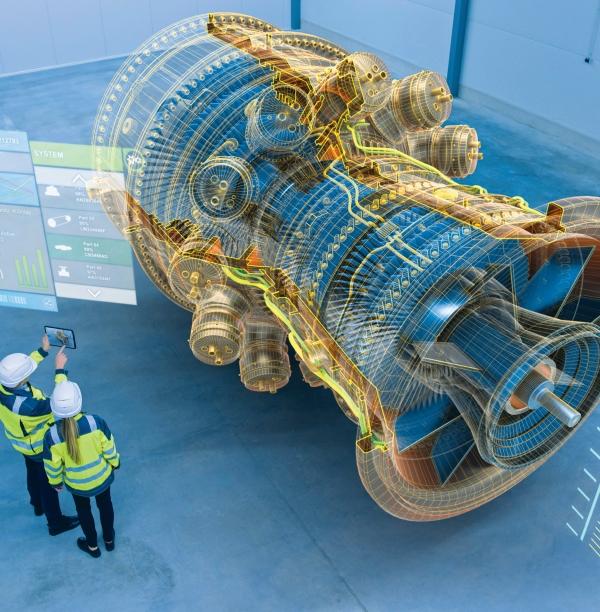
Digital Twins Come of Age: Faster, More Accurate Performance Prediction for Aerospace Assets
Aerospace programs continue to face pressure to improve asset performance, reduce engineering cycle time, and strengthen lifecycle economics without compromising safety. Digital twin technology is emerging as a practical way to achieve these goals. It combines high-fidelity simulation, sensor data, and predictive analytics to provide actionable insights into how components behave under real operating conditions.
Traditional digital twins built on full-order physics models have been effective, but they are slow and computationally intensive. Their complexity makes them difficult to use in production environments where decisions must be made quickly. A more operationally viable approach is now taking hold: Reduced Order Modelling (ROM). ROM-based digital twins retain essential physics but run fast enough to support real-time or near-real-time engineering decisions. A recent Quest Global analysis demonstrates how ROM-based models significantly accelerate performance prediction, manufacturing non-conformity disposition, and remaining functional life assessment for aero-engine components.
A More Practical Digital Twin for Aerospace Operations
The article defines a digital twin as a virtual copy of a physical asset, continuously updated using sensor data and linked to an analytics platform capable of predicting future behavior. This twin architecture comprises four key elements: the physical asset, the virtual model, a data layer that synchronizes real and virtual states, and an analytics or IoT platform that interprets the data and delivers actionable insights.
Instead of attempting to model an entire engine, the approach focuses on component-level twins where accuracy and speed directly influence cost, safety, and turnaround time. In the Quest Global work, ROMs were generated by running a DOE using high-fidelity CFD and structural simulations, then using this dataset to train a surrogate model. Once validated, the ROM can be connected to sensor inputs and integrated into a predictive analytics workflow, eliminating the need for repeated full-order simulation runs.
The article also illustrates three scenarios where ROM-based twins deliver measurable engineering and operational value. Rather than treating them as isolated demonstrations, they underscore a broader theme: when a digital twin is grounded in validated physics and aligned with real data streams, it becomes a versatile decision-support tool across the asset lifecycle.
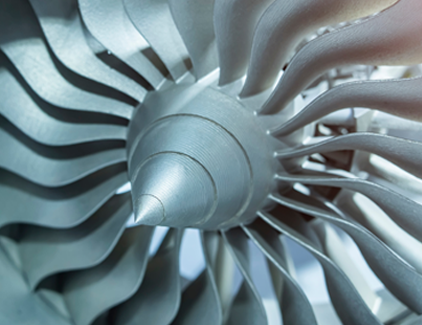
Faster Thermal Margin Assessments for High-Pressure Turbine Blades
For propulsion engineers, High-Pressure Turbine (HPT) blade temperatures are a critical indicator of performance, thermal margin, and material degradation. In the article, a ROM constructed from CFD data achieved approximately 99% fidelity relative to traditional CAE predictions.
The major advancement is speed. The ROM allows engineers to evaluate maximum blade temperatures under varying throttle settings, flight conditions, or mission profiles in seconds rather than hours. The architecture is also engineered for future connection to FADEC or engine health-monitoring sensor data, enabling near-real-time thermal awareness on test stands or fielded engines.
For OEMs and MROs, this capability provides:
- Faster understanding of thermal risk during development
- More responsive analysis during flight test or engine teardown
- Reduced reliance on repeated full-order simulations for routine assessments
This marks a meaningful step toward embedding physics-based thermal intelligence directly into propulsion health-monitoring ecosystems.
Reducing Manufacturing Disposition Time on the Production Floor
Production systems across commercial and defense aerospace continue to ramp up. Every dimensional deviation or geometric mismatch flagged during inspection must be assessed for fitness-for-flight. Traditional finite-element-based disposition cycles can take days per case, an unsustainable pace when programs are trying to hit aggressive delivery targets.
The article examined a Low-Pressure Turbine (LPT) disc with parameterized geometry variations representing real shop-floor findings. ROMs were trained using DOE data to predict stress and fatigue life across a wide envelope of deviations.
With the ROM integrated into a predictive analytics portal, engineering disposition time was reduced by more than 90%, without compromising the confidence levels associated with full CAE-based evaluations.
For manufacturing organizations, the impact is significant:
- Fewer unnecessary scrap decisions on high-value rotating hardware
- Higher throughput during quality inspection
- More consistent engineering interpretation of deviations
- Better alignment with production-rate commitments
This directly supports many OEMs’ ambitions around Model-Based Definition (MBD) and digital-thread integration—providing a faster, evidence-driven path from inspection finding to engineering signoff.
Smarter, Mission-Informed Remaining Useful Life (RUL) Forecasting
Unlike automotive maintenance cycles, replacement intervals for turbomachinery cannot depend solely on hours or cycles. Missions vary. Temperature profiles vary. Environmental exposure varies. That variability makes static assumptions increasingly inadequate for modern fleets, especially in military aviation, where utilization patterns can be unpredictable.
ROM-enabled digital twins allow operators to tie life usage directly to actual operating conditions rather than nominal models. In the article, ROM-based twins were connected to operational parameters to compute life depletion in a physics-informed way.
This unlocks several strategic benefits:
- Condition-based maintenance (CBM) aligned to DoD and industry sustainment strategies
- Reduced unnecessary removals during shop visits
- Better availability forecasting for high-value spares
- Improved alignment with reliability-centered maintenance (RCM) programs
As propulsion systems become increasingly sensor-rich and sustainment budgets remain under scrutiny, the ability to model life usage dynamically will be essential for readiness planning across both commercial and defense fleets.
What This Means for the Aerospace & Defense Ecosystem
Across all three use cases, the article demonstrates that ROM-based digital twins can address multiple industrial challenges, including speeding up the visualization of performance parameters, reducing the time required to validate manufacturing non-conformities, and enabling more informed life predictions for critical components.
The article reinforces that the same underlying framework—validated virtual models, synchronized data, and an analytics platform—can support a wide range of lifecycle needs, from manufacturing quality decisions to in-service performance management.
For aerospace OEMs and operators, these results suggest a path toward integrating digital twins into existing engineering and maintenance workflows, without depending exclusively on full-order models or long analysis cycles. By focusing on carefully chosen use cases where prediction accuracy and speed directly affect cost and risk, digital twins can move from being an abstract concept to a practical tool used daily in decision-making.
Conclusion
In the referenced Quest Global analysis, digital twins constructed with reduced-order models were demonstrated to achieve near-CAE accuracy for key engine performance metrics, while significantly reducing analysis time, particularly in the context of validating manufacturing non-conformities. The same twin framework was also used to support better predictions of remaining life for critical turbomachine components.
These findings highlight how digital twins are transitioning from potential to practice in aerospace asset management. When grounded in validated simulation data and connected to real-world sensor inputs, ROM-based twins can help stakeholders make faster, more confident decisions about performance, quality, and lifecycle planning, moving the technology from promise to practice in aerospace and beyond.
Author: Vijayasarathy Narasimhan- Principal Engineer, Automation Solutions, Quest Global; Co-author: Pranav Kumar Prakash- Technical Manager, Quest Global