This article is published in Advanced Air Mobility part of Aviation Week Intelligence Network (AWIN), and is complimentary through Jan 09, 2026. For information on becoming an AWIN Member to access more content like this, click here.

Wisk Completes First Flight Of Gen 6 Autonomous eVTOL

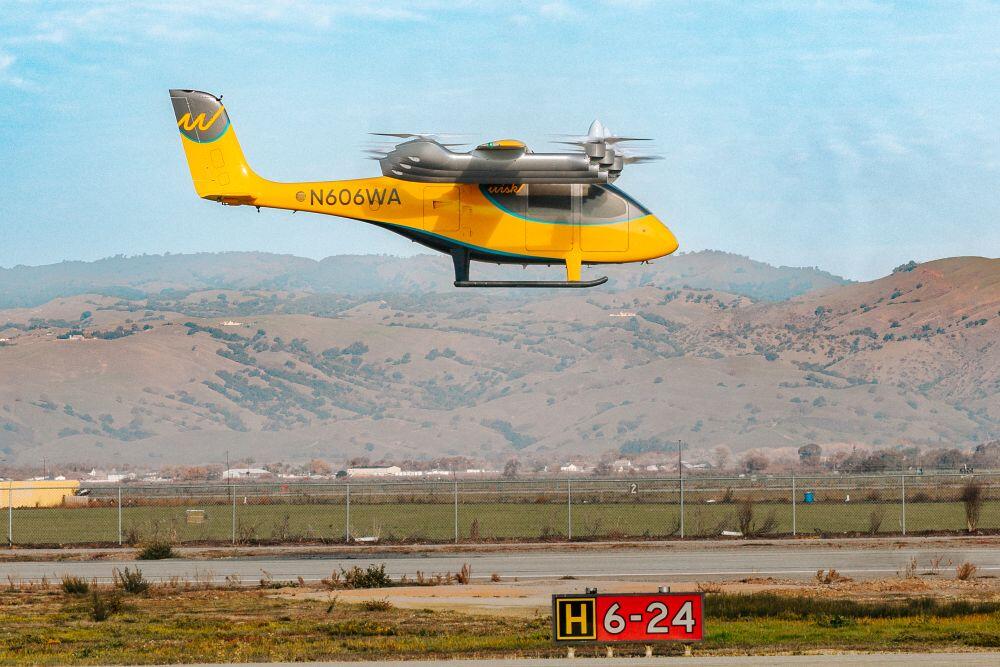
Wisk plans to certify its autonomous air taxi before the end of this decade. Credit: Wisk Aero

Wisk plans to certify its autonomous air taxi before the end of this decade.

Credit: Wisk Aero

Wisk Aero has completed the first flight of its full-scale Gen 6 autonomous eVTOL air taxi, marking a significant step in its plan to develop and certify one of the world’s first uncrewed passenger-carrying aircraft.

The untethered hover flight took place at Wisk’s flight test facility in Hollister, California, and involved the fully autonomous execution of a preprogrammed flight plan rather than remote piloting. The aircraft performed a vertical takeoff, hover, limited forward movement and landing, remaining airborne for slightly more than 30 sec., according to Guillaume Beauchamp, Wisk’s senior director of aircraft development.

“This was not a remote-piloted flight,” he told Aviation Week in a briefing following the flight. “We started using our autonomous system, which is meant to receive a flight plan. You send a flight plan to the aircraft, and it goes and flies that flight plan—exactly as commanded.”

Beauchamp said the first flight represents the culmination of roughly four years of work, beginning with early Gen 6 design concepts and progressing through internal gate reviews, manufacturing and extensive ground testing. That effort included component- and system-level testing, continuous software development and a range of vehicle-level tests. In addition to traditional ground vibration testing, Wisk conducted restrained hover tests to validate propulsion, control laws and structural behavior before committing to free flight.

“All that effort was really about making sure the system was ready,” Beauchamp said. “This first flight is just unlocking many more flights to come, where we start demonstrating that the configuration flies well and that all the systems on board work as intended.”

With the initial hover complete, Wisk is now transitioning into a structured flight test campaign focused on validating control laws and aircraft dynamics before expanding the flight envelope. Beauchamp said near-term sorties will concentrate on what the company refers to as “chirps,” or short, deliberate control inputs used to see how the aircraft reacts in flight and to check that real-world behavior matches predictions from models and simulation.

“You’re in hover and you ask the control laws to give a boost to a motor or make a small change,” he said. “You see how the aircraft responds, and you collect data to mature the control system before you start going faster and higher.”

From hover, Wisk plans to perform low-speed maneuvers forward and sideways before advancing into transition from thrustborne to wingborne flight. Beauchamp said the company expects to reach transition testing in roughly six months, a timeline he described as achievable given the amount of preparation completed ahead of first flight. Demonstrating stable transitions, including with simulated failures, will be a key indicator that the design is on track.

A central goal of the flight test campaign is validating Wisk’s models and simulations against real-world data. Early flights are intended to confirm that predicted aircraft behavior closely matches what is observed in flight, providing confidence that simulation can be relied on for large portions of the certification effort.

Wisk has already entered formal certification work with the FAA and is progressing through early phases of its type certification program while submitting increasingly detailed technical documentation. Beauchamp emphasized that validating autonomous behavior cannot rely on flight testing alone. “There is no way you can demonstrate robustness only by flying,” he said. Instead, Wisk is combining flight data with extensive simulation, running tens of thousands of scenarios that introduce variables such as winds, weather and mechanical failures using the real flight software in the loop. He likened the approach to certification methods used for advanced automation in conventional aviation, such as autoland systems.

Looking ahead, Beauchamp said Wisk is targeting a significant increase in flight test cadence beginning in 2026, with the goal of flying individual aircraft multiple times per day, several days per week. A second Gen 6 aircraft is already more than 90% complete and is expected to begin ground testing early next year before joining the flight test fleet.

Beauchamp said that Wisk still believes it is on track to certify the Gen 6 before the end of the decade.

Ben Goldstein

Based in Boston, Ben covers advanced air mobility and is managing editor of Aviation Week Network’s AAM Report.