This article is published in Advanced Air Mobility part of Aviation Week Intelligence Network (AWIN), and is complimentary through Feb 12, 2026. For information on becoming an AWIN Member to access more content like this, click here.
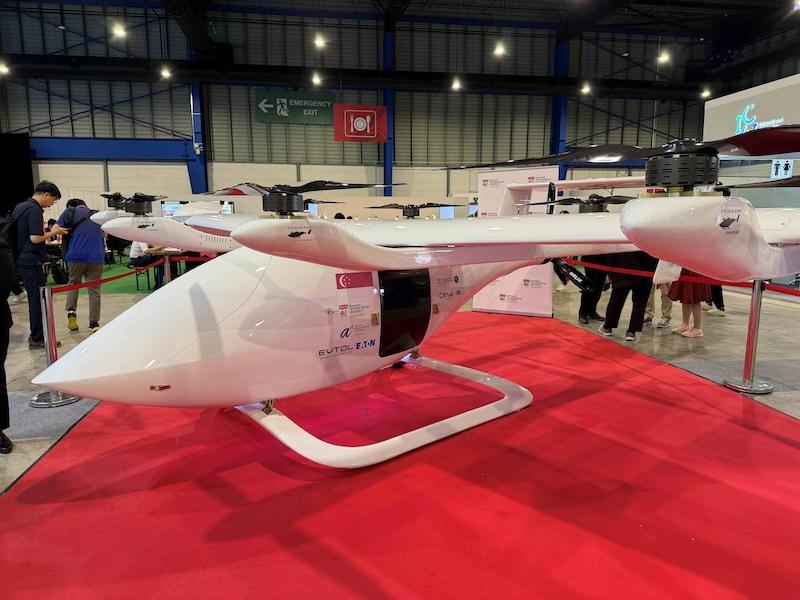
SINGAPORE—A subscale electric-vertical-takeoff-and-landing (eVTOL) demonstrator has been unveiled by Singapore’s Nanyang Technological University (NTU) and is expected to pave the way for a four-passenger, full-scale vehicle targeted for certification in 2030.
Developed over the past three years by a team led by rotorcraft designer James Wang—also well known for designing the AgustaWestland (now Leonardo) Project Zero eVTOL demonstrator—the lift-plus-cruise NTU aircraft is configured with eight pylon-mounted lift rotors and a single, three-blade pusher propeller.
“We have introduced a high voltage (400-volt) battery system which is more efficient, so we can have fewer harnesses,” says the project’s chief engineer, Xin Li. “That’s the key technology for electrical aircraft, because high voltage is rarely involved in traditional aircraft,” she adds.
For the full-scale 2.5-ton eVTOL, with a 500-kg (1,100-lb.) payload, “we will have to use 800 volts to save more weight on the harnesses,” Xin says. Compared to the 7.8-m (26-ft.) wingspan of the demonstrator, which conducted its first tethered hover in September, the production eVTOL will have a wingspan of 13 m.
Each of the demonstrator’s lift motors is rated at 11 kW, but with a potential maximum rating of 16 kW. In case of a motor failure, Xin says the electric power distribution system is designed to automatically maintain vehicle attitude by cutting power to the corresponding lift rotor on the opposite side of the aircraft. The pusher propeller is rated at 50 kW—slightly higher than required for the demonstrator. “We prefer to have more power,” Xin says.
Power is provided by a set of lithium-ion batteries configured in cylindrical cells, she adds.
Although initial hovering tests have been conducted in Singapore, Xin says more extensive flight tests, including transition to forward flight, will be undertaken at a site operated by German aerospace center DLR. DLR is a partner on the program along with Eaton, the EVTOL Research and Innovation Center and other academic and industrial contributors.