This article is published in Business Aviation & AAM Report part of Aviation Week Intelligence Network (AWIN), and is complimentary through Jan 15, 2027. For information on becoming an AWIN Member to access more content like this, click here.
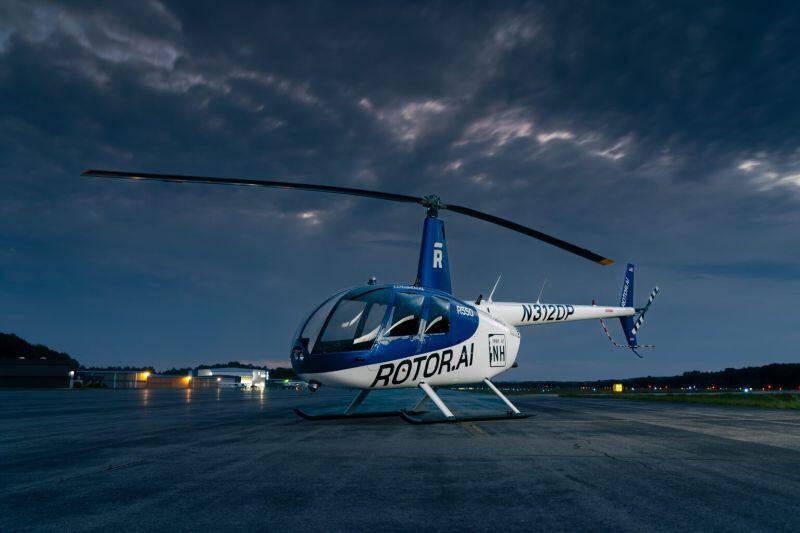
Rotor’s RPX system replaces conventional cockpit controls with a fly-by-wire architecture, sensors and remote pilot interface.
NASHUA, New Hampshire—Rotor Technologies is advancing toward scaled production of unmanned R44 aircraft by integrating its autonomy system into Robinson Helicopter’s assembly line.
The shift marks a turning point for the startup, which has spent the past several years developing remotely piloted versions of the Robinson R44 from its headquarters on a former aviation college campus here. What began as a small-scale, in-house development effort—combining software development, flight testing and hardware integration—is now evolving into a production program tied directly to an established original equipment manufacturer (OEM).
“We have very complementary skill sets in the sense that Robinson has decades of experience building helicopters with strong operational history, but they don’t focus on software or autonomy,” Rotor founder and CEO Hector Xu said. “We are focused on building intelligent flight systems and autonomy, which makes us a natural partner. Together we can deliver products that neither company could produce on its own.”
Marketed as the RPX flight system, Rotor’s autonomy suite replaces conventional cockpit controls with a fly-by-wire architecture, sensors and a remote pilot interface, allowing the aircraft to be operated from the ground. At the company’s Nashua facility, that interface is a cockpit-like ground control station with cyclic, collective and pedals, paired with multiple video feeds and system displays streamed from the aircraft.
The company has already delivered a small number of aircraft by converting used R44s, but Xu said the retrofit model quickly revealed its limitations as customer interest grew.
“It became clear that it would not be possible to build hundreds of aircraft through retrofits, and that serious operators want new aircraft built by the OEM,” he said. “If there is strong demand in the aftermarket, it means the manufacturer should be serving that need directly. That is what we are now doing by integrating our technology into the production line.”
That integration is now underway. The first factory-built unmanned R44—branded as the R44 Airtruck—is progressing through Robinson’s Torrance, California, assembly line, with Rotor engineers working alongside Robinson teams to embed the autonomy system during production rather than after delivery.
As part of the two companies' agreement, the Airtruck and Sprayhawk are now owned and will be produced and sold by Robinson Helicopter and its Robinson Unmanned division, with Rotor supplying the autonomy technology.
For Rotor, the move marks a transition from experimentation to industrialization. Early aircraft were produced at a rate of roughly one per quarter, with gradual increases as processes improved, but Xu said scaling beyond that level requires OEM involvement.
“We are currently at a point where production is one or two aircraft, but over time there will be dedicated capacity for these unmanned products,” Xu said. “We expect to ramp up to dozens of aircraft per year in the near term. Longer term, we believe production could reach into the hundreds annually as demand develops.”
Rotor is targeting missions that avoid the regulatory and technical barriers associated with passenger transport, focusing instead on applications such as cargo logistics, agriculture, inspection and firefighting support. Those use cases can typically be conducted without onboard crew and in less congested environments, making them more feasible under current regulatory frameworks.
While the company initially emphasized its Sprayhawk agricultural variant, Xu said near-term demand has increasingly shifted toward the cargo-configured Airtruck, which offers greater flexibility across mission types.
“The Airtruck has turned out to be a much more versatile platform for early customers,” he said. “It can support logistics, firefighting, inspection and other missions where flexibility is critical. Sprayhawk remains a very large market, but it is a more specialized application.”
That versatility is also shaping how operators use the aircraft.
Rather than directly replacing crewed R44s, Xu said unmanned systems are often being deployed in roles currently filled by larger, more expensive aircraft—or in missions that would not otherwise be flown.
“In many cases, operators are not replacing an R44 but replacing a much larger and more expensive aircraft,” he said. “For example, offshore logistics missions today might use a turbine helicopter costing thousands of dollars per hour. With an unmanned aircraft, you can perform the same mission at a fraction of the cost because you are fundamentally changing the safety model.”
Technically, Rotor continues to emphasize a stepwise approach to automation. The aircraft are operated by remote pilots using conventional controls, while software handles routine functions such as waypoint following and stability augmentation. Over time, the company says the pilot role will gradually shift toward supervision rather than remote piloting.
“Fundamentally, this is a remotely piloted aircraft system,” Xu said. “We use the word autonomous mostly as a marketing term, but in practice there is always a remote pilot monitoring and controlling the aircraft. By law and from a practical perspective, you’re always going to have a remote pilot monitoring and controlling it.”
The unmanned R44 integrates multiple layers of sensing and communication, including cameras, lidar and redundant data links spanning radio, cellular and satellite networks. Rotor has focused heavily on low-latency control and human-machine interface design, aiming to preserve the feel of conventional helicopter flight while reducing workload.
Regulation remains a key factor in scaling operations, though Rotor’s focus on non-passenger missions simplifies the path. In the U.S., the company is pursuing a Section 44807 exemption, which would allow broader commercial operations for large unmanned aircraft. Meanwhile, in other markets, such as Brazil, regulators have already approved certain use cases.
For Xu, the company’s approach—building on an existing aircraft platform, partnering with an OEM, and targeting lower-risk missions—is a deliberate contrast to more ambitious autonomy efforts focused on passenger transport.
“We feel like we are at a point where everything is structurally in place for us to succeed,” he said. “We have the technology, the partnership and the demand signals from customers. Now the focus is on executing and delivering aircraft into real-world operations.”

Related Content