This article is published in part of Aviation Week Intelligence Network (AWIN), and is complimentary through Oct 14, 2026. For information on becoming an AWIN Member to access more content like this, click here.
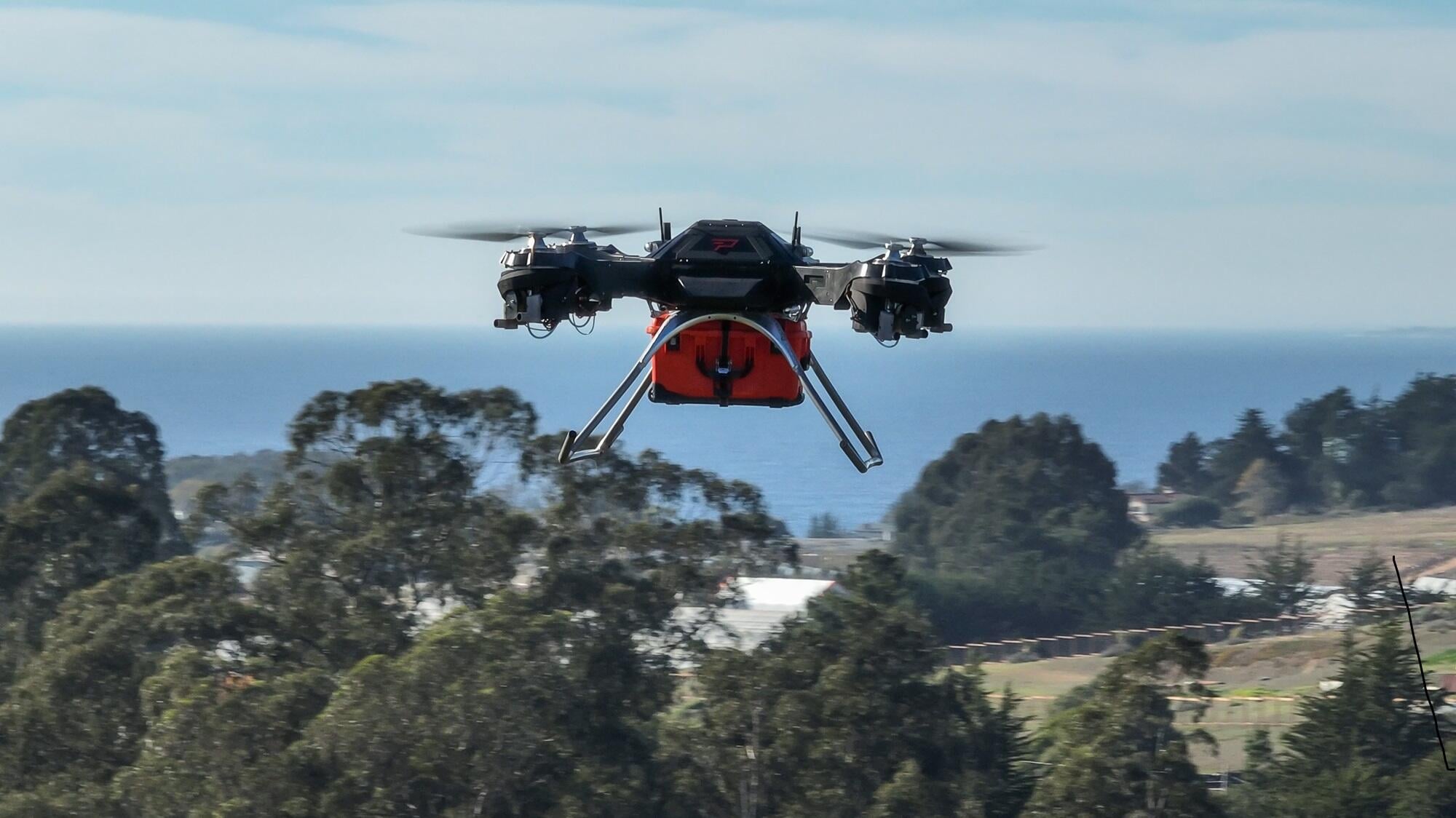
California-based startup Parallel Flight Technologies has received an award from the U.S. Office of Naval Research to develop a maritime version of its Firefly hybrid-electric, heavy-lift UAV.
The $3.74 million Sequential Phase II Small Business Innovation Research (SBIR) award will see the startup modify its Firefly drone to operate from naval vessels, work that will involve heavy fuel compatibility, advanced deck-landing sensors, saltwater corrosion protection, flotation devices, deck-locking mechanism and expanded beyond-visual-line-of-sight (BVLOS) testing, Parallel Flight Technologies says.
The modified Firefly will be capable of supporting advanced naval missions including mine countermeasures, underwater vehicle detection and hydrographic surveys, the company says.
Founded in 2018, Parallel Flight Technologies has developed the Firefly, a quadcopter UAV that uses a parallel hybrid electric multirotor propulsion system, in which each arm houses a hybrid pod that contains both a combustion engine and brushless electric motor, intended to combine the high energy density of liquid fuel with the superior controllability and redundancy of electric motors.
The company says the endurance of the Firefly is 10 times greater than all-electric drones, with the ability to supply 2 kW of continuous inflight power. The drone can carry payloads up to 100 lb. for 82 min.; a 50-lb. payload up to 3 hr.; and 10 lb. for 5 hr., according to Craig Stevens, the company’s CEO.
“It’s kind of like a mini-Prius at every prop, except we don’t run in all-electric mode,” Stevens says. “Basically, you have two parallel paths of energy going to the propeller. On the one side, you have an internal combustion engine directly connected through a gearbox to the propeller, and that allows the engine and the prop to run at their optimal rpm. Then, in parallel to that, you have an electric motor as well.
“While you’re flying, the internal combustion engine is told to go to a particular rpm based on flight requirements, and internal combustion engines are typically very laggy and slow to respond, so flying with those only would not be very successful in a quadcopter,” Stevens says. “To improve the flight dynamics, we use the electric motor to basically help us hit the targeted rpms from a flight control standpoint. The electric motor helps the internal combustion engine get to target rpm either by speeding it up or slowing it down.”
“When we slow it down, we actually go into a regen mode and basically harvest some of that energy out of that drivetrain, and then put that energy on the power bus, and that energy can be used by other drivetrains,” he adds.
Originally conceived as a firefighting drone, Stevens says the company has pivoted to focusing more on the defense market. But he also sees opportunities for civilian applications, including agriculture and missions that require carrying heavy sensors.

Related Content