This article is published in Advanced Air Mobility part of Aviation Week Intelligence Network (AWIN), and is complimentary through Dec 20, 2025. For information on becoming an AWIN Member to access more content like this, click here.
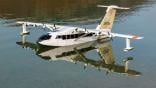
Lodd's Hili performs a hop in Al Ain just days before the Dubai Airshow.
AL AIN, United Arab Emirates—Lodd has begun flight trials of its autonomous, hybrid-electric vertical-takeoff-and-landing Hili cargo aircraft which aims to replace the trucks and aircraft that are linking logistics hubs with distribution centers.
The Abu Dhabi-based company’s vehicle takes off and lands using eight electrically powered rotors and a combustion engine driving a pusher propeller for cruise. The proof-of-concept vehicle flew for almost two minutes on Nov. 13 in what the company called the first official flight. LODD-01 took off, hovered at around 15 ft. and performed some basic maneuvers without transitioning into forward flight before landing.
The hop came little more than a year after the 2023-founded company flew a 30%-scale prototype before starting to build the first-flight vehicle this year.
Lodd has opted to focus on the middle-mile sector, which it sees as the main bottleneck in the logistics chain. This sector moves items from a regional hub to a local warehouse by air or truck, get loaded and unloaded along the way, and then shipped on further to a distribution center. “It has many interfaces, and it takes a lot of time. So, our idea is, how we can make this simple,” says CEO Rashid Al Manai, who sees pursuing a more direct path as the way forward. Another goal, he says, is to serve customers with time-sensitive cargo.
The 1.4-metric-ton air vehicle is designed to fly around 300 km (186 mi.) with fuel reserves and land in a 20x20 meter area to be close to a warehouse carrying 250 kg (550 lb.) of payload at a speed of up to 100 kt. Service ceiling would be around 14,000 ft., though Hili typically would operate around 2,000-3,000 ft. It has a wingspan of 11.9 m, is 8.9 m long, stands 3 m in height, and boasts a 2.7-m3 cargo bay.
Faisal Al Bannai, strategic advisor on technology to the UAE president, says the milestone shows “you can build stuff in the UAE” and underpins the country’s commitment to the advanced air mobility sector. “This opens up a huge opportunity,” he says, adding the program would aim to satisfy demand beyond the home market.
The company is aiming for certification in 2028, though requirements for those approvals in its performance category are still being fully defined by regulators.
To pave the way to certification, the company aims to finalize the certification plan early next year and have a couple of aircraft participating in experimental operations in 2026. Those should generate lessons that would inform the finalization of the production version of Hili around mid-2027.
Lodd built Hili with cargo doors on each side to facilitate the flow during loading and unloading to save time. The vehicle also has been designed to be insensitive to how items are loaded in terms of center of gravity. That should save time and cost by eliminating the need for a loadmaster specialist to oversee cargo storage. “This makes the aircraft very user friendly,” Al Manai says. The company is aiming to cut transport times in half and shave 30-40% off costs.
Missions are planned pre-flight with operators merely monitoring the aircraft, says Sanjay Suresh, Lodd’s head of strategy. Eventually, an operator should be able to oversee operations of three or four air vehicles, the company believes.
After takeoff, Hili’s electric motors are slowed down before locking the rotors at 60 kt. The combustion engine recharges the batteries in flight to reduce time on the ground, with only the combustion engine needing to be refueled.
The company recently began reaching out to potential customers and has signed an agreement with Etihad Cargo and, Suresh says, has received interest from the UK and Southeast Asia. Etihad Cargo will support flight trials starting next year. Lodd also signed an agreement with Skyports, which agreed to buy up to ten Hilis.
Al Manai says the company designed Hili to be compliant with Missile Technology Control Regime restrictions that govern the sale of uncrewed, autonomous systems above certain weight and range limits. However, the company is not chasing the military market given the size of the commercial opportunity, he adds.
Lodd is already looking at design refinements, including a range extension to around 650 km by adding fuel, and a climate-controlled cargo bay.
The company hopes to have 600 aircraft built by the end of the decade, using an assembly process that should take hours, not days. It sources from the U.S., Europe and China.
One of the early use cases, he said, could be emergency services, where cargo operations are needed.