This article is published in Aviation Week & Space Technology and is free to read until May 30, 2026. If you want to read more articles from this publication, please click the link to subscribe.

Joby's New York Flights Demonstrate eVTOL Ops In Complex Airspace

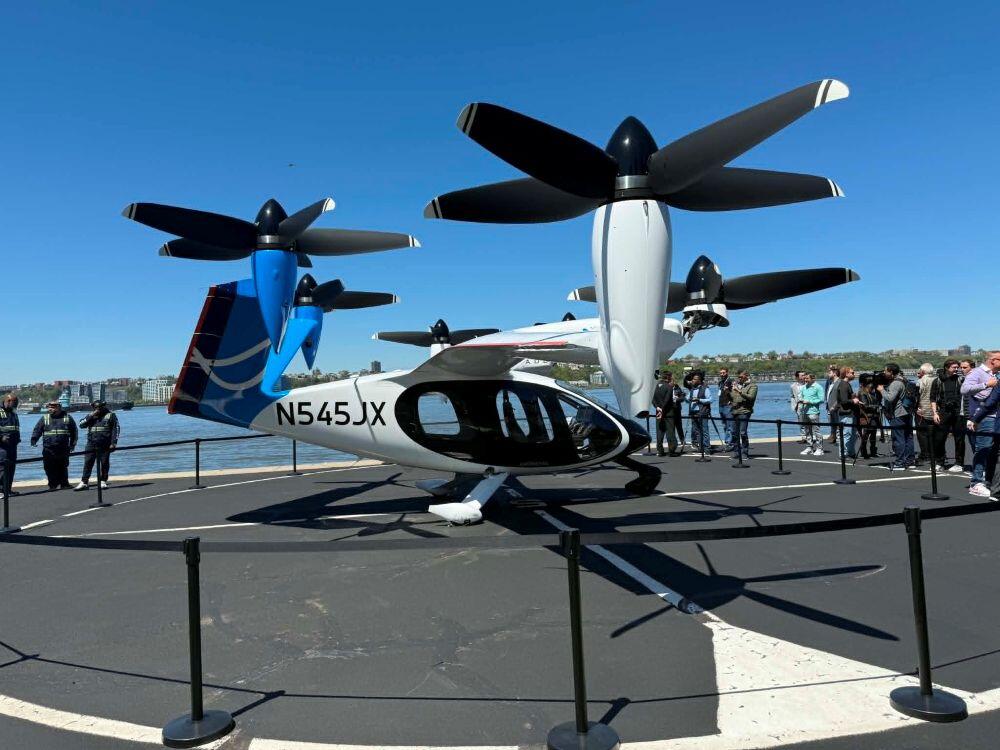
Joby S4 on helipad

Joby’s S4 eVTOL at the West 30th Street Heliport.

Credit: Ben Goldstein/AW&ST

Joby Aviation has begun a series of piloted demonstration flights across New York, offering one of the clearest examples yet of how electric vertical-takeoff-and-landing air taxis could operate on real airport-to-city routes in some of the busiest and most complex airspace in the U.S.

Aviation Week attended the second event in the four-flight campaign on April 27 from Blade Air Mobility’s passenger lounge at the West 30th Street Heliport in Manhattan. Under clear skies and temperatures in the mid-60s, Joby’s S4 aircraft arrived from John F. Kennedy International Airport at approximately 12:30 p.m., landing just outside the heliport terminal after a flight of roughly 7 min. The aircraft remained on the pad for about 20 min. before departing—without recharging—for the return trip.

From inside the Blade lounge, the most striking aspect of the demonstration was how quiet the aircraft was. As it lifted off just feet from the terminal, the sound was barely distinguishable over the chatter inside—a stark contrast from the conventional helicopters that routinely operate from the same heliport.

  • The flights marked first point-to-point eVTOL operations in complex U.S. airspace
  • Joby gears up for routine flights as part of FAA eVTOL Pilot Program

The flights are part of Joby’s Electric Skies campaign and come ahead of the planned mid-2026 launch of the FAA’s Electric Vertical-Takeoff-and-Landing (eVTOL) Integration Pilot Program (eIPP) in New York, which the company is pursuing in partnership with the Port Authority of New York and New Jersey and Skyports Infrastructure. The program is expected to enable early, limited operations linking Manhattan heliports with regional airports and fixed-base operators.

More broadly, the demonstrations represent a shift from isolated flight testing toward operational validation. While Joby and others have conducted extensive test flights in controlled environments, the New York campaign introduces real-world conditions—dense air traffic, urban infrastructure constraints and complex ground interactions—that more closely resemble eventual commercial service.

Cantor Fitzgerald analyst Andres Sheppard, who was in attendance, said he thought the demo stood out for how closely it resembled a real-world route rather than a controlled test flight. “You’re actually seeing the full mission profile—airport to city center, real airspace, real infrastructure,” he said. “That’s very different from what the industry has been doing up to now, which has mostly been in more controlled environments.”

The demonstrations also highlighted how Joby intends to leverage its acquisition of Blade Air Mobility’s passenger business to accelerate service entry. Blade operates helicopter shuttle flights connecting Manhattan heliports and area airports, providing both an existing customer base and access to facilities.

“Conventional helicopter technology has not changed for over 50 years,” Blade CEO Rob Wiesenthal, who is now the head of Joby’s passenger business, said at the event. “And today you’re really getting a glimpse of not the future but the near future.”

Joby Chief Product Officer Eric Allison said the aircraft’s low noise profile is central to how the company expects to integrate into urban areas. “When it’s flying in that forward flight mode, it’s virtually silent at 1,000 ft.,” he said. “We’re talking 45 dB. . . . That’s essentially the ambient noise of a city.”

For analysts, the New York campaign reinforces Joby’s position as the most operationally advanced eVTOL developer. The company has conducted hundreds of piloted transition flights and is now demonstrating those capabilities in real-world urban environments—something competitors have yet to match at scale.

“This is the first operational-like flight that was ever done,” said Sergio Cecutta, founder and partner at SMG Consulting. “They flew in one of the most complex airspaces in the country, with three major airports that basically overlap on top of each other. It’s like a first look at what’s going to be happening every day once these aircraft enter service.”

He added that the New York flights mark a clear inflection point in the competitive landscape of the emerging eVTOL sector. “The closer you get to the end, the less you can talk your way around your progress, because it’s tangible,” Cecutta said. “The fact that they had an airplane with the pilot flying in dense airspace over a major city shows how far ahead they are. I mean, it took a lot of steps to get here.”

The demonstrations also provide an opportunity to gather operational data that cannot be replicated in isolated test environments. During its landing at the West 30th Street Heliport, observers noted a slight lateral movement as the aircraft descended. Cecutta attributed this to downwash interacting with nearby structures.

Such insights are expected to be a key outcome of the eIPP, which is designed to generate real-world operational data while familiarizing regulators and the public with eVTOL operations. While the program may not directly accelerate certification timelines, it could help companies scale more quickly once approvals are secured.

“We’re all looking for certification, but we all know that for these things to make money, they have to fly like clockwork,” Cecutta said. “And so to me, that’s where the eIPP comes in.”

The New York campaign comes as Joby continues to advance toward FAA type certification of its S4 aircraft. The company has begun flight testing its first conforming aircraft and indicated it hopes this year to reach Type Inspection Authorization, the stage at which FAA pilots begin for-credit certification testing.

For now, the demonstrations remain pilot-only. But by integrating into active airspace and operating between existing infrastructure nodes, they offer a preview of how an air taxi network could function in practice, compressing a trip that can take 45 min. or more by car into a flight of 7 min.

Sheppard said: “This is the first time you can really see how this would work as a service—not just as a test.”

Ben Goldstein

Based in Rhode Island, Ben covers advanced air mobility and is a contributor to Aviation Week’s Business Aviation & AAM Report.