This article is published in Advanced Air Mobility part of Aviation Week Intelligence Network (AWIN), and is complimentary through Jan 13, 2026. For information on becoming an AWIN Member to access more content like this, click here.
Joby Aviation has accepted the first of two flight simulators developed in partnership with CAE.
The devices will be installed in the startup’s pilot training facility in downtown Marina, California.
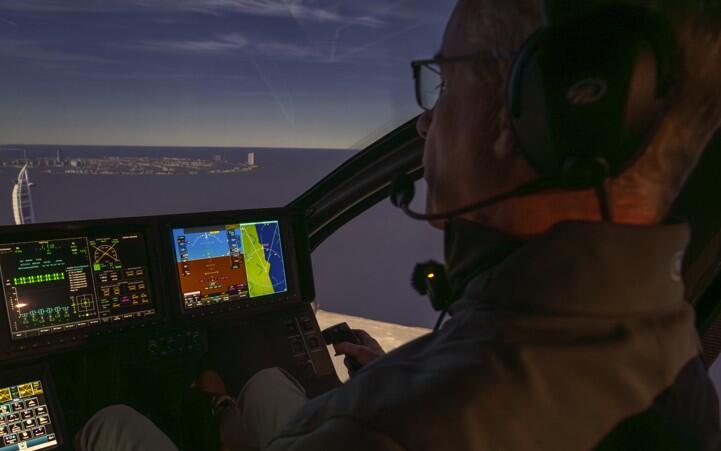
Both devices are based on CAE’s 3000-series helicopter flight simulator family and are equipped with 300 x 130-deg. visual systems using CAE’s Prodigy high-fidelity image generators.
The first to be accepted is a fixed-base simulator that is planned to be FAA-qualified as a Level 7 flight training device. This is to be followed later this year by a motion-equipped device that is planned to be qualified as a Level C full-flight simulator.
FAA-qualified flight simulators are required to be available for pilot training before Joby can launch commercial service with its S4 eVTOL air taxi under its FAA Part 135 air operator’s certificate.
The simulators will not be fully qualified until after the S4 has been type certified by the FAA and the final aircraft data package is available. But devices can receive interim approval, allowing pilots to earn flight hours in the simulator ahead of aircraft type certification.
In November, the FAA awarded interim Level C qualification to a simulator for the Bell 525, ahead of type certification of the helicopter. The device was built by TRU Simulation, a sister company of Bell’s within Textron. Long-awaited FAA certification of the fly-by-wire 525 is believed to be imminent.
Joby says it began working with CAE in 2022 to minimize the time required to develop and qualify flight simulators for an entirely new class of aircraft. Typically, approval can take several months after type certification, pacing entry into service. Joby has yet to fly a fully conforming aircraft with which to begin for-credit certification flight testing but continues to target the launch of commercial service this year.
Once the first two simulators are approved, the startup says it will have the capacity to train up to 250 pilots a year to support commercial operations. The FAA’s Special Federal Aviation Regulation for Powered Lift, which governs eVTOL pilot qualification, allows increased use of Level C and higher flight simulators for training on eVTOL aircraft such as the S4 that have only a single set of pilot controls.
Along with high-resolution visuals, Joby says the CAE simulators include audio, turbulence, and vibration systems that closely mirror real-world flight conditions, including wind flow around ground structures.
“These high-fidelity simulators are designed to be a digital twin of our aircraft, providing us a means of compliance and a robust tool to help prepare our pilots for the unique demands of high-volume operations in urban environments,” Bonny Simi, Joby’s president of operations, said in a statement.