This article is published in Advanced Air Mobility part of Aviation Week Intelligence Network (AWIN), and is complimentary through Mar 06, 2026. For information on becoming an AWIN Member to access more content like this, click here.
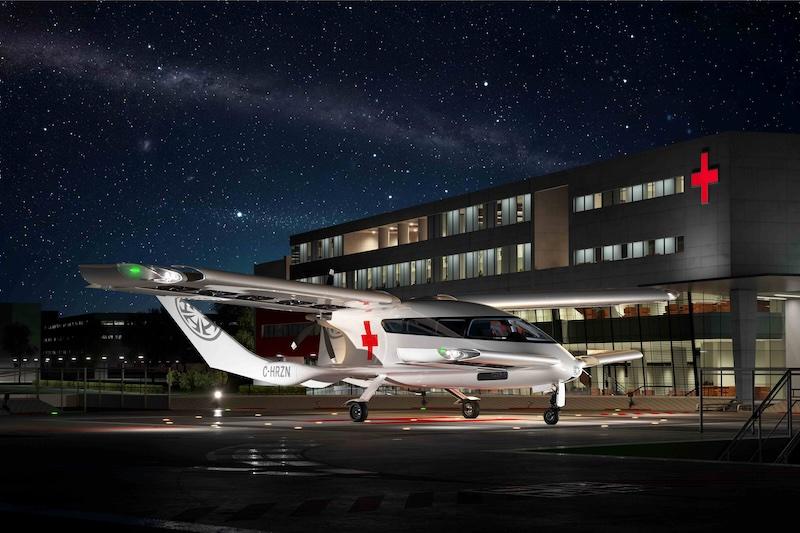
SINGAPORE—Canadian startup Horizon Aircraft is simplifying the configuration of its full-scale fan-in-wing Cavorite X7 hybrid-electric VTOL prototype, assembly of which is now underway.
Unlike the 22-ft.-wingspan subscale demonstrator that incorporated 14 lifter units—five lift fan units in each main wing for vertical thrust and two each in the canard foreplanes—the full-scale vehicle will have a total of 10 lift fans. The 48-ft.-span aircraft will house four lift fans in each wing and a single lift fan in each canard.
“So we learned a few things after flying the half-scale prototype,” says Horizon COO Jason O’Neill. “We had more induced lift out of those ducted wing fans than we first predicted through computer simulation,” he says. The simpler configuration “is all about safety, safety, safety.”
The aircraft also includes a pusher propeller for forward flight. Unlike the subscale demonstrator, which was battery powered, the full-scale X7 will incorporate a hybrid electric propulsion system based around a Pratt & Whitney Canada PT6-66A turboprop. Flight tests are expected to begin in early 2027.
Horizon is working with Pratt & Whitney Canada on the powertrain and has partnered with Motion Applied to support power electronics, systems integration, testing and analysis. Propellers will be provided by MT Propellers.
Work is also underway to develop a means of flying the X7 in known-icing conditions for year-round operations, O’Neill says. “Certification for flight in known icing is very rare with helicopters. But since it's a fixed-wing aircraft for most of its mission, we can put ice-phobic coatings on the wings and we can use bleed air from the turbine to create that anti-icing,” he adds.
“We're doing that work right now. We received a $1.4 million Canadian government grant under the Initiative for Sustainable Aviation Technology program, and that lets us accelerate that all-weather testing,” he adds.