This article is published in Business Aviation & AAM Report part of Aviation Week Intelligence Network (AWIN), and is complimentary through Jul 14, 2026. For information on becoming an AWIN Member to access more content like this, click here.
Aerofugia Links Battery Gains, Pilot Oversight In AE200 eVTOL Push
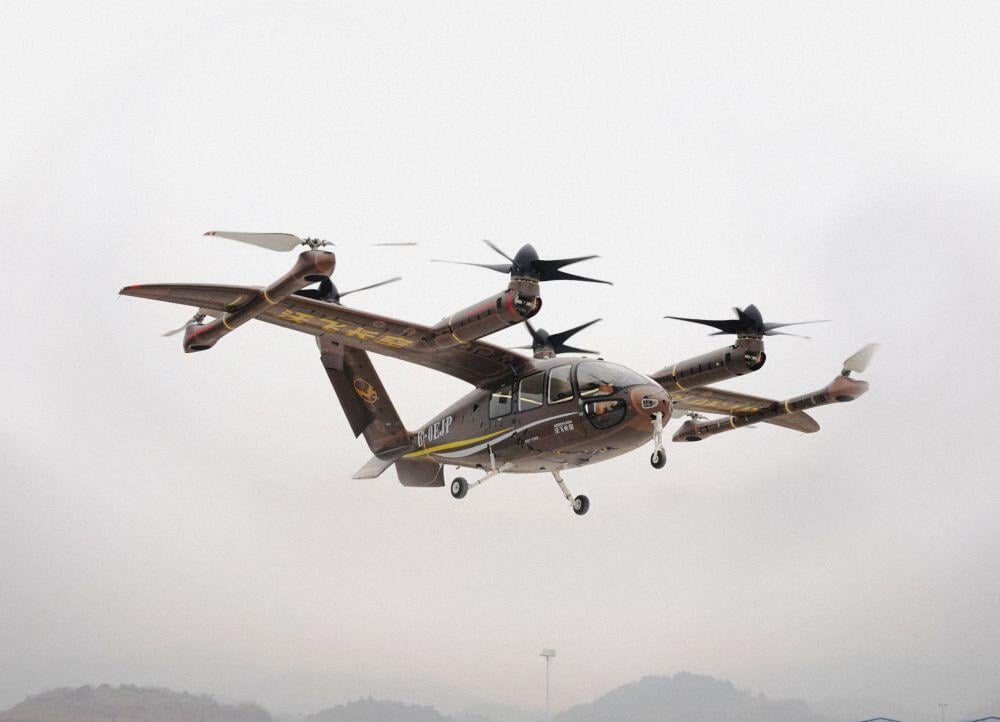
Aerofugia is targeting certification of its AE200-100 in late 2026 or 2027.
Amid a busy first half of 2026, including a nearly 1 billion RMB financing round and preparations for a STAR Market IPO, Aerofugia sat down with Aviation Week to discuss batteries, charging standards and the role of the human pilot as its AE200-100 eVTOL targets certification as soon as late 2026.
“In terms of performance indicators, the energy density of the cells exceeds 320 Wh/kg,” said Presales Technical Support Director Lu Xin. “The continuous discharge C-rate is above 5C, enabling stable long-duration power output to meet the high-power demands of eVTOL during takeoff, hovering and transition flight. The peak instantaneous discharge C-rate surpasses 9C. The continuous charging C-rate reaches over 3C, supporting a 20-minute fast charging process. Per design specifications, the cycle life is more than 5,000 cycles.” Retired cells, he added, can be repurposed for secondary applications and eventually recycled.
The AE200-100’s battery cells were developed by Zhejiang Fengli Lithium, a Ganfeng Lithium subsidiary, and received regulatory clearance from China’s regulator last July, a milestone the company called the first step toward scaling aviation-grade production. The partnership was extended in February through a long-term agreement focused on next-generation cells. The current semi-solid hybrid electrolyte chemistry, combined with pouch packaging, represents what Lu described as a balanced optimization across four core requirements for eVTOL batteries including high energy density, high power output, long cycle life, and reliability.
“Compared with traditional liquid electrolyte systems, the solution delivers high energy density and high-power output while greatly enhancing safety and mitigating thermal runaway risks,” Lu said. “Going forward, our two sides will further build a closed-loop cooperation ecosystem covering the full life cycle of battery cells, including inspection, maintenance and recycling.”
On charging, the AE200-100’s connector integrates an aircraft-ground communication interface and a 28V ground power supply while remaining compatible with the GB/T 20234 standard. All integrated interfaces support independent plugging and unplugging, allowing use of existing electric vehicle infrastructure. For sites without fixed chargers, the company has developed a 264-kWh mobile vehicle-mounted station capable of delivering a full charge in 20 min. from an 800-1000V DC platform. An onboard generator supports more than three continuous charging cycles.
“Designed in full compliance with civil aviation ground equipment standards, the mobile charging station is applicable to civil aviation airports, general aviation airports and various vertical takeoff and landing sites, and maintains good adaptability to future vertiport infrastructure,” Lu said.
Aerofugia has been equally focused on the human element, recently publishing a study in April in Aerospace, a peer-reviewed journal affiliated with the European Aerospace Science Network. The Necessity of a Human Pilot in eVTOL—Balancing Safety and Autonomy lays out the case for keeping a human pilot in the loop for at least the next decade, finding that in complex low-altitude environments, a fully autonomous system’s reliability would fall to approximately 10⁻⁶ per flight hour, while pilot intervention restores that figure to 10⁻⁸.
The paper further identifies collision risks with noncompliant UAVs, and cybersecurity vulnerabilities—including GNSS spoofing and ADS-B data injection—as unresolved challenges for full autonomy.
Lu said autonomous operations remain vulnerable to cyber threats due to communication link reliance, with comprehensive protection still uncertified. Onboard pilots and independent control channels add a critical buffer.
“While pilotless autonomous flight is the inevitable long-term trend for eVTOL, human-machine collaboration will remain the most practical operating model for the next three to 10 years, considering current technological maturity, infrastructure conditions, regulatory frameworks and public acceptance,” he said.
To optimize the human-machine interface, Aerofugia has developed two systems—an eye-tracking system and a virtual reality (VR) cockpit—that support the design and verification of the full AE200 series product line.
The eye-tracking system collects metrics including gaze fixation, dwell time, saccade trajectories, blink patterns and pupil diameter—data used for post-flight analysis of pilot workload and cockpit layout optimization, rather than real-time flight decisions. The 1:1 scale VR cockpit replicates the AE200’s spatial layout and control logic, allowing engineers to verify physical space, field of view, control accessibility, display readability, anti-glare performance and interior design schemes before hardware is finalized.
With its Phase I headquarters and production base now topped out, Aerofugia is transitioning from development into early industrialization. Equipment installation and commissioning are underway as the company targets initial manufacturing and deliveries of the AE200 series later this year.