This article is published in Aviation Week & Space Technology and is free to read until Oct 31, 2026. If you want to read more articles from this publication, please click the link to subscribe.
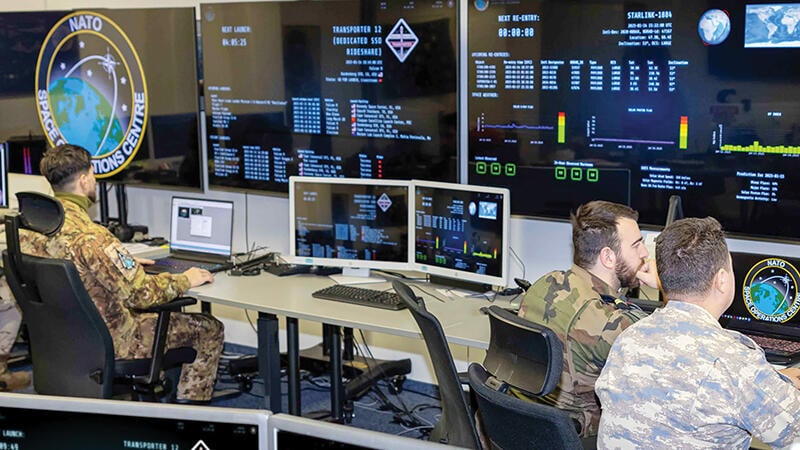
NATO’s progress in the space domain has lagged since the alliance established its Space Operations Center in Ramstein, Germany, in 2024.
For decades, NATO member states have defined their commitments to the alliance by the number of aircraft and tanks they pledge to contribute during times of war. Now NATO wants to add space and counterspace capabilities to that arsenal.
The move comes as more NATO members are fielding space systems and speaking openly about their counterspace capabilities and ambitions. The impetus for those pursuits is a sense that rivals, principally China and Russia, are conducting nefarious operations in space that alliance members want to be able to deter.
- Allies are slated to contribute effects, not tools
- Nato seeks more space personnel
“We are switching our mindset in NATO,” Brig. Gen. David Morpurgo, assistant chief of staff for force development for the alliance, told the UK Space Power Conference here. “What we are trying now to achieve is an effort . . . to produce effects in a warfighting domain that actually probably is going to be one of the first domains where we are actually going to fight.”
To achieve that, NATO plans to add space as one of its keystone planning efforts in procurement across member states. “For the first time, NATO’s Defense Planning Process [NDPP] will have capability targets for space,” Air Chief Marshal Johnny Stringer, deputy supreme allied commander for Europe, said at the event. He called the move “long overdue.”
The NDPP, which is updated every four years, spells out what capabilities—such as combat aircraft, tankers and troops—member states pledge to NATO. The political guidance that will kick off the process is due in February.
Stringer said he met with NATO’s military committee, which includes defense chiefs from all member states, on Sept. 28, and space was on the agenda. “As I briefed the military committee yesterday, I want us to be bold, broad and imaginative in what we ask for here,” he told the Royal Aeronautical Society here.
The actual capability targets would not be due for another two years.
“I can’t wait that long,” Stringer said. To jump-start the provision of forces by alliance members, he said he wants to devise a mechanism so countries receive credit for those commitments once 2029 comes around.
Among the challenges the alliance could face is that many space capabilities that members use are still highly classified—knowledge is sometimes not even well shared within a country’s defense organization.
NATO is trying to avoid that pitfall from the start. Stringer stressed that he is not looking for member states to hand over space systems to NATO but rather to deliver an intended effect, which might not require divulging how it was achieved. “What I do want are the effects I need to make deterrence work, and if it’s failing or failed, to make sure in any fight, we win, and we win fast,” he said.
Given the sensitivity of space assets, other policy hurdles loom. “The ability for us to share information remains one of our major challenges,” a UK defense official said. “Whereas the other domains generally fight at secret and below, we are a domain that fights at secret rarely, above secret a lot and compartmented even more.”
Another challenge within the alliance when it comes to space, the official added, is differing levels of maturity and capability. The U.S. is the only country with a military branch dedicated to space, for instance. Those varying capability levels could also present an impediment to getting contributions from every member.
An alliance official said, however, that disparity can be mitigated by the abundance of commercial services. Countries that do not have their own systems to offer NATO could fund and contribute commercial services such as communications or Earth imaging.
Although NATO declared space an operational domain in 2019 and set up its Space Operations Center in Ramstein, Germany, in 2024, it has been slow to mature its activities. Stringer is urging members to pick up the pace and not get bogged down in long procurement processes.
He called NATO’s two-year-old Alliance Persistent Surveillance from Space program a good model for the organization to embrace. Under the project, members share space-based Earth-observation information, and NATO can buy commercial services.
“It’s a good first step because that’s the sort of thing we should have been doing years ago,” Stringer said. “We should be putting money into it.”
He said NATO should also do more to build up its space staffing.
“At the moment, we need more people in the space theater component at Ramstein,” Stringer added. “It is trending up, but it needs to go faster.”

Related Content