https://aviationweek.com/themes/custom/particle/dist/app-drupal/assets/awn-logo.svg
Skip to main content
  • Market Sector
    • Aerospace
    • Air Transport
    • MRO
    • Defense
    • Space
    • Business Aviation
  • Markets
    • Aerospace
      • Aircraft & Propulsion
      • Connected Aerospace
      • Emerging Technologies
      • Manufacturing & Supply Chain
      • Advanced Air Mobility
      • Sustainability
    • Air Transport
      • Aircraft & Propulsion
      • Interiors & Connectivity
      • Airports & Networks
      • Airlines & Lessors
      • Safety, Ops & Regulation
      • Maintenance & Training
      • Sustainability
    • MRO
      • Aircraft & Propulsion
      • Interiors & Connectivity
      • Emerging Technologies
      • Supply Chain
      • Safety, Ops & Regulation
      • Workforce & Training
      • Sustainability
    • Defense
      • Aircraft & Propulsion
      • Sensors & Electronic Warfare
      • Missile Defense & Weapons
      • Supply Chain
      • Budget, Policy & Operations
      • Sustainability
    • Space
      • Launch Vehicles & Propulsion
      • Commercial Space
      • Space Exploration
      • Satellites
      • Budget, Policy & Regulation
      • Operations & Safety
    • Business Aviation
      • Aircraft & Propulsion
      • Interiors & Connectivity
      • Airports, FBOs & Suppliers
      • Flight Deck
      • Safety, Ops & Regulation
      • Maintenance & Training
      • Sustainability
    • In Focus
      • Middle East & Africa
  • Marketplace
  • Services
    • Services
      • Advertising
      • Marketing Services
      • Fleet, Data & APIs
      • Research & Consulting
      • Network and Route Planning
      • Marketplace
  • Store
    • Market Sector

      • Aerospace
      • Air Transport
      • MRO
      • Defense
      • Space
      • Business Aviation
    • Type View All Products
      • Intelligence Bundles
        • AWIN - Premium
        • AWIN - Aerospace and Defense
        • AWIN - Business Aviation
        • AWIN - Commercial Aviation
      • Market Briefings
        • Advanced Air Mobility Report
        • Aerospace Daily & Defense Report
        • Aviation Daily
        • SpeedNews
        • The Weekly of Business Aviation
      • Directories
        • Air Charter Guide
        • Aviation Week Marketplace
        • Route Exchange
        • The Engine Yearbook
      • Data Services
        • AC-U-KWIK
        • Aircraft Bluebook
        • Airportdata.com
        • ASM Global Route Development
        • CAPA – Centre for Aviation
        • Catchment Analyzer
        • Defense Market Analyzer
        • Fleet Discovery Civil
        • Fleet Discovery Military
        • Fleet & MRO Forecast
        • MRO Prospector
        • Tracked Aircraft Utilization
      • Publications
        • African Aerospace
        • Air Transport World
        • Arabian Aerospace
        • Aviation Week & Space Technology
        • Aviation Week & Space Technology - Inside MRO
        • Business & Commercial Aviation
        • CAPA - Airline Leader
        • Routes magazine
        • Show Business
  • Events
    • Recent webinars
    • Events View All Events
      • MRO
        • MRO Americas
        • MRO Asia
        • MRO Australasia
        • MRO Baltics & Eastern Europe Region
        • MRO Europe
        • MRO Greater China
        • MRO Latin America
        • MRO Middle East
        • MRO Southeast Asia
        • Military Aviation Logistics and Maintenance Symposium (MALMS)
      • Commercial Aviation/A&D
        • Aero-Engines Americas
        • Aero-Engines Europe
        • Aero-Engines Asia-Pacific
        • Engine Leasing Trading & Finance Europe
        • Engine Leasing, Trading & Finance Americas
      • Air Transport
        • Routes Americas
        • Routes Europe
        • Routes World
        • CAPA Airline Leader Summit - Airlines in Transition
        • CAPA Airline Leader Summit - Americas
        • CAPA Airline Leader Summit - Latin America & Caribbean
        • CAPA Airline Leader Summit - Australia Pacific
        • CAPA Airline Leader Summit - Asia & Sustainability Awards
        • CAPA Airline Leader Summit - World & Awards for Excellence
        • GAD Americas
        • GAD World
      • Aerospace and Defense
        • Defense Conference
      • Awards
        • Aviation Week 20 Twenties
        • Aviation Week Laureate Awards
        • ATW Airline Awards
        • Program Excellence Awards and Banquet
        • CAPA Asia Aviation Summit & Awards for Excellence
        • Space Tech Challenge Awards
  • About
    • About Aviation Week Network
      • Our Story
      • Content and Data Team
      • Aviation Week & Space Technology 100-Year
    • Contact Us
      • Subscriber Services
      • Advertising, Marketing Services & List Rentals
      • Content Sales
      • Events
      • PR & Communications
      • Content Licensing and Reprints
      • FAQ
  • Log In
  • Register
  • My Account
    • Profile
    • Sign Out
  • AWIN Access
  • My cart
    Back to
  1. MRO

Share

Six Non-Destructive Evaluation Technologies At GE Aviation

January 10, 2017

Infrared Thermography – Flash IR

Credit: GE Aviation

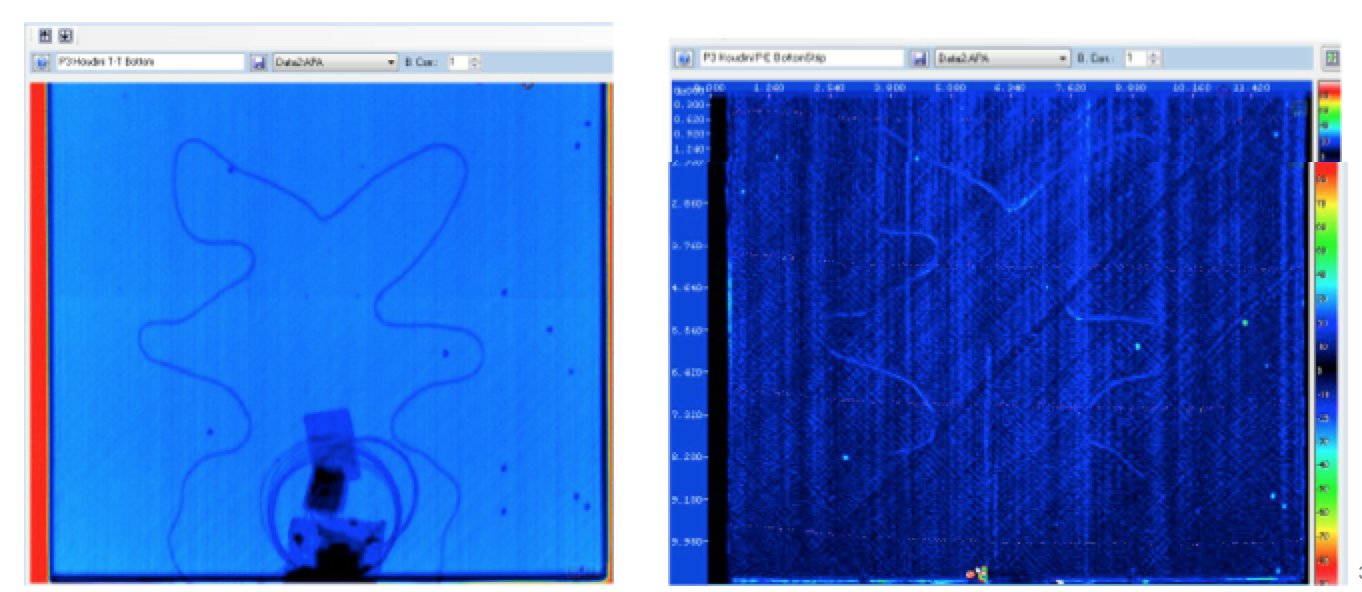
One technique that GE Aviation uses to test advanced composite materials is infrared thermography. Flash thermography uses a high-speed infrared camera to collect millions of temperature measurements in seconds. These flashes create a thermal movie that is evaluated against rigorous requirements set in design. Thermography will detect any internal features and material uniformity and non-conformity, allowing researchers to determine and potential defects in materials. 

Ultrasonics (UT)

Credit: GE Aviation

UT uses high-frequency sound to detect subsurface indications. GE Aviation uses this technology to inspect the interior volume of critical engine components made from metals and composites. Sound waves travel through materials with a predictable signal loss unless intercepted by a discontinuity. Any interruptions are evaluated by carefully considered acceptability criteria. The high-resolution ultrasonic lab at QTC supports material engineers with pre- and post-mechanical test inspection feedback and analysis, the efforts of design engineers to determine inspectibility and acceptability criteria for specific parts and manufacturing engineers with inspection plans and standards for development and production hardware. 

Automated Robotic Eddy Current Inspection

Credit: GE Aviation

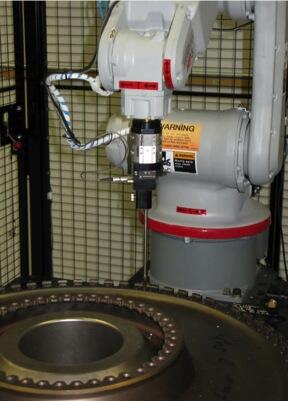
Eddy current uses electromagnetic fields to detect small surface and near-surface indications in electrically conductive materials. GE developed a demonstration of a robot cell to replace manual and semi-automated inspections of HPT and fan disk dovetail slots. This technology provides one system to replace the use of separate inspection kits for each part and provides lower initial investment cost with a focus on increased inspection speed with 4X to 8X faster inspections than other systems on the market. 

Assisted Defect Recognition (ADR)

Credit: GE Aviation

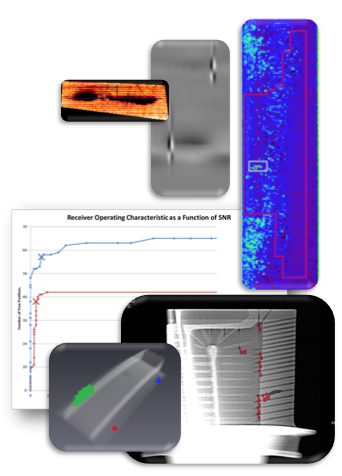
ADR Software algorithms assist in the detection, identification, classification and quantification of anomalies given NDE data as input. ADR programs reduce the cost of component inspection and evaluation as well as improve the quality of the inspection. This software aids with eddy current, ultrasonic bullet, ultrasonic forging, radiographic turbine blade, CT airfoil wall thickness and ultrasonic braze inspection. GE Aviation's current ADR projects include VCT turbine blade and VCT ceramic matrix composite components inspection.  

Radiography

Credit: GE Aviation

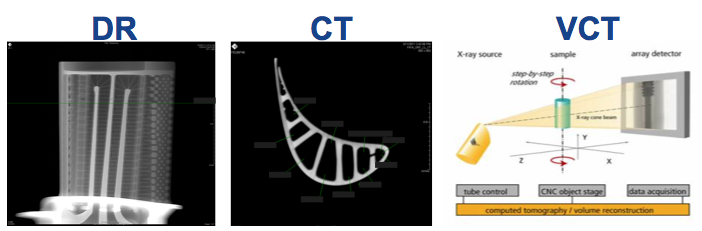
Radiography uses X-rays to examine the internal characteristics of engine parts. GE Aviation uses 3D X-ray systems to provide DR and computed tomography inspections with high image quality. New developments in volumetric CT utilize scatter correction to provide high-resolution 3D images with reduced acquisition times. 

Dimensional Metrology

Credit: GE Aviation

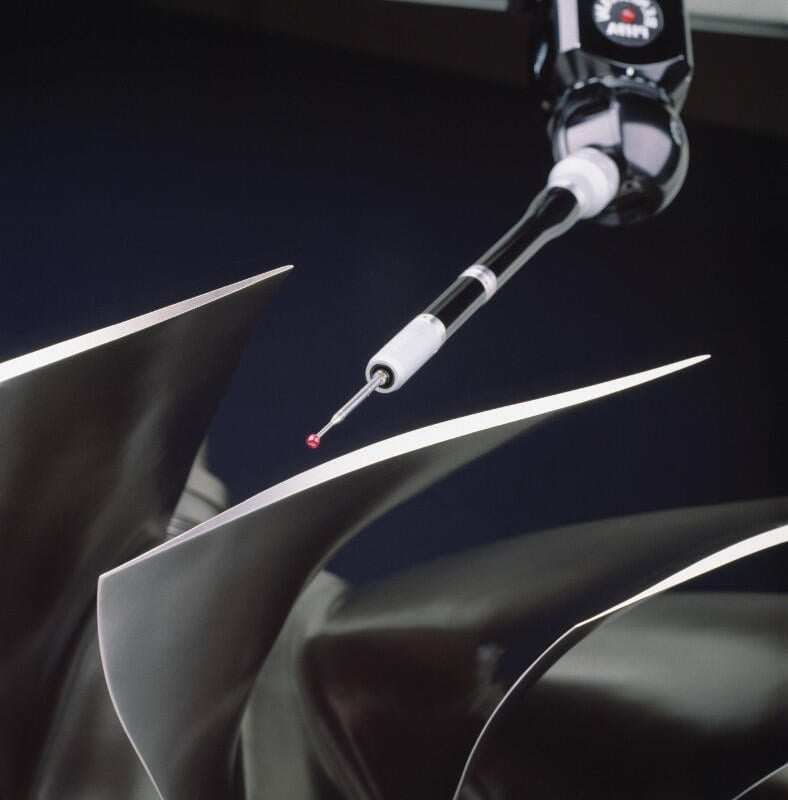
Advanced dimensional metrology uses a basic 3-axis coordinate measuring machine with multi axis sensor and rotary part manipulation. Coordinate measurement machines are equipped with both contact and noncontact probes that inspect engine components and find defects. The sensors are able to achieve both tactile probe measurements and optical vision/laser scanning. These probes provide virtually unlimited flexibility in data-gathering capabilities. 

Previous
Next

Non-destructive evaluation (NDE) is a form of analysis techniques used to evaluate materials and components without causing damage. GE Aviation's facility in Cincinnati continually research and develops a variety of different types of NDE to inspect engine components. Above are six types of NDE GE uses today. 

Follow us on

Markets

  • Aerospace
  • Air Transport
  • MRO
  • Defense
  • Space
  • Business Aviation

Products

  • AWIN Intelligence Bundles
  • Market Briefings
  • Publications
  • Data Services
  • Directories
  • Resources

Contact Us

  • Subscriber Services
  • Advertising, Marketing Services & List Rentals
  • Content Sales
  • Events
  • PR & Communications
  • Content Licensing and Reprints
  • FAQ

Other Resources

  • Aviation Week Marketplace
  • Knowledge Center
  • Newsletters
  • ShowNews
  • Advertising - Media Kits
  • Japanese 日本語
  • Korean 한국인
Copyright © 2026. All rights reserved. Informa Markets, a trading division of Informa PLC.
  • Accessibility
  • Privacy Policy
  • Cookie Policy
  • Terms of Use