This article is published in Aerospace Daily & Defense Report part of Aviation Week Intelligence Network (AWIN), and is complimentary through Dec 21, 2025. For information on becoming an AWIN Member to access more content like this, click here.

Airbus Eyes Next A400M Capability Enhancement Package

Credit: Airbus
Credit: Airbus

SEVILLE, Spain—Airbus is in talks with some A400M users to define the next round of capability enhancements as the military airlifter program looks to expand its mission capabilities after a challenging development.

The company is looking to introduce before the end of the decade enhanced satellite communications on the platform and the ability to control uncrewed aircraft systems (UAS), among other features. The effort is gaining traction as Airbus aims to complete the baseline package of A400M capabilities, known as SOC 3, in October 2026 to finally close out the development contract.

Airbus last year signed an agreement with European joint defense procurement agency Occar for a Block 0 enhancement package and is now in talks to sign a contract for Block 1 toward the end of next year, A400M Chief Engineer Francisco José Hernández says. Block 0 includes narrowband communications upgrades, human-machine interface improvements, and the introduction of the Link 16 Multifunction Information Distribution System.

Connectivity is a particular focus to ensure the A400M is a key node in the evolving battlefield, Hernández said. That means incorporating different wideband connectivity options to the platforms using both geostationary orbit (GEO) satellites and the growing options in low Earth orbit (LEO), as well as other data links.

One of the options Airbus is exploring is a roll-on/roll-off system for use on the hatch to connect to LEO constellations using a dedicated antenna. For the GEO system, because different users have different national systems to link to, Airbus wants to devise a generic installation system with, for instance, a common fairing and links to the modem, and then accommodate the antenna that specific users need to connect to the their preferred constellation. The goal is to have that ready by 2029, Hernández said, as part of the Block 1 effort.

Airbus also wants to install its Aircraft Links Integration Management System as a link server tool.

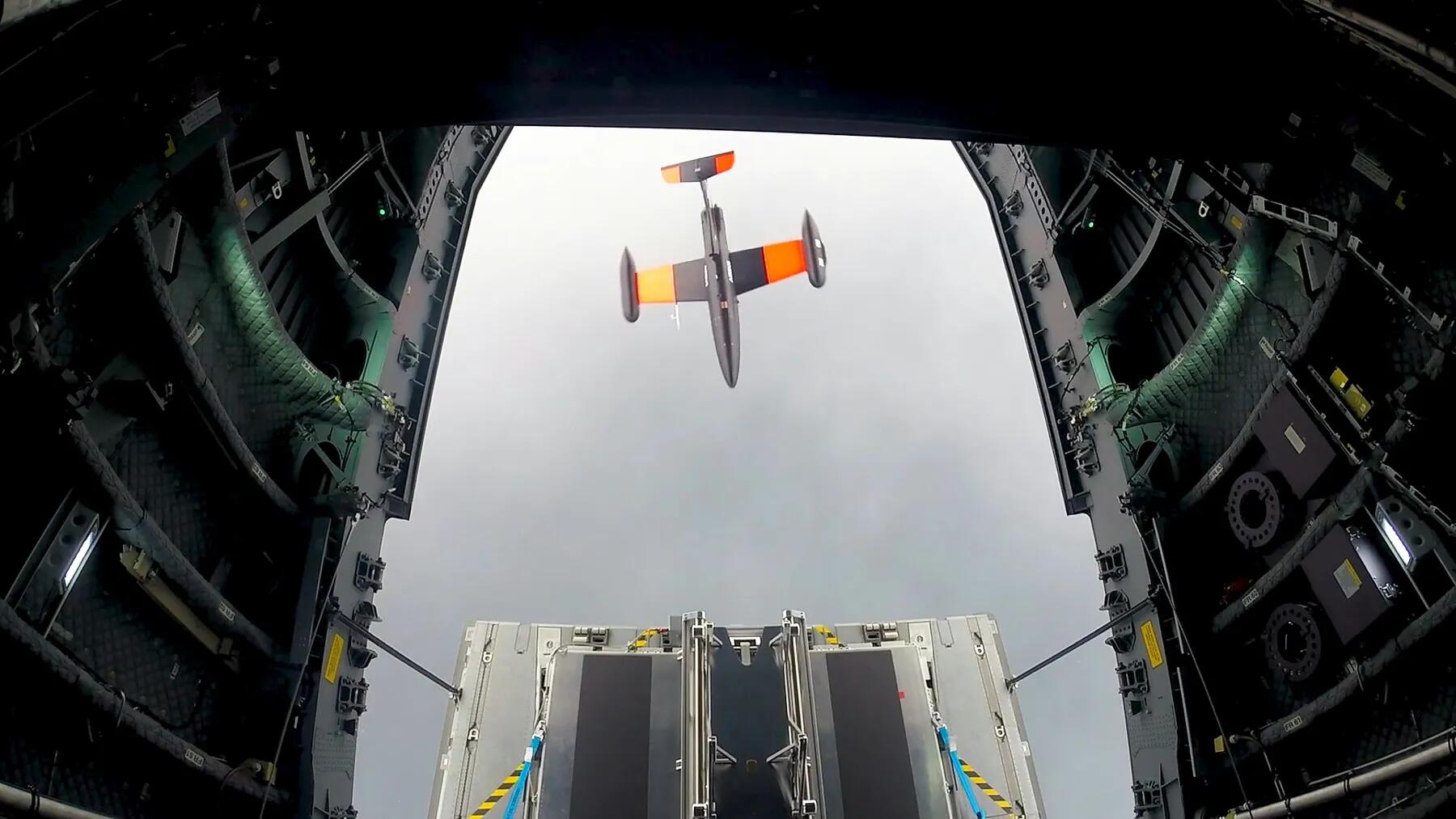
The system also is part of an ambition to turn the A400M into a UAS mother ship or missile launch system. Airbus already has demonstrated the ability to deploy a UAS from the airlifter and has plans to deploy and control up to 36 medium-sized air vehicles with about 500 km (310 mi.) range and different payloads. That also means adding mission control stations on the platforms, Hernández said.

Customers have expressed interest in a minimum capability by 2029. The initial setup likely would involve simply deploying a smaller number of drones and having onboard workstations, before growing the number and moving to full onboard control about two years later with the enhanced datalink capability, Hernández added.

Airbus already is working for one customer on integrating the workstations, derived from those developed for the company’s missionized C295 airlifter. The user wants to operate electro-optical/infrared sensor capability mounted on the A400M’s sponson. The company plans up to six workstations on the aircraft.

The company previously disclosed plans to increase the maximum takeoff weight of the 400M to 40 metric tons from 37, without changes to the structure or engines. That is being enabled largely by imposing some flight control limits on the transport that are not required when operating at such high loads, which typically are strategic cargo missions rather than tactical operations, Hernández said. The extra lift potential also could be used to extend range around 250 mi. The feature would be something that could be applied to existing aircraft, if operators want the enhancement.

Airbus also has tested a firefighting mechanism for the A400M to deploy retardant and continues to explore electronic attack options.

Robert Wall

Robert Wall is Executive Editor for Defense and Space. Based in London, he directs a team of military and space journalists across the U.S., Europe and Asia-Pacific.