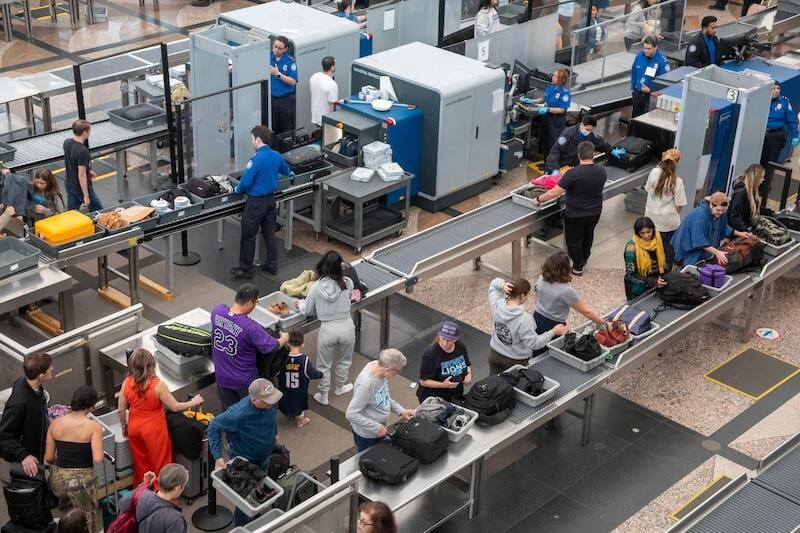
The U.S. Transportation Security Administration (TSA) will no longer require passengers to remove shoes at airport checkpoints, ending a policy that was in effect for nearly two decades.
At the same time, two UK airports—Birmingham (BHX), England, and Edinburgh (EDI), Scotland—said they have been cleared by the government to lift the 19-year-old rule restricting passengers taking liquids through checkpoints. BHX and EDI are the first two UK airports to be permitted to allow liquids in containers up to two liters to be left in carry-on bags and taken through security checkpoints.
The relaxations should speed up security screening, which can often be a bottleneck, smoothing passenger throughput and thus providing operational and potentially economic benefits to airports.
TSA began requiring that passengers’ shoes be scanned along with carry-on luggage at airport security checkpoints in August 2006. The agency at the time cited “intelligence pointing to a continuing threat” of improvised explosives in shoes.
“Thanks to our cutting-edge technological advancements and multi-layered security approach, we are confident we can implement this change while maintaining the highest security standards,” U.S. Homeland Security Secretary Kristi Noem said July 8.
The change in policy takes effect immediately at all U.S. airports. Passengers in TSA’s PreCheck program had already been exempted from the shoes-off policy, as were people over the age of 75. “We expect this change will drastically decrease passenger wait times at our TSA checkpoints,” Noem said.
BHX and EDI said July 7 that the UK government has allowed the airports to lift the liquids rule, with EDI saying in a statement it gained the approval “following the installation of top-of-the-range security x-ray technology.”
According to EDI, “liquids in containers up to two liters can now … be kept inside” carry-on bags. The airport added, “There is no limit on the amount of liquids that can be taken through as long as they are no larger than two liters.”
BHX advised passengers to “not put your liquids, pastes and gels into plastic bags. Please leave them loose in hand luggage.” BHX said that any liquid in a container greater than two liters “will be removed and destroyed,” but seconded EDI in saying there is no limit on two liter containers.
EDI CEO Gordon Dewar said, “The change allows more flexibility for passengers to take liquids through security, all while maintaining and improving our high safety levels through the use of 3D technology.” Smiths Detection screening equipment is used at EDI checkpoints.
The UK Transport Department has said airports with appropriate computed tomography scanners—similar to those used in medical imaging—will be able to lift the liquids rule. Only BHX and EDI have been approved so far.
In August 2006, the UK government revealed it had disrupted a plan by terrorists to blow up multiple transatlantic flights between London and the U.S. on the same day, with liquid explosives carried onto aircraft in plastic bottles. UK officials described the plot as an effort to commit “mass murder” in the air.
Airport security on both sides of the Atlantic was immediately tightened, with restrictions put in place regarding liquids taken through checkpoints and TSA requiring shoes to be scanned.
The agency had been concerned about explosives in footwear since Dec. 22, 2001, when the “shoe bomber” Richard Reid attempted to trigger homemade explosives hidden in his shoes on an American Airlines flight from Paris to Miami.
“During the flight, Reid tried to detonate his shoes, but he struggled to light the fuse,” according to a Federal Bureau of Investigation (FBI) summary of the episode. “Crewmembers and passengers noticed and restrained him.”
The aircraft was diverted to Boston, where Reid was detained. After pleading guilty to terrorism charges, a judge imposed a life sentence in federal prison. According to the FBI, “bomb techs determined that the bomb would have blown a hole in the plane’s fuselage and caused the plane to crash if it had detonated.”