Vienna Airport
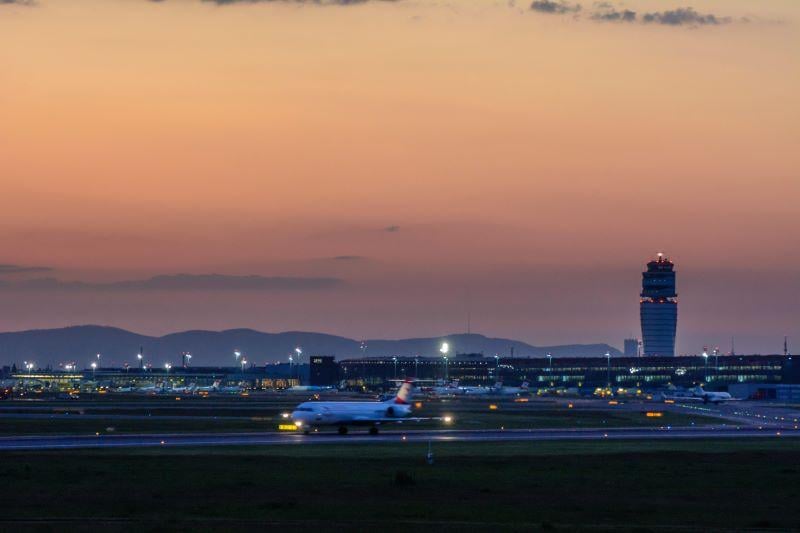
Vienna Airport is pressing for reform of Austria’s aviation tax, arguing the levy puts the hub at a regional disadvantage.
As reported by Aviation Week, Wizz Air will close its five-aircraft Vienna base in two phases, beginning with the withdrawal of two Airbus A320neos on Oct. 26, followed by the remaining three on March 15, 2026. The carrier currently serves 28 routes to 20 countries from Vienna.
Ryanair is also reducing its presence in the Austrian capital, shifting some capacity to nearby Bratislava, Slovakia. CEO Michael O’Leary announced the Vienna-based fleet will shrink from 19 aircraft last winter to 16 for the upcoming winter schedule.
Both moves are linked to Austria’s Air Transport Levy, which costs €30 ($35) for flights under 350 km (189 nm) and €12 for flights over 350 km. “Until recently, we were not in a good position to argue with our government regarding the aviation tax, because we had such strong growth,” Flughafen Wien joint CEO and COO Julian Jäger told Routes at Routes World 2025 in Hong Kong. “But I think now they are starting to realize and understand that this is actually a competitive disadvantage. Hungary, our neighboring country, has abolished it. There’s no aviation tax in the Czech Republic or Slovakia. So therefore, yes, this is a definite disadvantage.”
Vienna Airport plans to cut its airline charges by about 4% next year in a bid to boost competitiveness, but Jäger said broader policy support is needed. “We believe that overall, abolishing it, or at least reducing it, would be beneficial not only for the aviation sector, but for the whole country.”
More News And Analysis From Routes World 2025
Despite the pressure from ULCC retrenchment, VIE is on course for record traffic. “We expect this year to be a record year with 32 million passengers,” Jäger said. August was the airport’s busiest month ever, with 3.4 million travelers and a single-day peak of 121,000.
Long-haul development has been a key contributor to the growth. In June, Scoot launched Vienna’s first nonstop to Singapore in more than two decades, while Hainan Airlines restored flights to Shenzhen and Chengdu in 2024. The Middle East is also seeing renewed interest. Air Arabia will resume flights from Sharjah in December, while Saudia added Jeddah service in June.
“A lot of airlines are waiting for capacity, and when we get into 2026 and 2027, I hope some of those issues will be solved,” Jäger added. “Once that happens, I’m quite optimistic that we will see even more long-haul capacity, both towards the U.S. and towards East Asia.”
Vienna is pairing its traffic growth with a significant infrastructure upgrade. The €420 million south terminal expansion, due for completion during the second quarter of 2027, will provide a new security hall, 10,000 m² (108,000 ft.2) of retail and food space, new lounges, and larger waiting areas.
For Jäger, the short-term challenges underscore the importance of a long-term perspective. “Whenever one door closes, another one opens,” he said. “Austrian has already announced two additional short-haul aircraft in Vienna for next summer. We won’t replace the lost [Ryanair and Wizz] capacity in a few months, but I’m very optimistic about the coming years.
“We don’t change our long-term plans. We are investing heavily in our infrastructure and expanding our terminal. This is only a short-term setback, nothing that alters our long-term strategy.”