This article is published in Advanced Air Mobility part of Aviation Week Intelligence Network (AWIN), and is complimentary through Nov 12, 2026. For information on becoming an AWIN Member to access more content like this, click here.
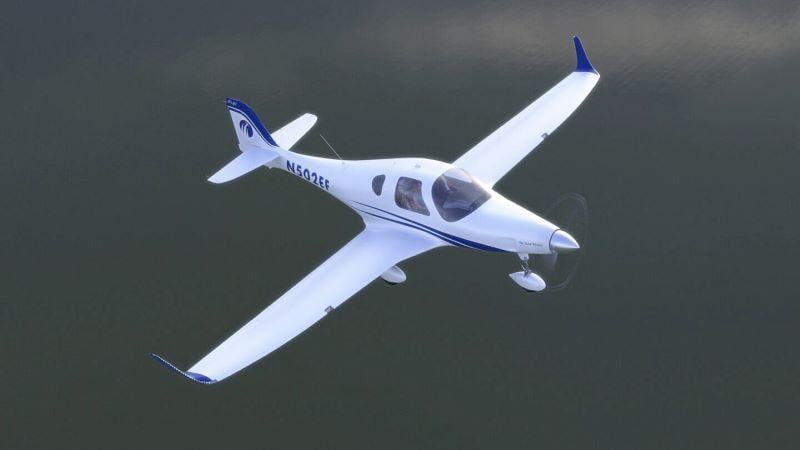
Bye Aerospace expects to certify the eFlyer 2 in time for first deliveries in 2028.
Bye Aerospace has shifted its production strategy while it works on its full-scale prototype two-seat electric trainer ahead of a planned first flight next year.
The startup had previously been fabricating composite structures, including the 30-ft. main wing spars, at its facility at Centennial Airport in Denver, Colorado. But in a strategy shift, CEO Rod Zastrow tells Aviation Week that the company has instead decided to partner with an as-yet undisclosed aerospace prototyping company, which will take over composite fabrication work going forward, while Bye Aerospace will shift its focus to assembly and systems integration.
“We’ve built about 50% of the structural parts here in our hangar ... But now that those activities are complete for this phase, the larger parts and the fuselage bonding and assembly—all the major structures—are going to be taken care of by this partner,” Zastrow says. “We’re now transitioning the hangar floor into an aircraft integration area, which is more like an assembly area. It’s more of a system integration and testing hangar rather than a composite fabrication hangar.”
Bye Aerospace studied the issue and found there was “both an economical and strategic benefit” of outsourcing its composite fabrication work, Zastrow says. “It’s the same approach as with our batteries. We’re not producing our batteries, and we certainly didn’t produce our engine. Our expertise is designing the aircraft, integrating, testing, and then flying the aircraft, along with our production expertise.”
Assembly of the airframe structure is expected to be completed by January, and systems integration is expected to conclude in time for a first flight in March or April. “That’s our aim, and we’re not promising anything, but that’s what we’re hoping to do, and so far, we’re on track,” Zastrow says.
Bye Aerospace this month announced the selection of MagniX’s Samson battery pack to power its eFlyer 2. The batteries offer industry-leading energy density, according to MagniX, with a life of over 1,000 full-depth discharge cycles. Previously, the company had used batteries from Electric Power Systems for its proof-of-concept aircraft.
Zastrow says the selection of MagniX came after an “extraordinarily thorough” analysis of four companies with seven different products. MagniX, he says, came out on top in terms of best value and potential to meet the startup’s technical specifications of two-hour mission time plus 30 minutes reserve.
Bye Aerospace announced in July the selection of portable 40-kW, 80-kW, and 240-kW chargers from Australian startup Electro.aero, with the 240-kW version able to charge two aircraft simultaneously in less than 30 min.
The company has also selected the 110-kW Safran EngineUS 100 air-cooled electric engine and Garmin G500 TXi flight display system.
Zastrow says he expects the eFlyer2 to be certified in time for first deliveries in 2028. The company currently plans to certify under FAA Part 23 Amendment 64, although he said it is also studying whether it can certify under the FAA’s MOSAIC rules for light-sport aircraft.

Related Content