This article is published in Aerospace Daily & Defense Report part of Aviation Week Intelligence Network (AWIN), and is complimentary through Oct 09, 2026. For information on becoming an AWIN Member to access more content like this, click here.
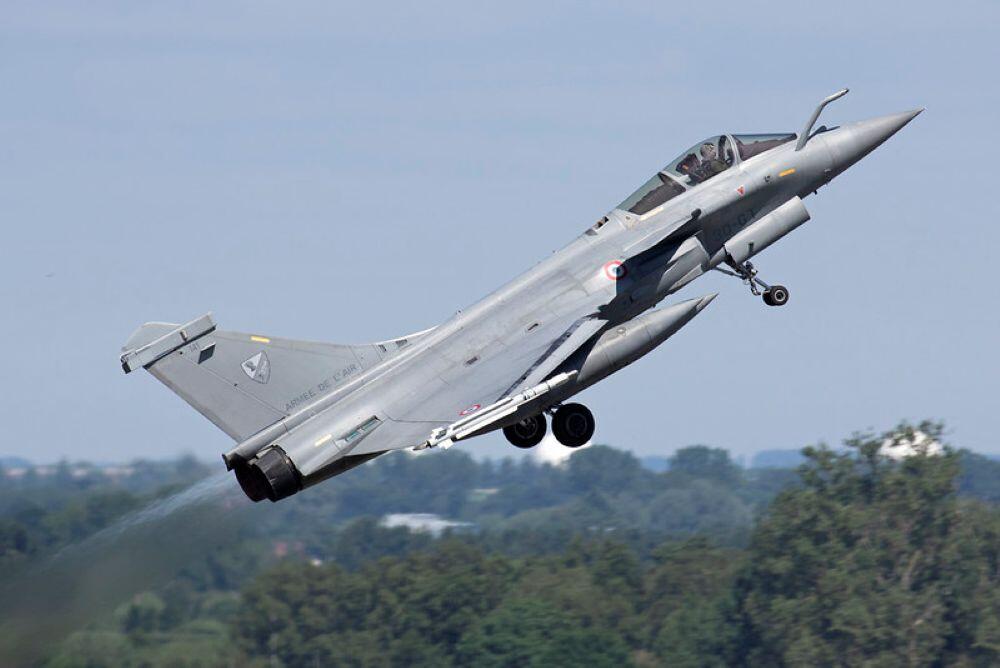
The French air force plans to experiment with collaborative combat aircraft working with the Rafale in 2028.
The French air force will trial a collaborative combat aircraft (CCA) with a Dassault Rafale in 2028 as the service prepares to embrace autonomy and artificial intelligence (AI) to boost the lethality and survivability of its crewed platforms.
The flight trials with a yet-to-be-selected CCA form part of the French air force’s HypAIRion initiative—a multipronged, multiyear effort to boost the capabilities of its combat aircraft that will also explore modular, open-architecture avionics and mission systems.
As part of HypAIRion, two Dassault Mirage 2000Ds will be modified with additional flight computers by year’s end, enabling them to serve as AI testbeds. AI algorithms will also be introduced on the Rafale as aircrew aids through upcoming upgrade packages.
Until now, France has only declared an interest in pairing the Rafale with an uncrewed combat air vehicle (UCAV), often referred to as Neuron NG because it would build on technologies developed through the Neuron experimental UCAV tested in the 2010s.
But France now wants to expand that approach to include lower-cost, potentially expendable CCAs, reflecting what French officials see as the return of an era of high-intensity, prolonged conflict.
“These combat drones allow for greater mass and reduce the risk and increase the survivability of the inhabited [crewed] platform,” Col. Cédric, head of the French air force’s capability development office, told journalists during an Oct. 1 briefing. His full name, and those of his project colleagues, were withheld for security reasons.
Similar CCA development efforts are already underway elsewhere in Europe. The UK Royal Air Force plans to demonstrate control of a BAE Systems-developed CCA from a Eurofighter Typhoon as soon as next year, while German industry plans demonstrations over the coming year aimed at paving the way for an operational German air force CCA capability by the end of the decade.
Meanwhile, France’s defense materiel agency, the DGA, issued a request for information (RFI) for CCAs in June. It is seeking multirole platforms able to carry up to 500 kg (1,102.3 lb.) of payload, with a combat radius of more than 1,000 km (621.3 mi.) and speeds exceeding Mach 0.8. French industry has already begun proposing platforms. Toulouse-based Aura Aero revealed in June that it aims to fly a CCA demonstrator in 2028.
Cedric said the service was adopting an “incremental approach” to development and that the aircraft selected for the 2028 trials may not ultimately be the platform adopted for operational use. But the trials would “support all the work that will allow us to select a platform,” he said.
Ahead of the trials, HypAIRion will develop a road map covering doctrine, concepts of use, equipment and employment.
The aim is to field a CCA capability as part of the Rafale F5 upgrade package, which is due to enter service in the late 2030s.
Beyond CCAs, HypAIRion is also focused on providing the air force’s combat aircraft with more open and modular mission systems and avionics that can be rapidly adapted to changes in threats, tactics and technology, while also easing the introduction of AI.
The aim is to move away from proprietary systems that lock down sensors and weapons, Cedric said, allowing aircraft capabilities to be adapted more readily between missions.
“We estimate that the equipment we go to war with will be different at the end of the battle,” he told journalists.
“The one who detects, understands, decides and acts faster can win against an opponent ... and with the mass of data that we have at our disposal today, we can make the crew’s task easier and help them make those decisions,” Cedric said, adding that AI could provide an operational advantage.
Last month, Dassault Aviation revealed it had successfully flight tested two sovereign AI algorithms on Rafale, one developed in-house and the other by Thales’ cortAIx business unit, but did not disclose what roles they performed.
Sebastien, a DGA engineer and director of the Rafale program at the agency, confirmed that work was underway to deliver an AI algorithm for use on the Rafale in 2027 that will assist pilots in the operation of the platform’s Thales Talios targeting pod.
To be delivered in 2027, the algorithm performs the detection and recognition of ground targets, and then “designates vehicles that it thinks constitutes a threat or an objective priority,” Sebastien said.
Work is also underway to apply AI to mission preparation and training, as well as to enable the operation of uncrewed platforms alongside the Rafale.
As part of the effort, DGA is establishing an industrial hub that will enable companies, including established players and small and medium-sized enterprises, to register and exchange ideas.
Officials said partnerships beyond France would also be explored, although European partners would be prioritized.

Related Content